First Seen
2025-03-27T22:57:04.912365+00:00
simple-description (qwen3.5_2b-q8_0)
Meme Context:
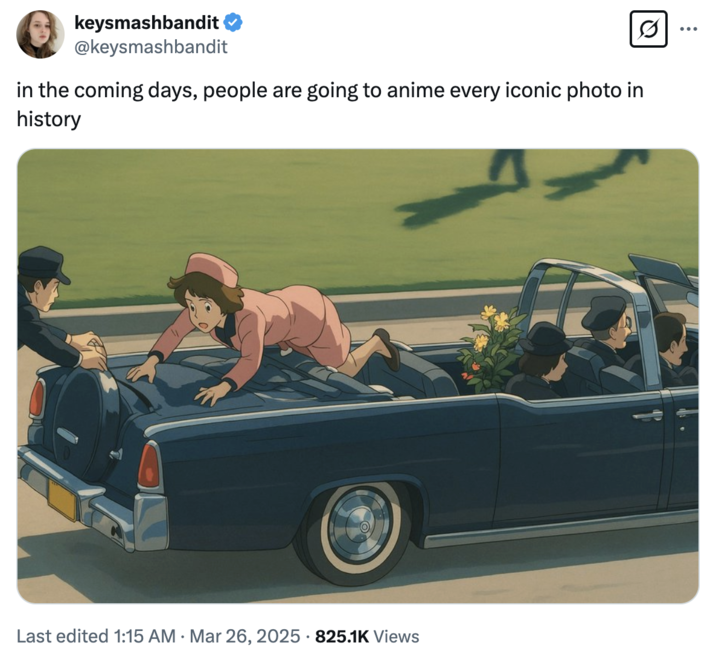
This meme serves as a visual prophecy about the "Ghiblification" internet trend—where AI models are predicted to force anime styles onto real-world images in the future. The tweet predicts that in the near future, AI will turn every famous historical photo into an anime scene. This image is that prediction, depicting a 1960s presidential limousine parade that has been reimagined in anime art style to match the aesthetic described in the caption.
Description:
"This image illustrates the trend of 'Ghiblification'—where AI is predicted to convert real-life photos into anime scenes. The tweet caption predicts that people will eventually animate every iconic photo in history, and the image below shows that exact concept in action: a 1960s limousine scene has been rendered in anime style, complete with characters and a specific color palette typical of 80s anime."
detailed-analysis (gemma3_27b-it-q8_0)
Okay, let's dissect this meme – a depiction of Jacqueline Kennedy climbing onto the trunk of a limousine after JFK’s assassination, re-rendered in the visual style of Studio Ghibli – through the lens of the "AI Art - Ghiblification" category, and applying relevant theoretical frameworks.
Visual Description
The image is a digitally created artwork that takes a highly iconic, historically loaded photograph (Eddie Adams’ Pulitzer Prize winning photo of Jacqueline Kennedy) and reimagines it in the visual style of Studio Ghibli, the renowned Japanese animation studio. Key aspects include:
- Ghibli Aesthetics: The artwork employs Ghibli's characteristic style: soft, watercolor-like textures, a detailed yet gentle lineart, a pastel color palette, and a focus on atmospheric light and shadow. The shading is rich, creating a depth that softens the harsh reality of the source photograph.
- Composition: The core composition is maintained – Jackie is depicted in mid-climb on the limousine, clutching at the trunk, the bouquet of flowers visible. The figures in the car (Secret Service/other officials) are present, but rendered in a way that feels less confrontational and more…observational.
- Emotional Tone: The Ghibli style immediately alters the emotional impact. The original photograph is raw, jarring, a visual testament to grief and shock. Here, the Ghibli aesthetic filters that emotion, lending a sense of melancholy, fragility, and a dreamlike quality. It's less about the immediate horror and more about a quiet, haunting sadness.
- AI Integration: The image is indicative of AI tools capable of style transfer. AI models have been trained on large datasets of Ghibli artwork, enabling them to replicate and apply that style to new images, like this one.
Foucauldian Genealogical Discourse Analysis
This meme represents a fascinating disruption of historical discourse. Michel Foucault's work centers around how power operates through discourse – the ways we talk and think about things, which shape our understanding of reality.
- Power/Knowledge & Historical Narrative: The original photograph is a powerfully constructed piece of knowledge. It solidified a particular narrative about JFK’s assassination, capturing a very specific moment of collective grief and trauma. By re-presenting it as Ghibli art, the meme re-negotiates that knowledge. It doesn’t erase the original event but challenges its dominant interpretation.
- Genealogy of Emotion: Foucault encourages genealogical inquiry – tracing the historical development of concepts and ideas. Here, we see a genealogy of emotion in relation to this historical event. The original photograph provokes a visceral, immediate emotional response. The Ghibli version evokes a different kind of emotional response – one that is mediated through a specific aesthetic framework (the stylized world of Ghibli films, often dealing with loss, resilience, and the relationship between humanity and nature).
- Subjectification: The "Ghiblification" process alters how we are positioned as viewers. The aesthetic style encourages a more contemplative, internalized experience. We’re less confronted by the historical event and more invited to reflect on it.
Postmodernism
This meme very strongly aligns with core tenets of Postmodernism.
- Pastiche & Intertextuality: The image is a clear example of pastiche - combining stylistic elements from different sources (a historical photograph and an animation style). It's deeply intertextual, reliant on the viewer’s recognition of both the historical reference and the Ghibli aesthetic.
- Deconstruction of Grand Narratives: Postmodernism challenges "grand narratives" – overarching explanations of history and truth. By re-contextualizing such a historically significant event through a fantastical and emotionally different lens, the meme actively undermines the idea of a single, definitive interpretation of JFK’s assassination. It's saying that history isn't just a series of facts, but a collection of interpretations.
- Simulation & Hyperreality: The image exists as a simulation – a digital recreation of a historical moment filtered through a stylized lens. It contributes to a hyperreality where the line between "real" and "representation" becomes blurred. The meme itself becomes a layer of meaning on top of the original historical event.
Critical Theory
In line with critical theory, specifically regarding representation, this image reveals the ways in which power and ideology are embedded within the act of re-presentation.
- The Politics of Style: The choice of the Ghibli aesthetic is not neutral. Ghibli films are often associated with themes of peace, environmentalism, and empathy. Applying this aesthetic to a traumatic historical event subtly imbues that event with those values. It’s a form of ideological work.
- Spectacle and Emotional Labor: The original photograph was part of a spectacle that defined a historical moment. The meme recycles that spectacle, but alters its function. It encourages emotional labor – asking us to process grief and trauma through a different emotional register.
- The Gaze: Critical theory also considers who is doing the looking. The meme's impact relies on the viewer's cultural capital - understanding the original photograph and the Ghibli aesthetic.
In essence, this meme is a complex commentary on history, representation, and the power of aesthetic style. It demonstrates the potential of AI art to not just replicate images, but to critically engage with the cultural meanings embedded within them.
simple-description (llama3.2-vision_11b)
The meme is a digital art piece that combines the style of Studio Ghibli with the iconic 1963 car chase scene from "It's a Mad, Mad, Mad, Mad World". The image shows a cartoon-style illustration of the scene, with the car's occupants looking surprised and the driver's face contorted in a comedic expression. The text "In the coming days, people are going to anime every iconic photo in history" is written above the image, suggesting that the creator is anticipating a surge in anime-style reimaginings of famous historical events.
detailed-analysis (gemma3-27b-vision)
Okay, let's break down this image and the tweet's sentiment through the lenses of various critical theories. It's a complex image prompting a lot of potential interpretations, particularly given the tweet's claim about "animating iconic photos."
Please note: The interpretations below are suggestions based on the image and tweet. Critical theory is open to multiple readings, and the relevance of each section will vary depending on how one chooses to analyze it.
1. Visual Description
The image appears to be a still from a 2D animated film or series, evoking a retro aesthetic that strongly resembles styles seen in animation produced by Studio Ghibli or similar studios. The scene depicts a woman in a pink outfit scrambling on top of a dark-colored, classic American car (likely a Cadillac or similar model from the 1950s or 1960s). She appears to be reaching towards someone inside the car. There are multiple figures wearing dark suits and hats surrounding the car, and a bouquet of flowers rests on the hood. The setting is a sun-dappled street, casting long shadows. The overall mood is one of chaotic drama and urgency. The color palette is relatively muted, with pink being the most striking color.
2. Foucauldian Genealogical Discourse Analysis
The image and tweet invite a Foucauldian analysis centered around the discourse of historical representation, particularly around “iconic” moments.
- Power/Knowledge: The tweet suggests a reclaiming, or re-writing, of history through animation. This implies a challenge to established historical narratives – the “iconic photos” – and an assertion of new forms of knowledge. Who gets to define what is iconic? This image proposes that the power to shape historical narratives isn’t limited to photography; it extends to animation.
- Genealogy: A genealogical approach would trace the evolution of the idea of the “iconic photo.” How did certain images come to be seen as representative of a moment? What historical and social forces shaped that perception? The act of "animating" it disrupts that history, layering a new set of meanings on top of the original.
- Discipline and Surveillance: The figures in suits surrounding the car could be interpreted as representatives of societal structures or control. The woman scrambling on top of the car might be read as a transgression of norms, a refusal to be contained within those structures, and a desperate attempt to disrupt the established order.
- Archive: The "iconic photos" represent a kind of visual archive of the past. Animating them isn't destroying the archive, but it's re-mixing it, creating a new version.
3. Critical Theory
A broader Critical Theory approach would focus on how the image challenges dominant ideologies and power structures.
- Ideology: The image can be seen as a commentary on how history is constructed and presented. The act of animation challenges the notion of "objective" historical truth. It reveals how history is always interpreted, and those interpretations are subject to bias.
- Commodification of History: The "iconic photos" have become commodified, used in media, textbooks, and advertising. Animating them might be a way to critique this process, to reclaim the past from commercial exploitation.
- The Spectacle: The suits and drama surrounding the car can be seen as a theatrical performance, a spectacle of control and the suppression of emotion.
4. Marxist Conflict Theory
A Marxist reading focuses on class conflict and power dynamics.
- Power and Control: The figures in suits likely represent the ruling class or the established order. Their presence around the car suggests control and authority. The woman struggling on top of the vehicle could be interpreted as a symbol of resistance against this control.
- Alienation: The scene can be read as a depiction of alienation and the suppression of individual agency. The woman’s desperate act might be seen as a rejection of a system that marginalizes and controls her.
- Historical Materialism: Analyzing the specific car (presumably from a specific era) allows for examination of the material conditions of that time and their impact on social relations. The car can be seen as a symbol of wealth and power, while the woman's actions are a challenge to that power.
5. Postmodernism
Postmodernism offers a lens focused on the fragmentation of meaning and the rejection of grand narratives.
- Intertextuality: Animating "iconic photos" is a clear act of intertextuality—mixing elements from different texts (the original photo and the animated representation).
- Deconstruction of History: The image can be seen as a deconstruction of historical narrative. It questions the notion of a fixed, objective past and suggests that history is always a construction.
- Simulation and Hyperreality: The animation creates a simulation of a historical moment, potentially blurring the line between reality and representation.
- Loss of Authenticity: Animating iconic photos could be seen as a loss of authenticity or historical truth, but postmodernism would suggest that such concepts are inherently unstable.
6. Queer Feminist Intersectional Analysis
This is a complex area and depends on context, but the image could be read through this lens.
- Gender Performance: The woman's actions are a dramatic and unconventional expression of agency. This can be read as a disruption of traditional gender roles and expectations.
- Resistance to Control: The struggle on top of the car can be interpreted as a metaphor for the struggle against patriarchal structures and societal control.
- Intersectionality: The image might resonate with experiences of marginalization and oppression faced by individuals at the intersection of multiple identities (gender, race, class, etc.). The specific context of the original photo would be crucial for understanding this dimension.
- Emotional Labor: The woman’s desperate, potentially emotional, display can be seen as highlighting the emotional labor often expected of women.
Final Thoughts:
This image is rich with potential interpretations. The tweet’s claim about animating iconic photos adds another layer of complexity, suggesting an intentional attempt to challenge historical narratives and reclaim agency. Each of these theoretical frameworks offers a unique perspective, and a more comprehensive analysis would likely draw on multiple approaches. The power of the image lies in its ambiguity and its ability to provoke thought and discussion.
simple-description (llama3.2-vision)
The meme is a screenshot of an animated scene from the 1995 film "Princess Mononoke" by Hayao Miyazaki. The image shows a woman, San, falling out of a carriage and being caught by a man in a horse-drawn carriage. The text above the image reads, "In the coming days, people are going to anime every iconic photo in history."