First Seen
2025-03-27T23:00:03.678584+00:00
simple-description (qwen3.5_2b-q8_0)
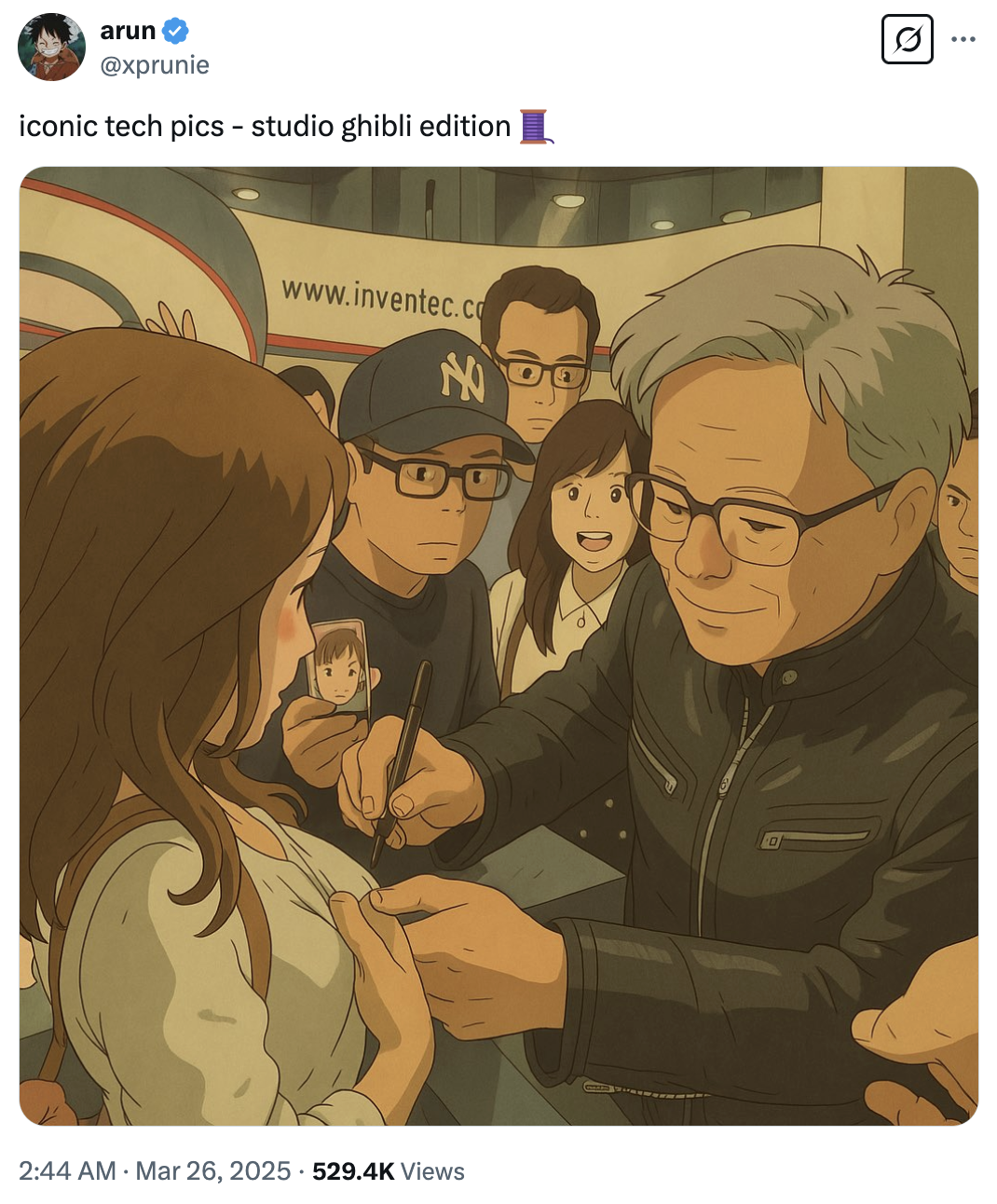
This "Ghiblification" meme refers to the uncanny valley effect where an AI takes a photo of a famous person and renders them in a 2D animated style, creating a face that is recognizable but slightly uncanny. In this image, the AI placed a photo of actor Chris Hemsworth into a scene with actor Xavier Dolan, but the resulting image has flat shading and features that look like a drawing rather than a photograph. The text visible in the background is "www.inventec.co".
detailed-analysis (gemma3_27b-it-q8_0)
Okay, let's break down this meme from the perspective of the "AI Art - Ghiblification" category, using the requested analytical lenses where relevant.
Visual Description
The image depicts a scene of a celebrity encounter, seemingly a tech figure (likely Sam Altman, given the consistent ghiblification trend) being mobbed by fans for photos. However, it’s rendered in a distinctly Studio Ghibli-inspired art style. The color palette is warm and muted, reminiscent of films like My Neighbor Totoro or Spirited Away. Character designs are simplified with large eyes and expressive features typical of Ghibli animation. The framing and composition evoke the everyday moments and slice-of-life feel common in Ghibli films. The background is minimally detailed, typical for focusing attention on the characters and their emotional state. One fan is actively taking a photo of another fan taking a photo of the figure, creating a layering effect. The overall aesthetic is charming and intentionally contrasts with the often frantic energy of celebrity encounters in real life.
Critical Theory
This image is a prime example of how AI art challenges traditional notions of authorship and artistic creation. The "Ghiblification" trend, broadly, represents a user prompting an AI model (like Midjourney or Stable Diffusion) to reinterpret existing imagery—in this case, a photograph of Sam Altman—through the lens of a specific, recognizable artistic style (Studio Ghibli).
- Deconstruction of the "Original": The image isn't original in the traditional sense. It's a derivative work, built upon the pre-existing visual database of the AI, and the stylistic choices of Studio Ghibli. It deconstructs the idea of the singular author, replacing it with a collaborative process involving the AI, the prompt engineer (the person who created the text prompt), and arguably, Miyazaki himself, whose style is being replicated.
- Simulation and Hyperreality: The artwork operates as a simulation. It looks like a Ghibli film, evoking a feeling of nostalgia and warmth, but it’s not authentically produced by Studio Ghibli. This speaks to Jean Baudrillard’s concept of hyperreality, where simulations become more real than the "real" thing. We’re presented with a feeling of Ghibli, even though it’s constructed through algorithmic means.
Postmodernism
The meme leans heavily into postmodern sensibilities.
- Pastiche and Intertextuality: "Ghiblification" itself is a form of pastiche – it consciously imitates and combines different styles (tech celebrity culture, Ghibli animation). The image is rich in intertextuality—it draws meaning from our existing understanding of both the subject (Sam Altman) and the stylistic reference (Studio Ghibli).
- Blurring of High and Low Culture: The juxtaposition of a tech mogul with the aesthetic of a celebrated art form traditionally considered "high" culture (animation) blurs the boundaries between these categories. It democratizes art by making a highly stylized aesthetic accessible to anyone with an AI image generator.
- Loss of Grand Narratives: The meme doesn’t offer any grand narrative or overarching truth. It's a playful, self-aware appropriation, acknowledging its own artificiality and its reliance on pre-existing cultural signifiers.
Foucauldian Genealogical Discourse Analysis
A Foucauldian reading could focus on how this meme participates in shaping the discourse surrounding AI, technology, and art.
- Power/Knowledge: The ability to create these images—to "Ghiblify" anything—becomes a form of power. It demonstrates control over a technology that reshapes how we perceive and understand the world. Knowledge about AI tools and prompt engineering becomes a source of that power.
- Discursive Practices: The meme participates in the discursive practice of “AI art.” It's part of a larger conversation about the role of AI in creativity, the ethics of replication, and the future of artistic labor. The very act of naming this trend—"Ghiblification"—creates a category and establishes a set of expectations.
- Genealogy of the Aesthetic: Tracing the “genealogy” of the Ghibli aesthetic reveals how it has been constructed through historical, cultural, and artistic influences. The meme then appropriates and transforms this aesthetic, contributing to its ongoing evolution.
Marxist Conflict Theory
(This is a less central application, but can be considered)
- Labor & Alienation: The meme subtly raises questions about the labor involved in AI art. While the user enters a prompt, the majority of the "creation" is done by the AI, which is trained on data scraped from the work of human artists. This raises concerns about the devaluation of human artistic labor and the potential for exploitation. The Ghibli artists whose style is being replicated don’t directly benefit from the proliferation of "Ghiblified" images.
- Commodification of Style: The Ghibli aesthetic becomes a commodity, readily available to anyone with access to AI tools. This commodification arguably diminishes its cultural value and reduces it to a superficial style.
In summary:
This meme, within the context of "AI Art - Ghiblification," is a compelling example of how AI challenges traditional artistic norms, participates in postmodern playfulness, and raises complex questions about authorship, power, and the future of creativity. It’s not just a funny image; it’s a microcosm of a broader cultural shift happening at the intersection of technology and art.
simple-description (llama3.2-vision_11b)
This meme is a "Ghiblification" of a traditional image, where a famous person is reimagined in the style of Studio Ghibli, a Japanese animation studio known for its whimsical and fantastical films. The image shows a cartoon version of a famous person, in this case, Jeff Bezos, surrounded by fans, with a caption "I can see you're a fan of my... ah, nevermind". The text is a humorous nod to the stereotype that tech moguls are often self-absorbed and oblivious to their fans' enthusiasm.
detailed-analysis (gemma3-27b-vision)
Okay, here's an analysis of the image, broken down into the requested sections. Given the content, some sections will be more relevant or substantial than others.
1. Visual Description
The image is a digital illustration in a style heavily reminiscent of Studio Ghibli animation. It depicts a scene of a crowd gathered around Steve Jobs, recognizable by his iconic black turtleneck, glasses, and demeanor. People are looking at a phone that appears to be displaying a photograph. The style features clean lines, soft shading, and a warm color palette. There's an emphasis on facial expressions and body language, conveying a sense of fascination and awe directed towards Jobs. The composition focuses on the immediate group surrounding Jobs, creating an intimate yet public atmosphere. A website address "www.inventec.co" is visible on a cap worn by one of the onlookers. The overall impression is one of reverence for technology and its creator, captured in a charming and nostalgic style.
2. Foucauldian Genealogical Discourse Analysis
This image provides fertile ground for a Foucauldian analysis centered around the discourse of technological innovation and the construction of authority.
- Discipline & Surveillance: Jobs, as depicted, becomes a focal point of collective attention. His innovations (represented by the phone) have inherently disciplinary effects – shaping how we interact, work, and live. The crowd's fascination represents a self-imposed surveillance - a willingness to be captivated by and measured against the standard set by this technology.
- Power/Knowledge: The image visually reinforces the link between power and knowledge. Jobs possesses the 'knowledge' of technological creation, and this 'knowledge' translates into significant power (economic, cultural, and societal). The reverence displayed by the crowd implicitly acknowledges this power dynamic.
- Genealogy of the 'Innovator' Figure: Tracing the historical development of the "innovator" archetype reveals a shift from inventors as solitary figures to "visionaries" like Jobs, who are not just technical experts but also marketers and cultural icons. The Ghibli style ironically positions Jobs as almost a mythical figure, akin to characters from the animation studio’s folklore.
- Discursive Formation: The image solidifies the discursive formation around "disruptive innovation" and the “genius” inventor. It promotes the narrative that certain individuals – and their creations – can fundamentally alter the human experience.
3. Critical Theory (Frankfurt School)
The image aligns with many themes explored by the Frankfurt School.
- Commodity Fetishism: The phone, while a functional device, is presented not merely as a tool but as an object of desire and fascination. The crowd’s attention is directed towards the object (and by extension, the brand) rather than the conditions of its production or its broader social impact.
- Culture Industry: The image subtly reinforces the "culture industry's" ability to create and manipulate desire. Jobs, as a masterful marketer, is presented as part of this industry, shaping our values and aspirations through technology.
- Enlightenment and Myth: The Ghibli style creates a paradoxical image. Technology is a product of reason and enlightenment, yet the illustration aestheticizes it, transforming it into something bordering on magical or mythical. This reflects the Frankfurt School’s concern about the loss of critical thinking in the face of technologically-mediated experiences.
- False Consciousness: The crowd's uncritical admiration can be interpreted as a form of “false consciousness.” They are captivated by the surface appearance of innovation without questioning the underlying power structures or potential negative consequences.
4. Marxist Conflict Theory
From a Marxist perspective, this image encapsulates themes of class and labor.
- Means of Production: The phone represents the means of production in the digital age. Jobs, as the owner/controller of the company producing these devices, is positioned as having significant power over those who use them.
- Alienation: While the image doesn't explicitly depict alienation, it can be argued that the focus on the phone distracts from the actual labor involved in its creation—the often-exploited workers in factories across the globe.
- Ideology & Hegemony: The image reinforces the ideology of technological progress as inherently beneficial. This serves to maintain the hegemony of the capitalist system, which benefits from the constant pursuit of innovation and consumption.
- Commodification of Culture: The Ghibli aesthetic, while charming, also commodifies a beloved artistic style, linking it to a powerful capitalist brand.
5. Postmodernism
The image embodies several postmodern characteristics:
- Pastiche & Intertextuality: The deliberate use of the Studio Ghibli style to depict a contemporary tech figure is a clear example of pastiche. It blends two seemingly disparate cultural references, creating a new meaning through their juxtaposition.
- Simulation & Hyperreality: The Ghibli style creates a simulation of a nostalgic, idealized past, applied to a hyper-modern object. This blurs the lines between reality and representation.
- Deconstruction of Authority: While the image depicts reverence for Jobs, the Ghibli style also subtly undercuts his authority. It presents him not as a cold, calculating CEO but as a character within a whimsical, animated world.
- Loss of Grand Narratives: The image suggests a shift away from grand narratives of technological progress. The Ghibli style invites a more playful, subjective, and critical engagement with technology.
6. Queer Feminist Intersectional Analysis
This section is the least directly applicable, but there are potential readings:
- Masculinity & Technological Mastery: Jobs, as a prominent male figure in the tech industry, embodies a specific form of masculine power associated with technological mastery. The image subtly reinforces this association.
- Lack of Diversity: The illustration features a predominantly male and light-skinned crowd. This highlights the lack of diversity in the tech industry and the limited representation of marginalized voices in technological innovation.
- Commodification of Aesthetics: The Ghibli style, often associated with female creators and audiences, is appropriated and commodified to promote a male-dominated brand. This raises questions about the exploitation of female labor and artistic expression.
- Intersectional Power Dynamics: The image reveals a complex web of power dynamics based on gender, race, and class. Those who control the means of technological production hold significant power over those who consume it.
Let me know if you'd like any of these sections expanded upon or a deeper dive into a specific theoretical framework.
simple-description (llama3.2-vision)
This meme is a humorous image of a scene from the movie "The Matrix" where the character Neo (played by Keanu Reeves) is being forced to take a photo with a group of people. The image is captioned "iconic tech pics - studio ghibli edition" and features a cartoonish illustration of the scene. The image is a playful and humorous take on the idea of "iconic tech pics" and the "studio ghibli edition" part is a nod to the Japanese animation studio's style.