First Seen
2025-03-27T22:57:55.723475+00:00
simple-description (qwen3.5_2b-q8_0)
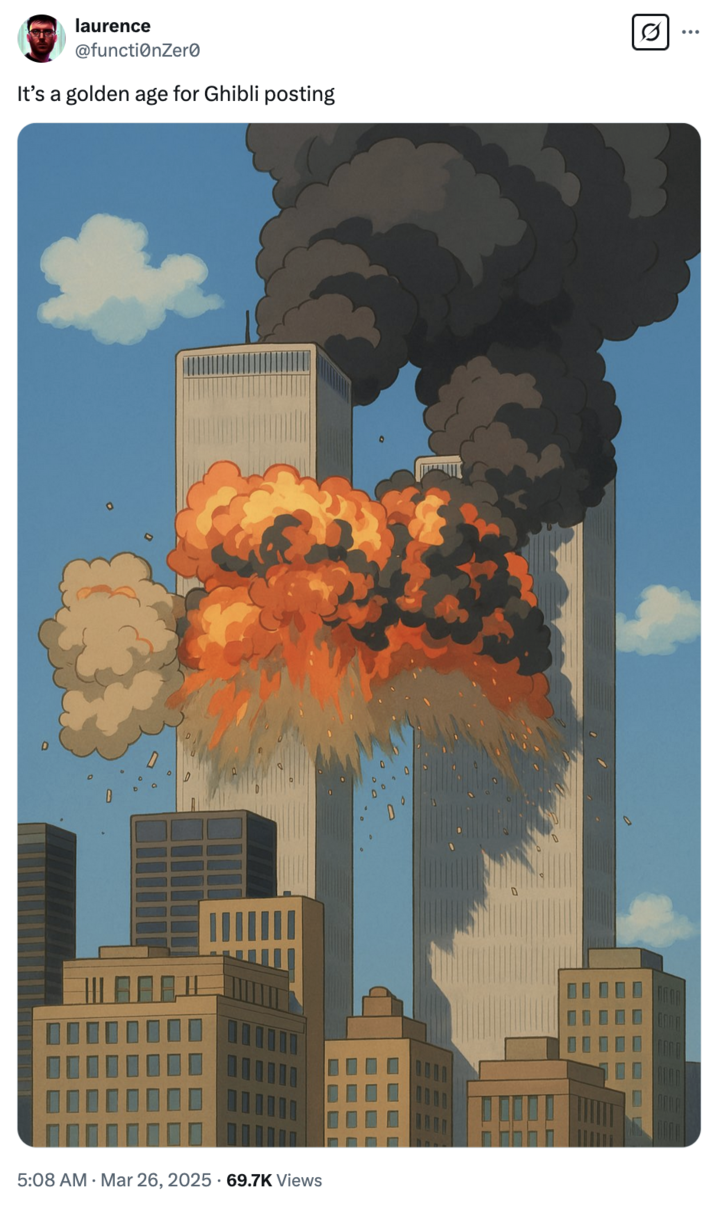
The image features a hand-drawn, vibrant animation style reminiscent of Studio Ghibli movies, such as Spirited Away or My Neighbor Totoro. It depicts massive explosions and thick black smoke rising from two tall skyscrapers, with the caption "It's a golden age for Ghibli posting." This humorously suggests that this specific artistic style is currently extremely popular and trending.
detailed-analysis (gemma3_27b-it-q8_0)
Okay, let's break down this profoundly disturbing meme through the lens of the "AI Art - Ghiblification" category, using the frameworks you've requested. It's important to preface this with a warning: this image depicts a horrific historical tragedy, and examining it through these theoretical lenses doesn't diminish that horror, but attempts to understand the why behind its creation and circulation within the context of AI art trends.
Visual Description
The image is a digital artwork styled to mimic the aesthetic of Studio Ghibli films, particularly those with a slightly more dramatic tone (e.g., Castle in the Sky). It depicts the 9/11 attacks on the World Trade Center, specifically the moment of impact and the beginning of the collapse. Key visual elements include:
- Ghibli Style: The buildings, smoke, and debris are rendered with softened lines, rounded forms, and a limited, pastel-like color palette typical of Ghibli’s art style. The smoke puffs are especially evocative of Ghibli's fantastical imagery.
- Iconic Scene: The composition focuses on the towers during the impact, with recognizable details despite the stylistic simplification.
- Contrast: The jarring disconnect between the cheerful, gentle Ghibli aesthetic and the tragic event it depicts is the central, disturbing characteristic.
- Absence of People: Notably, there are no visible people in the image, which contributes to a distancing effect.
Foucauldian Genealogical Discourse Analysis
This image is a very strong example of how power/knowledge constructs around trauma are being reshaped by new technologies. Michel Foucault’s work on genealogy explores how dominant understandings of events (like 9/11) are built through historical discourses.
- Discursive Shift: The “Ghiblification” trend itself is a new discourse. It takes a historical event and filters it through the established cultural meaning of Ghibli films: childhood, escapism, wonder, peace, and safety. This re-codes the event.
- Power Dynamics: The power lies in who controls the means of representation. AI tools and image generation platforms democratize this power, but also create space for potentially harmful reinterpretations. The meme creator isn't necessarily a powerful figure in a traditional sense, but they are shaping the narrative, even if through provocation.
- Normalization of Trauma?: The act of “Ghiblifying” 9/11 can be seen as a kind of historical flattening. The intense, complex emotional weight of the event is reduced to an aesthetic exercise. Foucault would ask: what kind of knowledge about 9/11 does this generate and what knowledge does it obscure?
- The Archive: This image contributes to a new "archive" of digital representations of 9/11. It’s a layer added to the existing documentation, journalism, and personal accounts, potentially influencing future understandings of the event.
Critical Theory
From a critical theory perspective (drawing on thinkers like Adorno and Horkheimer, and more recently, thinkers analyzing digital culture), this image demonstrates the problematic relationship between art, commodification, and trauma.
- Culture Industry: The ease with which one can "Ghiblify" anything points to the logic of the culture industry. Experiences are turned into aesthetic commodities, losing their unique and critical force. 9/11, a uniquely horrific event, is reduced to a stylistic trope.
- Shock Value and Spectacle: The image's power relies on its shock value. It's a spectacle born of the deliberate juxtaposition of the unthinkable with the idyllic. This can be seen as a form of aesthetic violence.
- Loss of Aura: Walter Benjamin’s concept of “aura” (the sense of authenticity and presence in a work of art) is completely absent here. The AI-generated aesthetic removes any connection to lived experience or historical weight.
- Desensitization: Repeated exposure to these kinds of images (even as critique) could contribute to a desensitization toward real-world suffering.
Postmodernism
Postmodernism would find this image a fascinating (and likely deeply unsettling) embodiment of several of its key tenets:
- Pastiche and Intertextuality: The image is a clear example of pastiche—it’s a stylistic imitation (Ghibli) applied to a historically significant event. It's also highly intertextual, relying on the viewer's pre-existing understanding of both Ghibli films and 9/11.
- Simulation and Hyperreality: Jean Baudrillard's concept of simulation suggests that we live in a world increasingly dominated by signs and symbols that have lost their connection to reality. This image exemplifies that – a representation of a representation, further removed from the original event.
- Death of the Author: The AI, and even the user prompt, challenge the traditional notion of authorship. Who is responsible for the meaning of this image?
- Fragmentation of Meaning: Postmodernism rejects grand narratives. The image doesn't offer a coherent explanation or interpretation of 9/11; it simply presents a fragmented, jarring juxtaposition.
Why is this meme being made and shared?
It’s crucial to understand that the “Ghiblification” trend wasn’t created as a tribute to the victims of 9/11. It became popular because it represents an exploration of what AI can do, and the reactions it elicits. The negative reaction (shock, outrage) is part of what makes it viral.
In conclusion:
This image isn’t simply a misguided attempt at artistry; it’s a symptom of a complex set of cultural and technological forces. It raises serious ethical questions about the use of AI, the representation of trauma, and the potential for commodification of historical events. Its virality, framed within the "AI Art - Ghiblification" category, speaks to the current moment's fascination with the unsettling potential of generative technologies and the ways they are reshaping our relationship to history and memory.
simple-description (llama3.2-vision_11b)
The meme is a humorous take on the concept of "Ghiblification" - a style of art that combines traditional Japanese animation with Western animation. The image depicts a iconic scene from a famous Western film, but with a Ghiblification twist. The text "It's a golden age for Ghiblification" pokes fun at the idea that there is a "golden age" for this style of art, implying that it's a current trend.
detailed-analysis (gemma3-27b-vision)
Okay, let's break down this image and its implied meaning through several critical lenses, as requested. Be aware that interpreting art is inherently subjective, and these analyses are not definitive but rather explorations of possible interpretations. It's also important to note the deeply sensitive and potentially traumatic nature of the imagery.
Please be warned: This image depicts a catastrophic event, specifically evoking the 9/11 attacks. The following analysis acknowledges the gravity of this event and proceeds with the intent to critically examine the image's layers of meaning, not to trivialize or celebrate tragedy.
1. Visual Description
The image is a stylized depiction of a large explosion occurring near a skyscraper that strongly resembles the Twin Towers. The style is clearly inspired by the animation aesthetic of Studio Ghibli, a Japanese animation studio famous for its lush and emotionally resonant films. The explosion is rendered in a mix of reds, oranges, and blacks, creating a dramatic and chaotic central element. Flames and debris are visible around the skyscraper. The overall color palette is somewhat muted, using a limited range of colors that contributes to the image's surreal and dreamlike quality. The city skyline in the background is simplified and appears cartoonish.
2. Foucauldian Genealogical Discourse Analysis
A Foucauldian analysis would look at the discourse surrounding the events depicted – that is, how language and power structures have shaped our understanding of 9/11 and terrorism. This image specifically re-styles the event. This is a crucial point.
- Power/Knowledge: The original event became a heavily mediated spectacle, a source of authority for political decisions (the "War on Terror"). This image, by re-presenting it in a Ghibli style, attempts to wrest control of that visual and emotional narrative. It's a counter-discourse, offering a different way of understanding/remembering the event.
- Genealogy: A genealogical approach would trace the historical development of the "terrorism" discourse, how it emerged and solidified. By using a Ghibli aesthetic, the image potentially disrupts this historical trajectory, associating the event with themes of fantasy, nature, and emotionally complex storytelling, which are prominent in Ghibli films. It’s a deliberate attempt to reframe the narrative away from solely political/military interpretations.
- Disciplinary Power: The original event was used to justify increased surveillance, security measures, and political control. This image, by aestheticizing the event, might be interpreted as a challenge to those disciplinary mechanisms, asking us to question how we remember and respond to trauma.
3. Critical Theory
From a Critical Theory perspective, this image is a form of cultural commentary.
- Commodification of Trauma: The use of a beloved aesthetic like Ghibli could be viewed as the commodification of trauma. Is the emotional weight of 9/11 being exploited for artistic/internet-based “engagement”?
- Spectacle & Detachment: Drawing on Debord's concept of the spectacle, the image can be seen as a further layer of mediation between the viewer and the reality of the event. The stylized rendering creates distance, potentially fostering a sense of detachment or disengagement from the suffering caused.
- Aestheticization of Violence: This image may be viewed critically as aestheticizing violence, which could contribute to a desensitization of viewers towards the tragic events.
4. Marxist Conflict Theory
A Marxist interpretation would examine the underlying power dynamics and class conflicts potentially at play.
- Imperialism & Resource Control: While not directly depicted in the image, a Marxist reading would connect the 9/11 attacks to broader geopolitical conflicts, rooted in imperialist ventures and the control of resources in the Middle East. The image, even in its stylized form, acts as a visual shorthand for those larger conflicts.
- Symbol of Capitalism: The Twin Towers themselves were symbols of global capitalism and American economic power. The destruction of these symbols can be viewed as a challenge to that system, even if the image doesn't explicitly endorse it.
- Control of Narrative: The image’s creator and those who share it participate in the control of the dominant narrative, and the re-framing can be interpreted as a resistance to the official explanations and justifications for the “War on Terror.”
5. Postmodernism
This image aligns strongly with postmodern themes.
- Hyperreality & Simulation: The image is a simulation of a historical event. It's not the event itself, but a re-presentation, divorced from the immediate emotional impact. It fits Baudrillard’s idea of hyperreality – a simulation that becomes more real than the real.
- Pastiche & Intertextuality: The use of the Ghibli style is an example of pastiche – the imitation of another style. This creates a level of intertextuality, inviting the viewer to make connections between the image, Ghibli films, and the historical event.
- Deconstruction of Grand Narratives: Postmodernism rejects grand narratives (e.g., the “War on Terror,” American exceptionalism). By re-framing the event in a fantastical style, the image challenges those narratives and opens up alternative interpretations.
6. Queer Feminist Intersectional Analysis
This is perhaps the most challenging lens to apply, but worth considering.
- Trauma & Vulnerability: A queer feminist perspective emphasizes the ways in which trauma disproportionately affects marginalized communities. The image, as a depiction of a traumatic event, may resonate with those who have experienced violence and oppression.
- Challenging Dominant Narratives of Strength: Traditional representations of 9/11 often emphasize strength, heroism, and national unity. A queer feminist reading might question those narratives, focusing instead on the vulnerability, grief, and loss experienced by all those affected.
- The Gaze & Representation: Consider who is creating this image and who is consuming it. The aesthetic choices may appeal to certain audiences while excluding others. The image may be seen as a form of reclaiming representation, but it's important to consider the potential power dynamics at play.
Important Note: This analysis is just a starting point. The meaning of any artwork is ultimately subjective and open to interpretation. It’s crucial to approach this image with sensitivity and a critical awareness of the complexities of the historical event it evokes.
simple-description (llama3.2-vision)
This meme is a humorous take on the 9/11 terrorist attacks, which are often referred to as a "golden age" of internet culture. The image is a satirical representation of the 9/11 attacks, with a cartoonish depiction of the World Trade Center towers exploding, surrounded by a caption that reads "It's a golden age for Ghibli posting".