First Seen
2023-05-10T21:03:32+00:00
simple-description (llama3.2-vision_11b)
The meme is a humorous image of a person trying to explain a complex concept using a simple analogy, but getting it completely wrong. The image shows a person standing in front of a whiteboard, with a puzzled expression on their face, and a caption that reads "I'm not trying to explain this, I'm just trying to understand it". The image is likely a humorous take on the struggles of trying to explain complex concepts, and the caption is a witty commentary on the challenges of communication.
detailed-analysis (gemma3-27b-vision)
Okay, here's a breakdown of the image, with sections addressing the requested theoretical frameworks where applicable. It's important to note that applying these frameworks to a single image is often interpretative and speculative, leaning into theoretical application rather than concrete "proof." I'll try to be as thoughtful as possible.
Visual Description
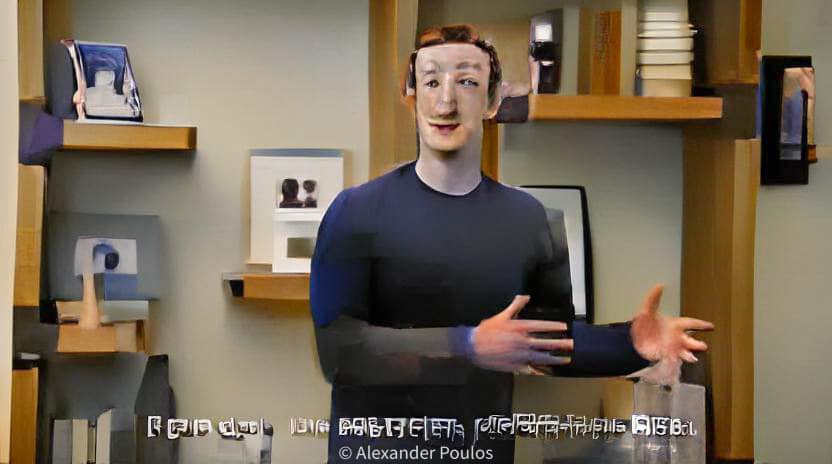
The image depicts a 3D animated rendering of Mark Zuckerberg, founder of Meta (formerly Facebook). He is standing in what appears to be a stylized home library. The rendering is noticeably "off"—Zuckerberg’s appearance is somewhat uncanny, with exaggerated facial features and a plasticky texture. He is dressed in a dark blue, long-sleeved shirt. His arms are outstretched in a gesture that could be interpreted as openness, explanation, or even manipulation.
The background is dominated by a large, symmetrical bookcase filled with books and framed photos. The bookcase is rendered in a bright, somewhat cartoonish style. The composition is centered, emphasizing Zuckerberg and framing him within a constructed, "domestic" environment. The lighting is fairly even, lacking strong shadows. The bottom of the image contains blurred text possibly identifying the artist.
Foucauldian Genealogical Discourse Analysis
This image is ripe for Foucauldian analysis. We can consider it a node within the discourse of technology, power, and identity. The genealogy of Zuckerberg’s image traces back to the evolving understanding of "the self" in the digital age.
- Power/Knowledge: The image isn't simply a portrayal, but a performative act of power. Zuckerberg constructs a particular image of himself: approachable, transparent (outstretched hands), and positioned as an authority within the digital realm. This image circulates and becomes part of the broader discourse, shaping perceptions of Facebook/Meta and its role in our lives. The way he is rendered as slightly uncanny is itself a construction of power, perhaps a means of subtly distancing the "real" Zuckerberg from his digital projection.
- Discipline & Surveillance: The backdrop of a "home library" can be read as a deliberate attempt to evoke notions of intellect, culture, and control. Libraries are historically associated with the archiving and organization of knowledge—a parallel to Facebook/Meta's own data collection and algorithmic categorization. The image subtly reinforces the idea that Facebook/Meta “knows” and “organizes” our lives.
- Subjectification: How does this image contribute to the way we understand ourselves as "users" of these platforms? It positions Zuckerberg as a benevolent architect of our digital experiences, potentially obscuring the ways in which these platforms subjectify us – shape our behaviors, preferences, and identities.
Critical Theory
From a critical theory perspective (particularly drawing on the Frankfurt School), this image is an example of the culture industry at work.
- Commodification of the Self: Zuckerberg, as a public figure and CEO, is himself a brand. This image is a piece of that branding—a curated representation designed to cultivate trust, acceptance, and ultimately, continued engagement with Meta's products. He's presented not as a person, but as a symbol of the platform.
- Ideology & False Consciousness: The image aims to project an ideology of connection, openness, and innovation. However, this masks the underlying power dynamics, data exploitation, and potential for manipulation inherent in the platform. It contributes to a “false consciousness” where users believe Facebook/Meta is a benevolent force for good, rather than a profit-driven corporation.
- Spectacle: The image is part of a larger "spectacle" (a concept developed by Guy Debord) where the representation of reality (Zuckerberg) takes precedence over the real (the actual effects of Facebook/Meta on society).
Marxist Conflict Theory
From a Marxist perspective, the image can be seen as reinforcing class structures and ideological hegemony.
- Means of Production & Control: Zuckerberg, as the owner of the “means of communication” (Facebook/Meta), holds significant power over the flow of information and the shaping of public discourse. The image reinforces his position as the "master" of this system.
- Alienation: The image, while seeming approachable, can be seen as contributing to the alienation of users from genuine connection. Social media, while promising community, often leads to superficial interactions and a sense of disconnection.
- Ideological Apparatus: The image functions as an "ideological apparatus"—a tool used by the ruling class (in this case, the tech elite) to maintain their power by shaping our beliefs and values.
Postmodernism
A postmodern reading of the image would emphasize its constructedness, its lack of a "real" meaning, and the blurring of boundaries between reality and simulation.
- Simulacra & Hyperreality: This isn't a "real" Zuckerberg, but a digitally rendered simulacrum. The image contributes to a "hyperreality" where the simulation (the image, the digital persona) becomes more real than the real.
- Deconstruction of Identity: The uncanny nature of the rendering raises questions about the very nature of identity in the digital age. Is the "digital self" a genuine expression of who we are, or simply a constructed performance?
- Fragmentation & Loss of Grand Narratives: The image lacks a clear, unifying message. It's fragmented, ambiguous, and doesn't offer any "grand narratives" about the future of technology or society.
Queer Feminist Intersectional Analysis
This framework is the most difficult to apply directly, but possible considerations:
- Gendered Representation of Tech Leadership: The image reinforces the pattern of tech leadership being overwhelmingly male. While not inherently problematic, it contributes to the underrepresentation of women and other marginalized genders in the field.
- Algorithms and Bias: Facebook/Meta’s algorithms have been criticized for perpetuating gender and racial biases. The image can be seen as a symbolic representation of the power structures that underpin these biases.
- Data Privacy & Vulnerability: Data collection practices can disproportionately affect marginalized communities. The image serves as a reminder of the need for greater data privacy and protection, particularly for those who are most vulnerable to surveillance and exploitation.
Important Note: These interpretations are inherently subjective and based on specific theoretical lenses. Other interpretations are possible, and the meaning of the image will always be open to debate.
Let me know if you'd like me to elaborate on any of these points or focus on a specific theoretical framework in more detail.
simple-description (llama3.2-vision)
This meme is a still image from a video of Mark Zuckerberg, the CEO of Facebook, speaking in a virtual reality (VR) environment. The image shows him standing in a virtual room, with a background of shelves and books, and a caption that reads "I can see your face". The meme is likely poking fun at the idea of VR technology being able to see and recognize people's faces, even in a virtual environment.
tesseract-ocr
Va) ; ki Fi, Cs) Va — i= a: _ 5 a | 1) ———_ MT a: -ouneameseae ss)