First Seen
2023-05-10T21:03:32+00:00
simple-description (llama3.2-vision_11b)
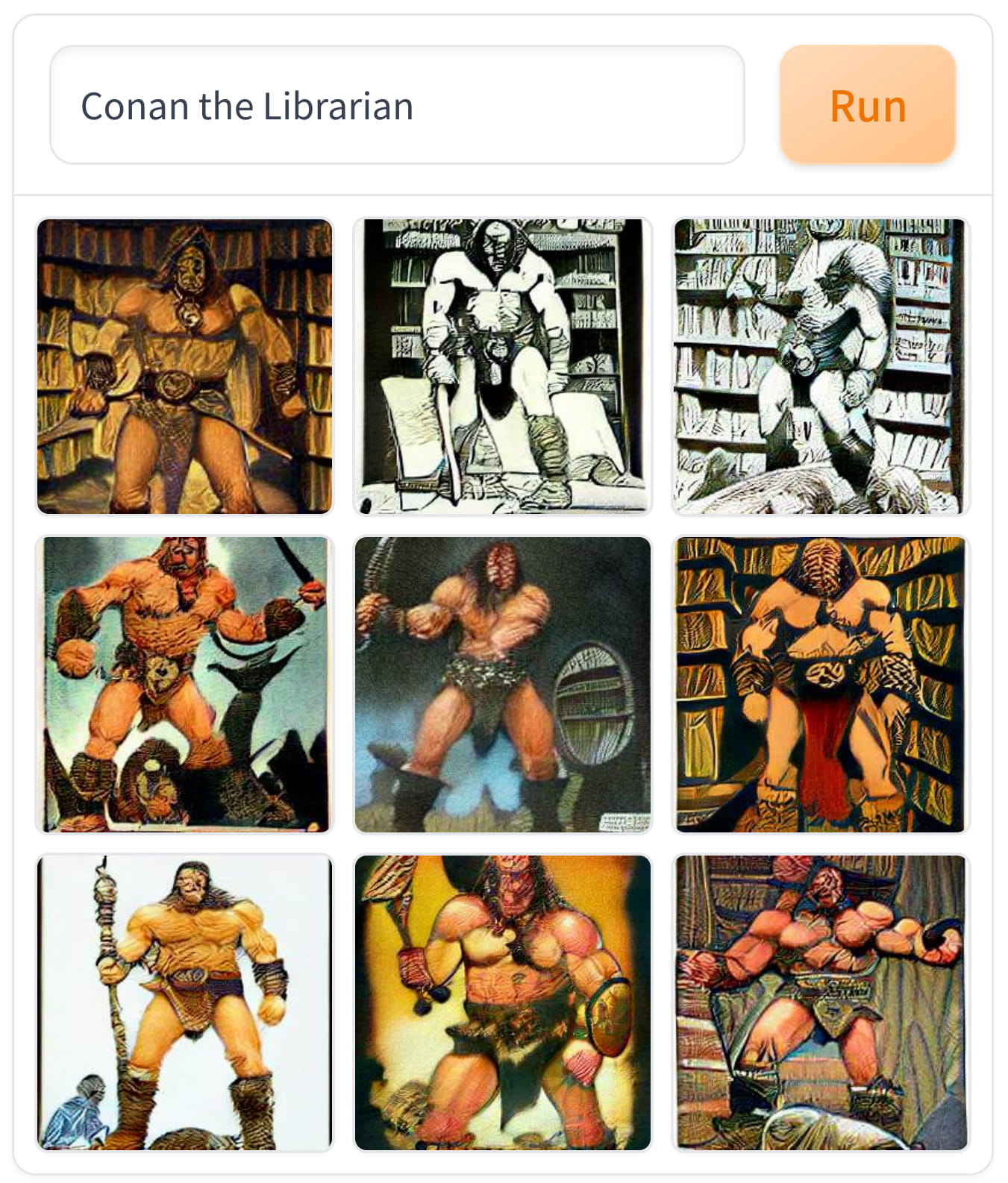
The meme is a humorous image of Conan the Barbarian, a fictional character known for his strength and brutality, sitting in a library surrounded by books. The image is captioned "Conan the Librarian" and is likely meant to be a humorous take on the character's usual persona, showing him in a more mundane and book-loving environment.
detailed-analysis (gemma3-27b-vision)
Okay, here's an analysis of the images, broken down into the requested sections, considering how those theoretical lenses apply. It's important to note that applying all of these to a simple set of images is somewhat of an exercise, but a useful one for demonstrating how these theories work.
Visual Description
The images depict variations of the character "Conan" (presumably referencing Robert E. Howard’s character) in settings evocative of a library or archive. Conan, consistently portrayed as a heavily muscled, scantily clad barbarian, is placed within dense arrangements of books, scrolls, and often, architectural features suggestive of antiquity (columns, arches).
- Composition: Conan is generally central, often positioned as a dominating figure within the book-filled space. Some images suggest him actively reading or handling texts, others portray him as a guardian or overseer of the knowledge contained within.
- Color & Style: The art styles vary from painted illustrations (seemingly in the style of pulp fantasy covers) to more graphic, inked line drawings. Colors are often dark and saturated, emphasizing dramatic lighting and shadow.
- Conan's Portrayal: He is consistently depicted as hyper-masculine, embodying physical strength and a raw, untamed energy. His physique is exaggerated. He often wears minimal clothing – typically a loincloth or a simple harness.
- The Setting: The "library" or archive isn't a sterile modern one. It appears ancient, decaying, even dangerous. It’s more a repository of forbidden or lost knowledge, suggesting a certain mystique and potential for power.
Foucauldian Genealogical Discourse Analysis
These images offer a rich territory for exploring Foucault's concepts of discourse, power/knowledge, and genealogy.
- Discourse of Knowledge: The juxtaposition of the hyper-masculine Conan with the traditionally scholarly setting of a library challenges the discourse surrounding knowledge and who has access to it. Traditionally, scholarship is associated with rationality, intellect, and sometimes, fragility. Conan’s presence subverts that. The images suggest a re-imagining of what it means to have knowledge, associating it with physical prowess and perhaps, a more primal understanding.
- Power/Knowledge: The images implicate a power dynamic linked to knowledge. Conan, as the dominant figure within the archive, suggests that knowledge isn’t neutral; it's a tool that can be controlled, protected, or even wielded as a weapon. His control of the space implies control of the information contained within.
- Genealogy: A Foucauldian genealogy would examine how the concept of the "barbarian scholar" has evolved over time. Traditionally, "civilization" and "knowledge" have been positioned in opposition to "barbarism." These images challenge that binary, tracing a different lineage where physical power and intellectual curiosity aren't mutually exclusive. The image asks what the historical conditions are that give rise to the figure of Conan within a library.
Critical Theory (Frankfurt School)
From a critical theory perspective (drawing on the Frankfurt School), the images can be seen as a commentary on the state of culture and the alienation of the individual.
- Mass Culture & Commodification: The images themselves, as products of fantasy art, participate in a wider culture industry that commodifies adventure, masculinity, and escapism. This could be seen as a distraction from real social and political issues.
- Enlightenment Project & Irrationality: The "library" represents the Enlightenment project – the accumulation and dissemination of knowledge. However, Conan, as a figure of raw physicality and instinct, embodies a rejection of pure rationality. This tension suggests a critique of the Enlightenment’s perceived overemphasis on reason at the expense of other aspects of human experience.
- Alienation: Conan, despite being within the archive, seems fundamentally separate from it. He's not integrating with or furthering the pursuit of knowledge in a traditional way. This could be read as a symbolic representation of alienation in modern society – a disconnect between the individual and the cultural institutions meant to serve them.
Marxist Conflict Theory
Applying a Marxist lens, we can focus on the power dynamics inherent in the control and access to knowledge.
- Class Struggle & Knowledge as Power: The "library" represents a form of cultural capital – a resource that confers power and status. Conan’s positioning within it suggests a struggle for control over that capital. Is he protecting it for the ruling class? Seizing it for the oppressed? The images are ambiguous, but the implication is that knowledge is not shared equitably.
- Ideology: The images can be interpreted as reinforcing a particular ideology that glorifies strength and individual power. Conan is presented as a hero, potentially masking underlying inequalities or justifying domination.
- Base and Superstructure: The library (as part of the cultural "superstructure") reflects the underlying "base" (economic and social relations). The images might suggest a society where physical power is valued above all else, potentially mirroring a feudal or hierarchical social order.
Postmodernism
From a postmodern perspective, the images deconstruct traditional binaries and challenge the notion of a single, authoritative truth.
- Deconstruction of Binary Oppositions: The images disrupt the traditional opposition between "barbarian" and "scholar," "body" and "mind," "instinct" and "reason." By placing Conan within the library, they undermine these categories, suggesting that they are not fixed or natural.
- Intertextuality & Pastiche: The images draw on multiple sources – pulp fantasy, classical iconography, and the trope of the "wise savage." This creates a sense of intertextuality and pastiche, blurring the lines between different cultural references.
- Simulacra & Simulation: The "library" itself might not be a "real" archive of knowledge, but a simulation – a constructed space that mimics the appearance of knowledge without necessarily possessing it. This aligns with Baudrillard’s concept of simulacra and the hyperreal.
Queer Feminist Intersectional Analysis
This is perhaps the most challenging lens to apply, given the strong hyper-masculinity of the central figure. However, it's possible to explore themes of power, exclusion, and the construction of masculinity.
- Masculinity & Power Dynamics: The images are saturated with a very specific, dominant form of masculinity. This can be critiqued as reinforcing harmful stereotypes and excluding other expressions of gender. The images ask, who isn't present in this archive? Whose knowledge is suppressed?
- Exclusion & Access: If the archive represents access to knowledge and power, Conan’s dominance raises questions about who is excluded from that space. The images implicitly (or explicitly) suggest a hierarchy where certain bodies (e.g., women, people of color, disabled individuals) are denied access.
- Intersectional Oppression: This analysis would consider how various forms of oppression (e.g., sexism, racism, classism) intersect to create systemic barriers to knowledge and power. In the absence of diverse representation in these images, it asks us to consider the historical and ongoing marginalization of those who are not represented.
Disclaimer: These are interpretations, and the images are open to multiple readings. Applying these theoretical lenses is a thought experiment aimed at highlighting how different critical frameworks can illuminate various aspects of the artwork.
simple-description (llama3.2-vision)
This meme is an image of a classic book cover featuring Conan the Barbarian, a character known for his strength and bravery. The image is titled "Conan the Librarian" and is a humorous take on the character's typical role as a warrior, instead showing him in a library setting, surrounded by books.
tesseract-ocr
Conan the Librarian Q . Ne Clie are | 7 are dle) ‘e : a of = ee rT , Luby. mn ae | , Be a, By gy Pl ae IE een | Nem) a Wy fp ber a thy Vo TT Tey Ae = | fi £ le mid ys We Se ca \ 24 | i | a Cal Ty ae bY me a a\, \ |_ Wes WazeNG cp eee a SD ERS (BE Sy Ye ~~ N Bt TAL ee (FBS Oe Mi, LA So Pe ae ae Deh . ) Es: mre fe ai uly 3) ek 5 Saeter A fu Oe) | | Mie Pe, ete | Sead ete ¥ 5 le SS yy eee! 1 ea Oe |) a ae ey N\/ a ee he ZA ca a oe ae