First Seen
2023-05-10T21:03:32+00:00
simple-description (llama3.2-vision_11b)
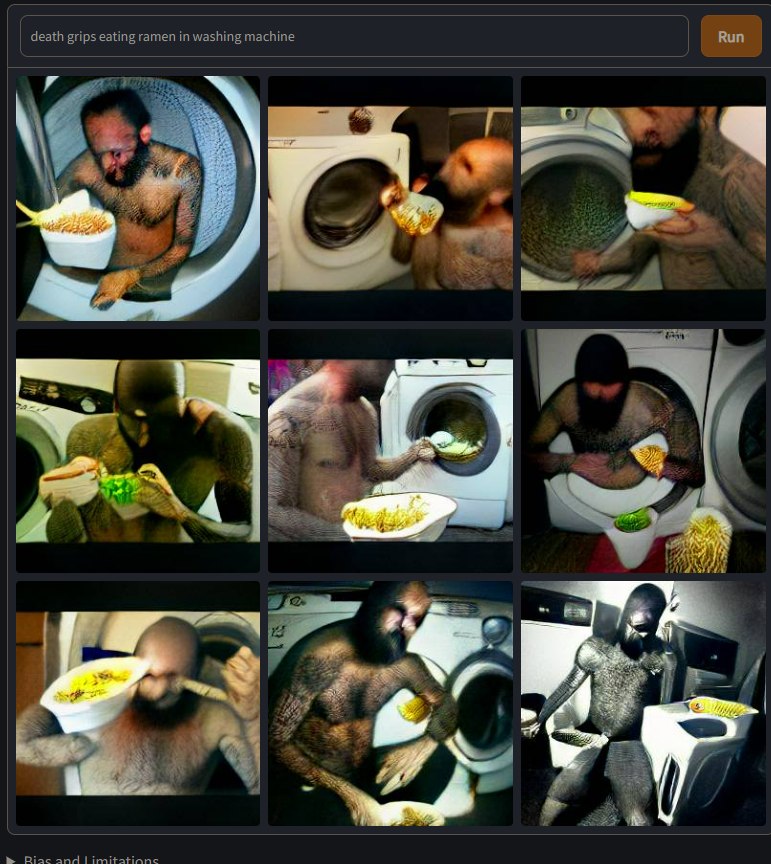
The meme is a series of images depicting a person, likely a celebrity or public figure, in various situations, all of which are being eaten by a "death grip" of a person or object, while holding a bowl of noodles in their lap. The text "death grips eating ramen in washing machine" is likely the title of the meme, implying a humorous and absurd scenario. The images show the person struggling to eat noodles while being held in a washing machine, with the caption "I'm not a chef, I'm a scientist" implying a sense of chaos and absurdity.
detailed-analysis (gemma3-27b-vision)
Okay, here's an analysis of the provided images, structured as requested, exploring potential interpretations through various critical lenses. Be warned: this is inherently speculative, given the bizarre and intentionally unsettling nature of the imagery. I'll note when a section doesn't fully apply. Also, due to the nature of the subject matter, some sections may touch on sensitive or disturbing themes.
Please read the disclaimer at the end.
Visual Description
The image grid presents a series of photographs depicting a heavily muscled, hirsute individual – often masked or with a balaclava – consuming instant ramen noodles within the drum of a washing machine. The setting appears to be a typical domestic laundry room. The individual exhibits exaggerated, almost primal physicality.
Key visual elements:
- Contrast: The image plays with contrast: the hyper-masculine physique against the mundane setting of a laundry room. The brightly colored ramen against the stark white of the washing machine drum.
- Repetition: The same action is repeated across the grid, emphasizing the performative and ritualistic nature of the act.
- Bodily Focus: The images are intensely focused on the body of the individual—specifically, the upper body. This can be read as both a celebration and an objectification of physicality.
- Masking: The balaclava or mask obscures the face, adding an element of anonymity and disrupting identification.
- Discomfort: The act of eating inside a washing machine is inherently absurd and unsettling. The lack of hygiene and confinement create a sense of claustrophobia.
Foucauldian Genealogical Discourse Analysis
Foucault's work centers on power, knowledge, and discourse. This imagery can be understood as a disruption of established discourses surrounding the body, cleanliness, and domesticity.
- The Docile Body: Foucault discusses the "docile body"—a body shaped and controlled by power structures. Here, the body is hyper-disciplined (extreme musculature), yet simultaneously rendered undisciplined through the absurd action. It subverts the idea of a normalized, productive body.
- Disrupting Normative Spaces: The laundry room is a space associated with cleanliness, hygiene, and the reproduction of domestic order. The act of consuming food within it contaminates the space, challenging its intended function. This is a transgression that reveals the constructed nature of these "natural" orderings.
- Power/Knowledge: The images could be a commentary on how power operates through the construction of bodily ideals (hyper-masculinity) and the imposition of domestic norms. The act of defiance (eating in the washing machine) can be seen as a rejection of those power structures, even if it's a bizarre and isolating one.
Critical Theory
The images lend themselves to interpretation through the lens of Critical Theory, particularly regarding alienation and the commodification of the body.
- Alienation: The individual seems profoundly disconnected from conventional social norms and activities. The absurd act of eating ramen in a washing machine can be seen as a symptom of alienation from both the material world and other people. It's an attempt to find meaning in a meaningless existence.
- The Spectacle: Drawing from Debord, the images could be viewed as part of the "society of the spectacle." The individual's body is presented as a spectacle, an object for observation and consumption (visually), divorced from authentic experience.
- Dehumanization: The hyper-focus on physicality and the isolating act can be interpreted as a form of dehumanization. The individual is reduced to a body performing a strange ritual.
Marxist Conflict Theory
While not immediately obvious, a Marxist reading can be applied.
- Commodity Fetishism: The hyper-masculine physique can be seen as a result of the pressures of capitalist society to achieve an idealized body image – a commodity itself. The emphasis on physical perfection is a distraction from the material conditions of life.
- Alienated Labor: The sheer physical labor implied by achieving that level of musculature could be seen as a form of alienated labor—a repetitive, meaningless pursuit driven by external forces.
- Critique of Consumerism: The use of instant ramen is interesting. Ramen is a cheap, readily available food, and can be read as a commentary on the way capitalism relies on easy and quick solutions for basic needs.
Postmodernism
This imagery resonates strongly with postmodern themes:
- Fragmentation & Pastiche: The images blend incongruous elements (hyper-masculinity, domesticity, absurdity) to create a fragmented and disorienting experience.
- Deconstruction of Meaning: The images actively resist a single, coherent interpretation. The absurdity of the act disrupts any attempt to assign a definitive meaning.
- Irony & Parody: The imagery could be read as a parody of both hyper-masculinity and domestic life.
- Rejection of Grand Narratives: The imagery does not suggest any inherent purpose or objective. It’s a deliberate subversion of established structures.
Queer Feminist Intersectional Analysis
This section is the most speculative, but could be explored.
- Subversion of Masculinity: The images can be interpreted as a deconstruction of traditional notions of masculinity. The hyper-masculine physique is juxtaposed with a childish and absurd act, challenging the idea of masculinity as strength and control.
- Body as a Site of Resistance: The body becomes a site of resistance against societal norms and expectations. The act of eating ramen in a washing machine is a refusal to conform.
- De-centering the Phallus: The imagery shifts the focus from the phallus as a symbol of power and dominance to the body as a vulnerable and absurd object.
Disclaimer:
This analysis is speculative and based on interpretation. The images are intentionally ambiguous and open to multiple readings. The interpretation offered here reflects a range of critical theories, but other perspectives are also possible. Additionally, the imagery could be disturbing or triggering for some viewers. It's important to approach this analysis with sensitivity and awareness. It is also crucial to note the lack of context; without knowing the artist's intention, any interpretation remains provisional.
simple-description (llama3.2-vision)
The meme features a person, "Death Grips", eating ramen noodles while being held in a washing machine. The image is captioned "death grips eating ramen in washing machine". The humor comes from the absurdity of the situation and the contrast between the high-tech, modern appliance and the low-brow, messy food.
tesseract-ocr
Ae) Tia. DW) Ou Te a ? e al wi im a aN / ey yy PY i Dave — i ae . - i Ai