First Seen
2023-05-10T21:03:32+00:00
simple-description (llama3.2-vision_11b)
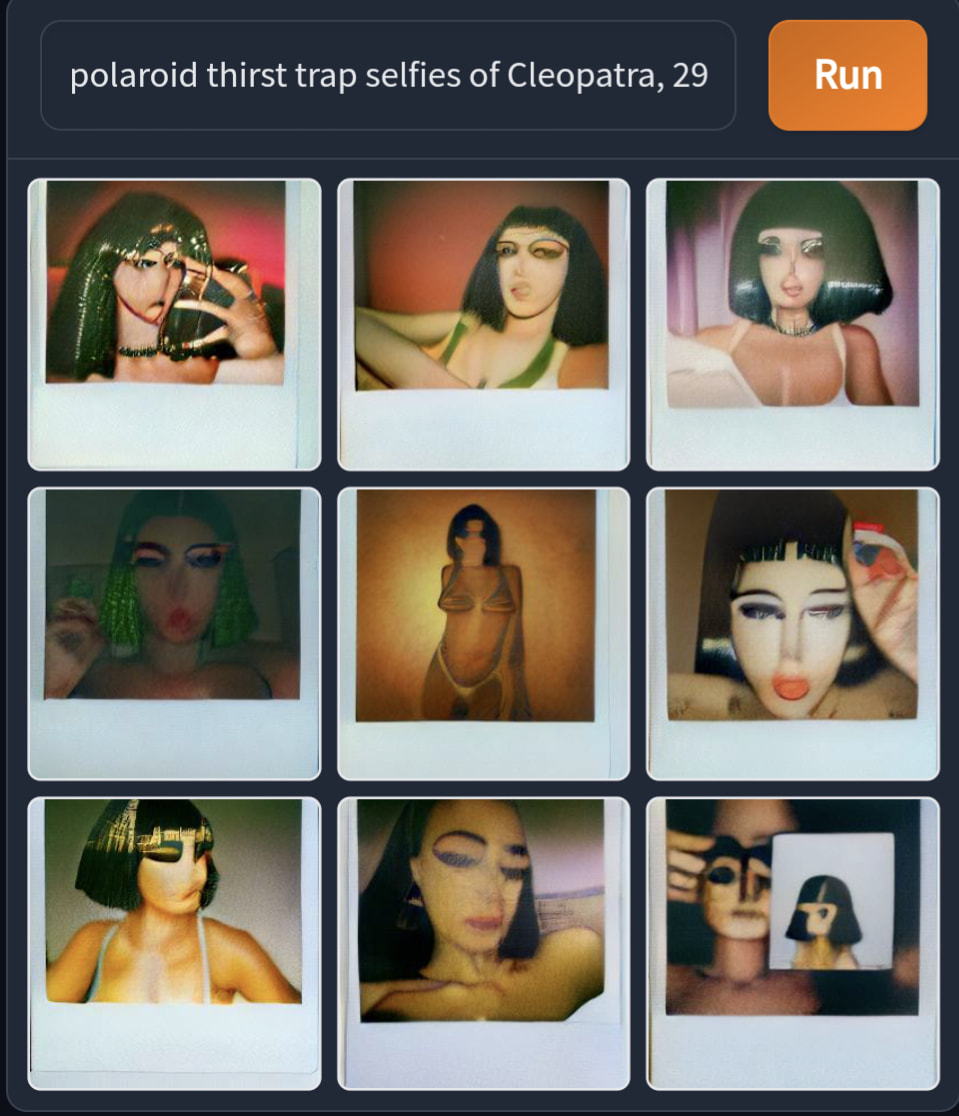
This meme is a collection of AI-generated images of Cleopatra, the ancient Egyptian queen, but with a twist: she's holding a drink and making a "toilet" face, implying she's not just a historical figure but also a party animal. The images are captioned "Cleopatra, 29" and "I can drink you under the table".
detailed-analysis (gemma3-27b-vision)
Here's an analysis of the images, broken down into sections covering the requested theoretical lenses, applied where relevant. Due to the nature of the images, some lenses are more applicable than others.
Visual Description
The artwork consists of nine digitally manipulated images presented to mimic Polaroid photographs. Each image depicts a digitally-rendered figure strongly referencing Cleopatra, but re-imagined within the aesthetic of a modern "thirst trap" selfie. Key features across the images include:
- Stylized Representation: The figure consistently embodies Cleopatra’s signature visual cues – dark hair, elaborate eye makeup (kohl eyeliner, often exaggerated), jewelry, and regal clothing/accessories. However, the rendering style is hyper-digital, lacking realism, giving it a synthetic, "doll-like" appearance.
- "Thirst Trap" Poses: The poses are distinctly sexualized and designed for contemporary social media. They involve gazing directly at the viewer, pouting, strategically revealing skin, and highlighting curves. The images use dramatic lighting and close-ups to accentuate the figure’s perceived attractiveness.
- Polaroid Framing: The Polaroid frame adds a layer of retro nostalgia and simulates the immediacy and intimacy of a personal photograph. The slight imperfections and color distortions typical of Polaroids are emulated, enhancing this effect.
- Diversity: The final Polaroid shows two figures, a dark-skinned Cleopatra and a white one.
Foucauldian Genealogical Discourse Analysis
The artwork engages with the historical discourse surrounding Cleopatra. Foucault’s genealogical method explores how power operates through discourse, shaping what is considered "truth" and normalizing certain ways of seeing the world.
- Historical Representation vs. Modern Re-imagining: The artwork deconstructs the traditional, often patriarchal, representations of Cleopatra. Historically, she’s been portrayed through the lens of Roman victors (Shakespeare, Renaissance paintings, etc.) emphasizing her exoticism, political maneuvering, and ultimately, her subjugation. The "thirst trap" reimagining appropriates her image, placing her within a context of contemporary female agency (albeit within the constraints of hyper-sexualized social media culture).
- Power & Self-Surveillance: The Polaroid format, and the association with personal photography, introduces the concept of self-surveillance. The subject is not simply being observed by a power structure; she is actively participating in the construction of her own image, seemingly on her own terms. However, this "agency" is still mediated by the expectations and demands of the platforms and viewers.
- Construction of "Female Desire": The "thirst trap" aesthetic itself is a product of contemporary discourse around female sexuality. This work interrogates how female desire is both expressed and controlled within digital spaces, where images are circulated, analyzed, and judged.
Critical Theory
The artwork utilizes a critical lens, challenging existing norms and power structures.
- Deconstruction of the Historical Gaze: By combining the historical figure of Cleopatra with the contemporary aesthetic of the "thirst trap," the artist deconstructs the traditional ways of looking at Cleopatra. It confronts the viewer with a figure who simultaneously embodies historical power and contemporary vulnerability.
- Challenging Authenticity: The hyper-digital rendering and the mimicry of Polaroid photography raise questions about authenticity and representation. The images are clearly constructed, artificial, and staged, challenging the notion of a "true" or "genuine" self.
- Consumerism and the Female Body: The "thirst trap" aesthetic is deeply connected to consumer culture and the commodification of the female body. The images can be interpreted as a critique of how women are pressured to present themselves as objects of desire in order to gain attention and validation.
Postmodernism
The artwork embodies several key characteristics of postmodernism.
- Intertextuality: The images are inherently intertextual, drawing on multiple sources – historical depictions of Cleopatra, contemporary social media aesthetics, the conventions of Polaroid photography, and the tropes of the “selfie.”
- Pastiche and Irony: The combination of disparate elements (historical figure, digital aesthetic, “thirst trap” pose) creates a sense of pastiche. There's an element of irony in juxtaposing the image of a powerful historical ruler with the superficiality of social media.
- Blurring of Boundaries: The artwork blurs the boundaries between past and present, high and low culture, authenticity and simulation. The lines between historical representation and contemporary self-expression are deliberately ambiguous.
- Fragmentation and Loss of Grand Narratives: The images can be seen as a rejection of traditional historical narratives and a celebration of fragmentation and individual expression.
Queer Feminist Intersectional Analysis
This is where the artwork has potential complexity. While the images directly center a female figure, there's a question of how they engage with queer and intersectional feminist perspectives.
- Reclaiming Female Agency: A feminist reading could focus on the attempt to reclaim female agency through self-representation. The figure is not passively depicted; she is actively posing, looking, and presenting herself on her own terms, even if those terms are shaped by societal expectations.
- Commodification and the Male Gaze: A critique, however, could center on the inherent commodification of the female body within the "thirst trap" aesthetic. The images may perpetuate the male gaze, reducing the figure to an object of desire and reinforcing patriarchal power structures.
- Lack of Intersectionality: While the final Polaroid image shows two figures of different ethnicities, the artwork doesn't directly address intersectional concerns (race, class, sexuality, etc.). It largely focuses on the representation of a single figure within the framework of a hyper-sexualized aesthetic.
It's important to note that interpretations can vary depending on the viewer's own background and perspective. This is especially true for artwork that engages with complex social and political issues.
simple-description (llama3.2-vision)
The meme is a collection of images of the Egyptian queen Cleopatra, but with a twist: they are all modified to look like they are drinking from a beer glass or a cocktail glass, with the caption "Cleopatra's got a thirst".
tesseract-ocr
polaroid thirst trap selfies of Cleopatra, 29 Run Pea. Ce é i re Fas A j 4 i is Le a) te we ps a, % ’ | A baa 7 4 n 4 ail | Ea]