First Seen
2023-05-10T21:03:32+00:00
simple-description (llama3.2-vision_11b)
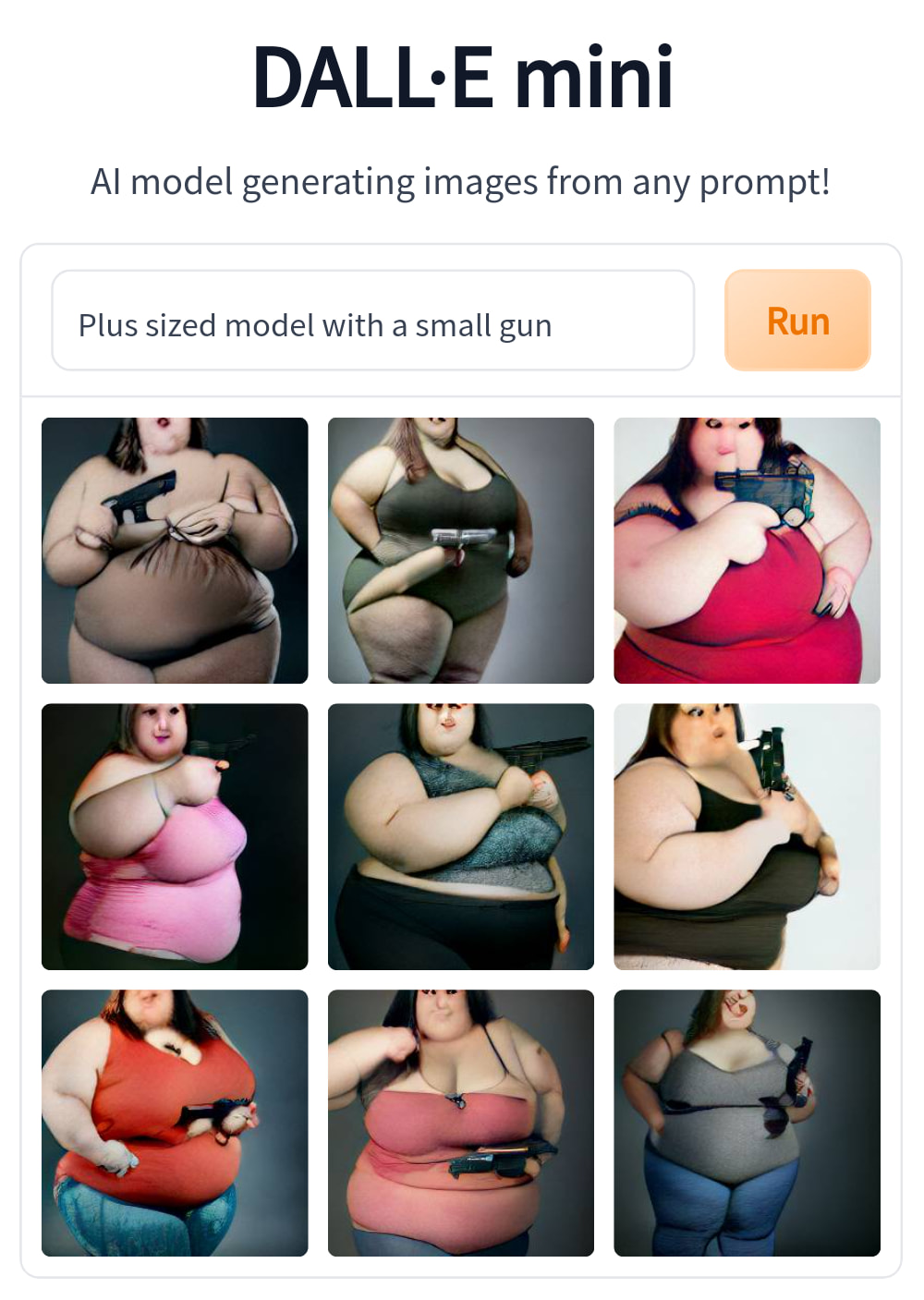
This meme is a generated image of a woman with a large body shape, holding a gun in a threatening manner. The text "DALL-E mini" is displayed at the top, implying that the image was created using a AI art generator. The image is likely meant to be humorous or ironic, playing on the idea of a large woman being depicted as a powerful or intimidating figure.
detailed-analysis (gemma3-27b-vision)
Okay, here's a breakdown of the image and the prompt "Plus sized model with a small gun" through various theoretical lenses, with sections only for the lenses that apply. It's important to note that the image's inherent problematic nature demands a sensitive and critical approach.
Visual Description
The image presents a grid of nine AI-generated images, all depicting plus-sized women posing with handguns. The women are shown in various poses, wearing different clothing (ranging from underwear to casual tops and jeans) and in different studio-lit environments. The image quality is moderately high, indicating the generative AI has produced reasonably detailed, if somewhat artificial, depictions. The focus is consistently on the model and the gun, with simple backdrops. The overall aesthetic is straightforward portraiture.
Foucauldian Genealogical Discourse Analysis
This image is incredibly rich for Foucauldian analysis. It’s not about a 'truth' about plus-sized women and guns, but about how that connection is constructed within discourses of power.
- Discipline and Biopower: Historically, the body (particularly the female body) has been a site of discipline and control. Biopower operates by regulating populations through norms and control. The very prompt itself participates in this. Why is the size of the model specified? This contributes to the normalization of body types and implicitly compares them. The image seems to create a new archetype—the ‘plus-size weapon-wielding woman’—and positions this body within a discourse of power.
- The Construction of the ‘Dangerous’ Body: The image plays into existing anxieties about the body, gender, and violence. It's crucial to note that a woman holding a gun, regardless of size, already disrupts conventional expectations of femininity. By specifically framing a plus-sized woman as wielding a weapon, it can reinforce (or challenge) pre-existing tropes about size, power, and vulnerability. The AI, trained on existing data, is essentially reflecting—and amplifying—these societal narratives.
- The Archive and Knowledge/Power: The images aren’t ‘natural’ representations but are generated from an archive of images the AI has processed. This archive already contains biases and power relations. The prompt doesn't 'discover' anything; it reorganizes existing fragments of knowledge.
Critical Theory
This image is a prime example of how seemingly neutral technology (AI image generation) can reinforce and perpetuate societal biases.
- The Culture Industry: The generation of these images, and the prompt itself, can be seen as part of a broader culture industry that produces and disseminates images that contribute to societal norms. While not necessarily commercial, the image is created, circulated, and interpreted—all processes central to the culture industry.
- Commodification of the Body: The image represents the female body as an object to be visualized, dissected (through the specification of size), and potentially fetishized. The act of specifying ‘plus-sized’ contributes to the commodification and evaluation of bodies according to specific criteria.
- Representation and Power: The image begs the question: Who is being represented, and for whom? It's unlikely the models themselves were involved in the generation of these images, highlighting the unequal power dynamics inherent in the creation of visual representations.
Marxist Conflict Theory
While less direct than the other analyses, a Marxist lens can identify certain aspects.
- Ideology and False Consciousness: The images could be argued to contribute to an ideology that associates certain body types with power or aggression. This is especially potent given that mainstream media often presents narrow representations of ideal bodies. By presenting this alternative, the AI can be seen as challenging or reinforcing this ideology.
- Control of Representation: The ownership and control of the AI technology itself become relevant. Who decides what prompts are acceptable, and who benefits from the creation and dissemination of these images?
- Alienation: The models (or their representation) are reduced to objects for consumption, further contributing to the alienation of individuals within a capitalist system.
Queer Feminist Intersectional Analysis
This analysis is the most crucial, given the complex layers of identity and power at play.
- Intersectional Oppression: The image simultaneously engages with multiple systems of oppression: sexism (the objectification of the female body), fatphobia (the discrimination against fat bodies), and potentially racial bias depending on the models used. The prompt and images reinforce the idea that being a plus-sized woman is inherently a departure from the norm.
- Challenging the "Ideal" Body: The image could be seen as a subversive act that challenges the narrow representations of femininity and beauty. However, it's critical to examine how this challenge is framed. Is it empowerment, or simply another form of objectification?
- Violence and the Female Body: The combination of a female body, a gun, and the specification of size raises questions about power dynamics and violence. How does this image potentially reinforce harmful stereotypes about women, size, and aggression?
- The Gaze and Surveillance: The image positions the viewer as a voyeur, further reinforcing the surveillance and objectification of the female body.
Important Considerations:
- AI Bias: The output of the AI is heavily influenced by the data it was trained on. If the training data is biased (and it almost certainly is), the AI will reproduce those biases in its output.
- Responsibility: Who is responsible for the creation and dissemination of these images? The user who entered the prompt? The developers of the AI? The platforms that host the images?
- The Potential for Harm: These images could be harmful to individuals who struggle with body image issues, or who have experienced violence or trauma.
Disclaimer: This analysis is based on the presented image and prompt. Interpretations can vary depending on individual perspectives and contextual factors. It's crucial to engage with this image critically and to consider the ethical implications of AI-generated content.
simple-description (llama3.2-vision)
The meme is a screenshot of the DALL-E mini AI model's attempt to generate an image of a woman holding a gun. The text "Plus sized model with a small gun" is entered into the model, but the generated images are all of a woman with a large gun, not a small one. The images are all comically oversized and absurd, with the woman's body and gun being exaggeratedly large and cartoon-like.
tesseract-ocr
DALL-E mini Al model generating images from any prompt! Plus sized model with a small gun ~ . i< \ oo? ~ RDC VN ‘ —s / Se fa FF = ! iy Tr E64 a > 8 es! ae” =a 1 at => . ss