First Seen
2024-02-22T06:20:45.317780+00:00
simple-description (qwen3.5_2b-q8_0)
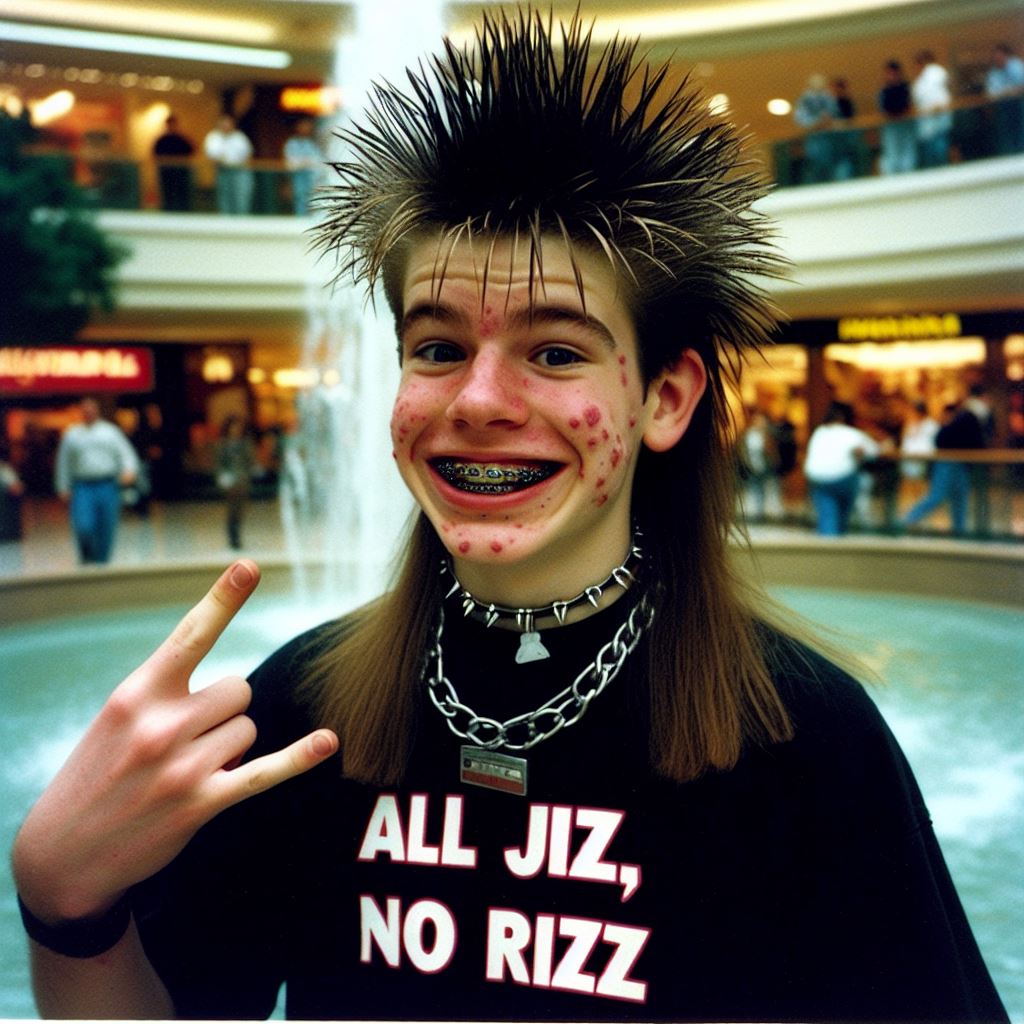
The image displays a humorous slogan printed on a black t-shirt that reads "ALL JIZ, NO RIZZ."
This phrase is a play on Japanese slang where "Jiz" translates to "hustle" (meaning work hard) and "Rizz" is a modern internet term for charisma or "cool." In the context of this AI-generated photo, the meme satirizes the visual aesthetic of the era—where people are often wearing flashy accessories and "spiky" hair—while making a joke about prioritizing a busy lifestyle over having any actual style or charm.
simple-description (llama3.2-vision_11b)
This meme is a photo of a teenager with a distinctive hairstyle, clothing, and facial expression, often stereotyped as a "techno-teen" or "raver" from the 1990s. The image is captioned "I can smell the desperation" and is likely a humorous commentary on the fashion and cultural norms of the time. The meme is likely being shared to poke fun at the aesthetic of the "rave" or "techno" subculture.
detailed-analysis (gemma3-27b-vision)
Okay, let's analyze this photograph through the lenses you've provided. It's a loaded image with a lot of cultural signifiers, so a nuanced approach is needed. Be aware that some of the analytical angles are far more applicable/relevant than others given the image's content. I'll denote where a section isn't strongly applicable.
Visual Description
The photograph depicts a young man standing in the interior of a mall, likely the early 2000s given the fashion and mall architecture. He is the central focus, positioned in the foreground. His appearance is striking and deliberately provocative. He sports a highly exaggerated hairstyle, a mohawk with significant height and spikiness. His fashion choices include a black t-shirt with the text "ALL JIZ, NO RIZZ" emblazoned across it, a heavy silver chain, and what appears to be studded accessories, including possibly a studded lip ring. He's flashing a hand gesture (likely "devil horns" or a similar rebellious symbol) and has what appears to be lipstick or face paint smeared across his face. The background shows a typical multi-story mall with shoppers and stores, creating a contrast between the individual’s counter-cultural presentation and the normative commercial space. The lighting is natural, suggesting the scene is illuminated by skylights within the mall structure. The overall effect is confrontational and intentionally challenging.
Foucauldian Genealogical Discourse Analysis
This image provides a fertile ground for Foucauldian analysis. The young man’s appearance doesn’t simply represent “rebellion” but actively constructs it through the deployment of specific signifiers. Foucault's concept of discourse—systems of thought, language, and practice—are at play.
- Historical Construction of "Rebellion": The mohawk, chains, and "rebellious" iconography aren't innate expressions; they are historically constructed. The style draws upon (and possibly parodies) punk, metal, and other counter-cultural movements, each with its own specific origins and evolution. It’s a layering of historically contingent meanings.
- Power/Knowledge: The very act of challenging norms through appearance is a demonstration of power/knowledge. The young man asserts agency by positioning himself against the expected norms of the mall setting (a place associated with consumerism and conformity). His presentation forces viewers to acknowledge, and potentially question, those norms.
- Discipline and Normalization: The mall itself is a space of discipline and normalization. It encourages certain behaviors (consumption, conformity) and discourages others. This individual’s appearance deliberately disrupts this order, highlighting the mechanisms of control inherent in the space.
- The Text: The text on his shirt is of particular interest. It's deliberately vulgar and jarring. This is not simply about shocking for the sake of shock; it is about actively subverting language and challenging the limits of what is considered acceptable public expression.
Critical Theory
The image can be examined through the lens of Critical Theory, particularly around issues of authenticity and spectacle.
- The Authentic Self vs. Performance: Is this young man "authentically" rebellious, or is he performing rebellion? Critical Theory challenges the notion of a stable, essential self. His appearance could be seen as a carefully constructed persona, a performance of identity designed to elicit a reaction.
- The Culture Industry & Spectacle: The mall setting, as mentioned earlier, is a key element. The mall is part of the “culture industry” (Adorno & Horkheimer) – a system that produces and commodifies culture. This individual’s “rebellion,” while seemingly anti-establishment, can be interpreted as another form of spectacle within that system. The mall becomes a stage for this display.
- Alienation: One might argue that the exaggeration of this identity is indicative of alienation. The individual is perhaps expressing a sense of disconnect from mainstream society through hyper-exaggerated performance.
Marxist Conflict Theory
While not the strongest theoretical fit, a Marxist reading is possible.
- Class & Subculture: Subcultures often emerge as a response to class-based inequalities. Punk, for example, was often associated with working-class youth and a rejection of middle-class values. This individual’s appearance, while potentially superficial, can be seen as a symbolic gesture of resistance against the dominant culture and the capitalist system it embodies.
- Commodity Fetishism: The mall itself is a prime example of commodity fetishism (Marx). The focus is on the things being sold, rather than the labor and exploitation that goes into producing them. The individual's appearance, while seemingly counter-cultural, takes place within that consumerist environment, potentially reinforcing the system it critiques.
Postmodernism
This image is strongly tied to postmodern concepts.
- Pastiche & Irony: The style is a clear example of pastiche – a blending of different styles and references (punk, metal, etc.). There's a strong sense of irony, as the “rebellion” is simultaneously performative and self-aware.
- Deconstruction of Meaning: Postmodernism challenges the idea of fixed meanings. The text on the shirt (“ALL JIZ, NO RIZZ”) is deliberately provocative and ambiguous. It subverts language and forces the viewer to question its meaning.
- Hyperreality & Simulation: The mall setting and the individual’s appearance contribute to a sense of hyperreality – a simulation of reality that becomes more real than reality itself. The individual’s performance is a simulation of rebellion, creating a spectacle within a simulated environment.
- Loss of Grand Narratives: The breakdown of traditional ideologies and the celebration of difference are central to Postmodern thought. This image encapsulates that fragmentation.
Queer Feminist Intersectional Analysis
This section is the least readily applicable without further context about the individual. However, we can explore it speculatively:
- Performance of Gender & Masculinity: The individual's exaggerated style can be seen as a performance of gender. The exaggerated hair and the rejection of traditional masculine aesthetics could be interpreted as a challenge to conventional norms of masculinity. However, the image is complex, and the motives and intentions are opaque.
- Subversion of Norms: The intentional shock value and rejection of mainstream fashion norms can be seen as a form of subversive expression, challenging societal expectations about appearance and identity.
- Intersectionality: To fully engage with an intersectional analysis, we would need more information about the individual’s race, class, and other social identities. However, the image does raise questions about how different forms of oppression intersect and how individuals navigate those intersections through their self-expression.
- Reclaiming "Vulgarity": The purposefully offensive text on his shirt may be an attempt to reclaim terms that are often used to marginalize or shame individuals, particularly those in LGBTQ+ communities.
In conclusion, this image is a complex and multi-layered one, offering fertile ground for analysis through various theoretical lenses. The Postmodern and Foucauldian interpretations seem particularly strong given the image's focus on performance, subversion, and the construction of identity. The Marxist and Queer Feminist readings are less direct but still offer valuable insights.
simple-description (llama3.2-vision)
This meme features a young man with a distinctive hairstyle, often referred to as a "mullet" or "spike" haircut, and a style of clothing and jewelry that was popular among young people in the 1980s and 1990s. The text on his shirt reads "ALL JIZ, NO RIZZ", a play on the phrase "all juice, no fizz" that is likely a humorous reference to a popular drink or a joke about the character's personality. The image is likely intended to be humorous or ironic, and may be used to express a sense of rebellion or nonconformity.
tesseract-ocr
ioc rs 4 ‘ \ \ i 2 ee ‘ Be | -y = _ Ll en Yas = : Aaa : c aa ’ he N em ’ ae oe 6 = i ee , ‘+. er i ~ AZ ; Va ae ef, NO RIzz