First Seen
2023-05-10T21:03:32+00:00
simple-description (llama3.2-vision_11b)
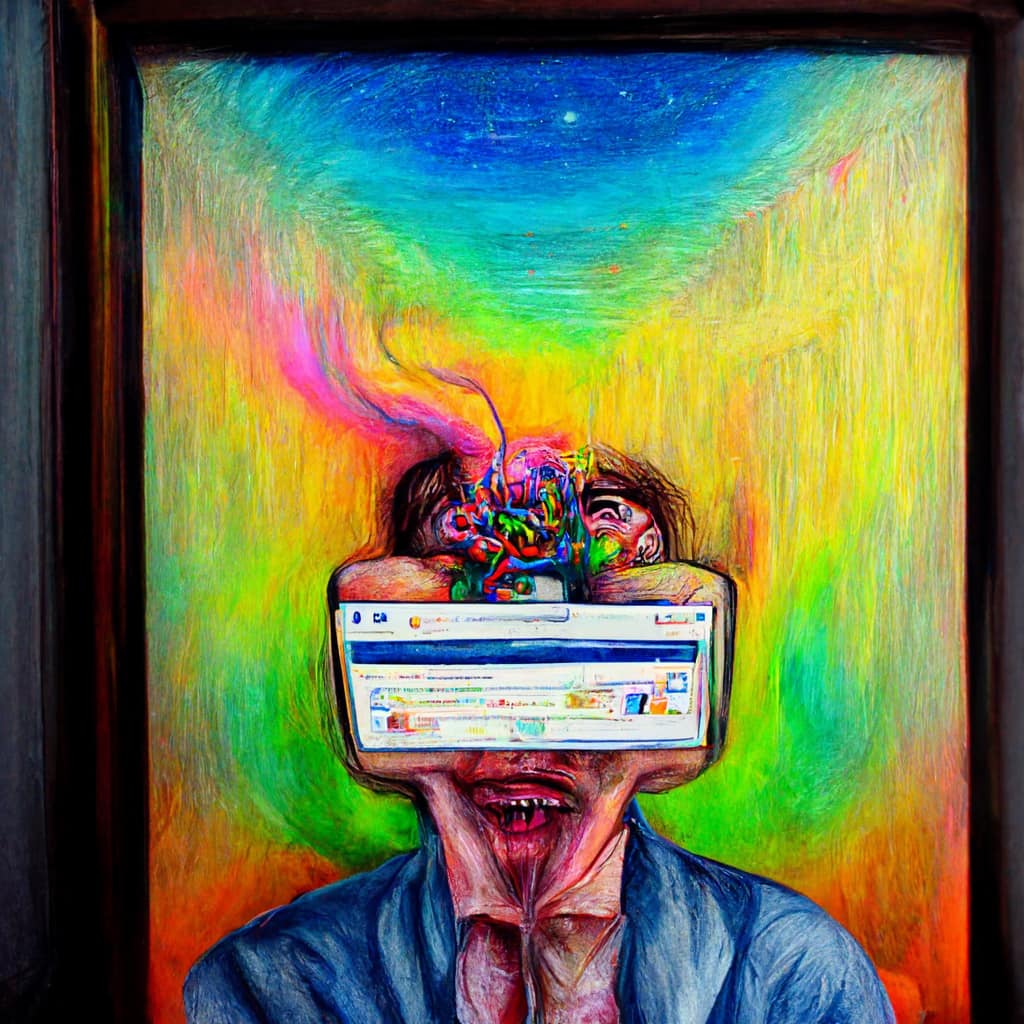
This meme is an AI-generated image of a person with a distorted face, with a computer screen for a face and a browser tab displaying a 404 error page. The image is a humorous representation of the frustration and confusion that can come from navigating the internet. The text "404 Not Found" is displayed on the screen, implying that the person is struggling to find what they're looking for online.
detailed-analysis (gemma3-27b-vision)
Okay, let's break down this striking image with the requested theoretical lenses. It's a complex piece that lends itself to several analyses.
Visual Description
The artwork depicts a man, rendered in a highly textured, almost feverish style, with a computer screen replacing his head. He's dressed in a dark business suit and tie, suggesting a professional context. The screen displays a website interface, filled with colorful bars and data visualizations that appear chaotic and overflowing. Above the screen, energy-like forms or streams of light radiate upwards, culminating in a tangle of wires, circuitry, and perhaps even organic forms, resembling brain matter.
The background is an abstract swirl of vibrant, primarily warm colors – yellows, oranges, reds, and hints of blue and green. The brushwork is heavily impastoed and expressive, lending the image a sense of turbulence and inner turmoil. The overall effect is intensely unsettling and suggestive of a loss of self, information overload, and the merging of human consciousness with technology. The lighting is dramatic, emphasizing the contrast between the figure and the chaotic energy around him. The painting is set within a decorative dark frame.
Foucauldian Genealogical Discourse Analysis
This artwork powerfully embodies Foucault’s concepts of power/knowledge and the formation of the subject. The man’s head being a computer screen is a clear visual metaphor for how discourse and technology shape and constitute our very selves.
- Archaeology & Genealogy: The image doesn't depict a 'natural' subject, but a subject produced by the discourses of digital technology and the demands of the professional world (signaled by the suit). The genealogy would trace the historical development of these discourses – the rise of the internet, the demands of a data-driven economy, the pressure to be ‘always-on’ – and how they’ve led to this form of subjectification.
- Power/Knowledge: The screen isn't just on the man’s head; it is his head. This suggests that knowledge (information, data) isn’t something separate from power, but a form of power. The chaotic stream of data represents the overwhelming flow of information that controls and defines the subject. The subject is not thinking, but being thought by the data.
- Discipline & Panopticism: The constant surveillance implicit in the internet and data collection can be linked to Foucault’s panoptic model. Even if the man isn’t consciously being watched, the possibility of surveillance shapes his behavior and self-perception. He is internally regulated by the expectations and data requirements of the system.
- Subjectivation: The image shows the man becoming subjected to the logic of the digital world. His identity is being constructed through and by the technology, rather than originating from within. He is a node in the network, a collection of data points.
Critical Theory (Frankfurt School)
This image aligns strongly with the concerns of the Frankfurt School, specifically regarding the dehumanizing effects of technology and the "culture industry."
- Commodification & Reification: The man, even as an individual, is reduced to a function within a system. He is a cog in the machine, a data point, and is therefore “reified” – treated as an object rather than a subject. His professional attire reinforces the idea of labor as a commodity.
- Loss of Authenticity: The replacement of the head with a screen symbolizes the erosion of genuine human experience. The authentic, embodied self is supplanted by a mediated, digitized version. The frantic energy around the screen suggests inner turmoil and a loss of connection to self.
- Instrumental Reason: The relentless flow of data and the emphasis on efficiency (implied by the professional context) represent the dominance of "instrumental reason" – a form of rationality that prioritizes means over ends, and reduces everything to its utility.
- Mass Culture & Manipulation: The image can be seen as a critique of the ways in which mass culture and technology shape our perceptions and desires. The overwhelming influx of information can be seen as a form of control, shaping the subject into a docile consumer.
Marxist Conflict Theory
From a Marxist perspective, the artwork highlights the alienation and exploitation inherent in capitalist modes of production.
- Alienation: The man’s dehumanization—his head replaced by a screen—is a powerful metaphor for alienation. He is alienated from his own consciousness, from his body, and from any authentic sense of self. He is reduced to a mere instrument of production.
- Class Struggle: The professional attire suggests a position within the capitalist system. However, even this position is depicted as one of vulnerability and powerlessness. The chaotic energy around his head could symbolize the pressures and anxieties of competing within a capitalist structure.
- Commodification of Labor: The image underscores how labor is reduced to a commodity, and how the individual is valued only for their productive capacity. The constant influx of data symbolizes the demands of the market and the relentless pursuit of efficiency.
- Ideology & False Consciousness: The image can be interpreted as a critique of the ideological forces that perpetuate capitalist exploitation. The subject may believe he is free and autonomous, but in reality, he is trapped within a system that controls and exploits him.
Postmodernism
The artwork resonates with several key themes of postmodern thought.
- Simulation & Hyperreality: The image blurs the lines between reality and simulation. The screen isn't just a representation of information; it is the head, suggesting that our experiences are increasingly mediated by technology and that the distinction between the real and the virtual is eroding. This aligns with Baudrillard’s concept of hyperreality.
- Fragmentation & Deconstruction of the Self: The chaotic energy and the fractured nature of the image reflect the postmodern emphasis on fragmentation and the deconstruction of stable identities. The self is not seen as a unified entity, but as a collection of disparate elements.
- Loss of Grand Narratives: The image suggests a rejection of traditional, overarching narratives. The absence of a clear, coherent identity reflects the postmodern skepticism towards universal truths and ideologies.
- Intertextuality: The artwork invites multiple interpretations and draws on a range of cultural references. The imagery evokes themes from science fiction, digital art, and contemporary anxieties about technology.
Important Note: These are just a few possible interpretations. The strength of this artwork lies in its ambiguity and its ability to evoke a range of emotional and intellectual responses. Different theoretical lenses will reveal different layers of meaning, and the ultimate interpretation is subjective.
Let me know if you'd like me to elaborate on any of these analyses or explore additional theoretical frameworks!
simple-description (llama3.2-vision)
This meme is a humorous image of a person's face being distorted and merged with a computer screen. The text "I can see your pixels" appears in the image, implying that the person is being digitally manipulated or hacked. The meme is likely used to express frustration or annoyance when someone's online activities are being monitored or tracked.
tesseract-ocr
yy ) — : aiccee RH | | aN ae = z | if ——— i ih ‘ h) i ' : ie i i et e acat i i i. NR Ss | | 1) a | mi) i.) iy Se. Lh it yin i hi | ayy) a) baal Te th ie SS sb We Hit 1 ii Hi yw — . 4 We Aly: Ny 4 See ‘: ‘ees =" i ih | His Se = i i i i nt ee Te B: ; i! Hy ‘i | ey, Ao, al i “Nie // ah i W J f Mt 7 | ey ASA i |