First Seen
2023-05-10T20:59:59+00:00
simple-description (llama3.2-vision_11b)
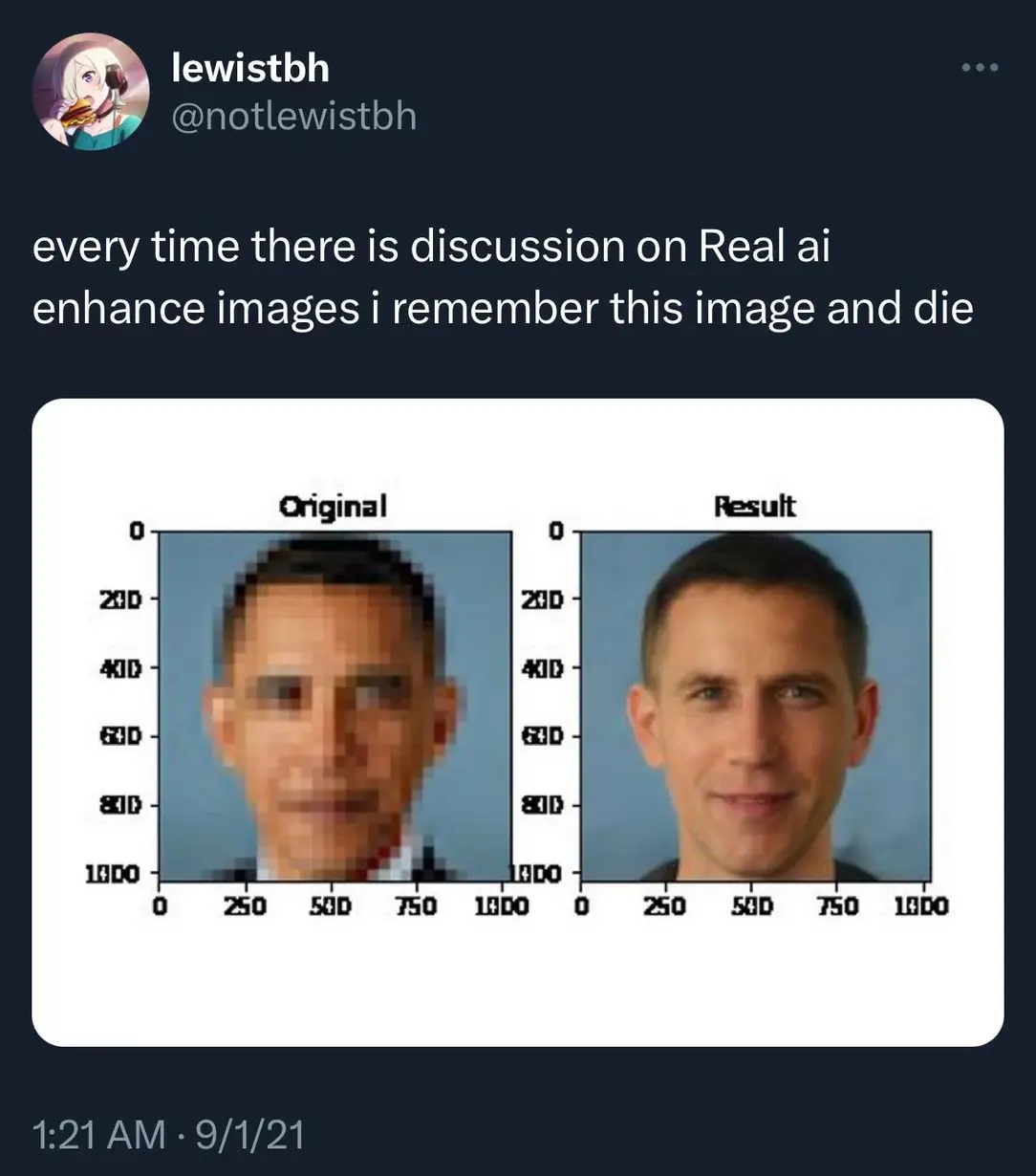
The meme is a joke about the limitations of AI art. It shows a before-and-after image of a person, with the left image being a poorly generated, pixelated representation of the person and the right image being a well-generated, realistic representation of the person. The text above the images reads, "every time there is discussion on Real AI art, I remember this image and die".
detailed-analysis (gemma3-27b-vision)
Okay, here's a breakdown of the image and its accompanying text, analyzed through the lenses you requested. I will only include sections where the requested theory actually applies. This is important, as forcing analysis where it doesn't fit isn't helpful.
Visual Description
The image presents a side-by-side comparison of two grayscale images of a man's face. The left image is labeled "Original" and is significantly pixelated and blurry, rendering facial features indistinct. The right image is labeled "Result" and depicts the same man’s face, but significantly enhanced. Facial features are clear and recognizable, even with the grayscale palette. The images have numerical scales on the x and y axes, resembling a coordinate plane, suggesting a technical representation of image data and enhancement process. The images appear as a "before" and "after" comparison meant to demonstrate AI-powered image enhancement. The tweet accompanying the image states, "every time there is discussion on Real ai enhance images i remember this." The post was made on September 1, 2021.
Foucauldian Genealogical Discourse Analysis
This image and text can be effectively analyzed through a Foucauldian lens. The “Real AI enhance images” represent a discourse around surveillance, identity, and the power of technology.
- Power/Knowledge: The ability to "enhance" an image from a blurry, unidentifiable state to a clear one is a manifestation of power. This power resides in the algorithms and the institutions controlling them. The knowledge required to create such algorithms, and the control over data used to train them, are intertwined with that power.
- Genealogy: The tweet implies that this particular image represents a turning point or a traumatic memory in relation to the development of this technology. It’s not about the image itself, but what it represents in the history of image enhancement and its implications. The "remembering" is a recalling of a moment when the true implications of this technology became clear.
- Disciplinary Power: The ability to reconstruct a face from low-resolution data allows for increased surveillance and control. It can be used for identification, tracking, and potentially, the repression of dissent. It shifts the power dynamic, placing more control in the hands of those who wield the technology.
- Discourse Formation: The tweet is a contribution to the ongoing discourse around AI and its impact. The individual is making a statement about their personal experience with this discourse, and their specific association with this image.
Critical Theory
This image operates within a framework relevant to Critical Theory, specifically regarding the manipulation and control of reality through technology.
- The Culture Industry: The advancement of AI image enhancement contributes to the wider "culture industry," a concept articulated by Adorno and Horkheimer. It produces a seemingly “natural” reality (a clear image) that is actually constructed and controlled by technological forces.
- Commodification of the Image: The image itself, and the ability to manipulate it, becomes a commodity. Companies sell software that performs these enhancements, effectively profiting from the manipulation of perception.
- Loss of Authenticity: As AI becomes more adept at reconstructing and manipulating images, the concept of an "authentic" image is eroded. The 'Result' image is not a direct reflection of reality, but an AI-constructed interpretation.
- Ideology & Control: The image highlights how technology can be used to reinforce existing power structures. The ability to enhance images for surveillance purposes serves to maintain social control and suppress dissent.
Postmodernism
The image embodies several aspects of postmodern thought:
- Simulacra & Simulation: The enhanced image can be seen as a simulacrum – a copy without an original. It's a reconstruction based on algorithms, bearing only a resemblance to the original person. This raises questions about the nature of reality and representation.
- Death of the Author/Original: The original image is almost irrelevant. The “result” image is a product of the algorithm, not the subject’s inherent appearance. The focus has shifted from the subject to the process of creation.
- Fragmentation & Instability: The original pixelated image represents a fragmented reality. The enhancement process attempts to reconstruct it, but the reconstructed image is still a digital construction, prone to manipulation and distortion.
- Deconstruction of Meaning: The image encourages us to question the very notion of a "true" image. What does it mean to "see" someone when that perception is mediated and manipulated by technology?
Let me know if you'd like me to elaborate on any of these points, or if you'd like me to analyze this image through a different theoretical lens.
simple-description (llama3.2-vision)
This meme is a humorous take on the concept of "AI-generated" images. The image shows two versions of a person's face, with the left one being a blurry, pixelated mess and the right one being a clear, high-quality image. The text above the images reads: "every time there is discussion on Real AI enhance images I remember this image and die".
tesseract-ocr
@ Woe 7) @notlewistbh every time there is discussion on Real ai enhance images i remember this image and die Original Result Qo 0 aD aD «ID | & xD] 4 he ep | "= . 1 q 5 . ID =p , 1000 B_ ri npo ; 0 230 «©50D)«=6 750 Sno lsCéO 230 «50D «=6FS0)—C «1 1:21 AM - 9/1/21