First Seen
2023-05-24T21:09:26+00:00
simple-description (qwen3.5_2b-q8_0)
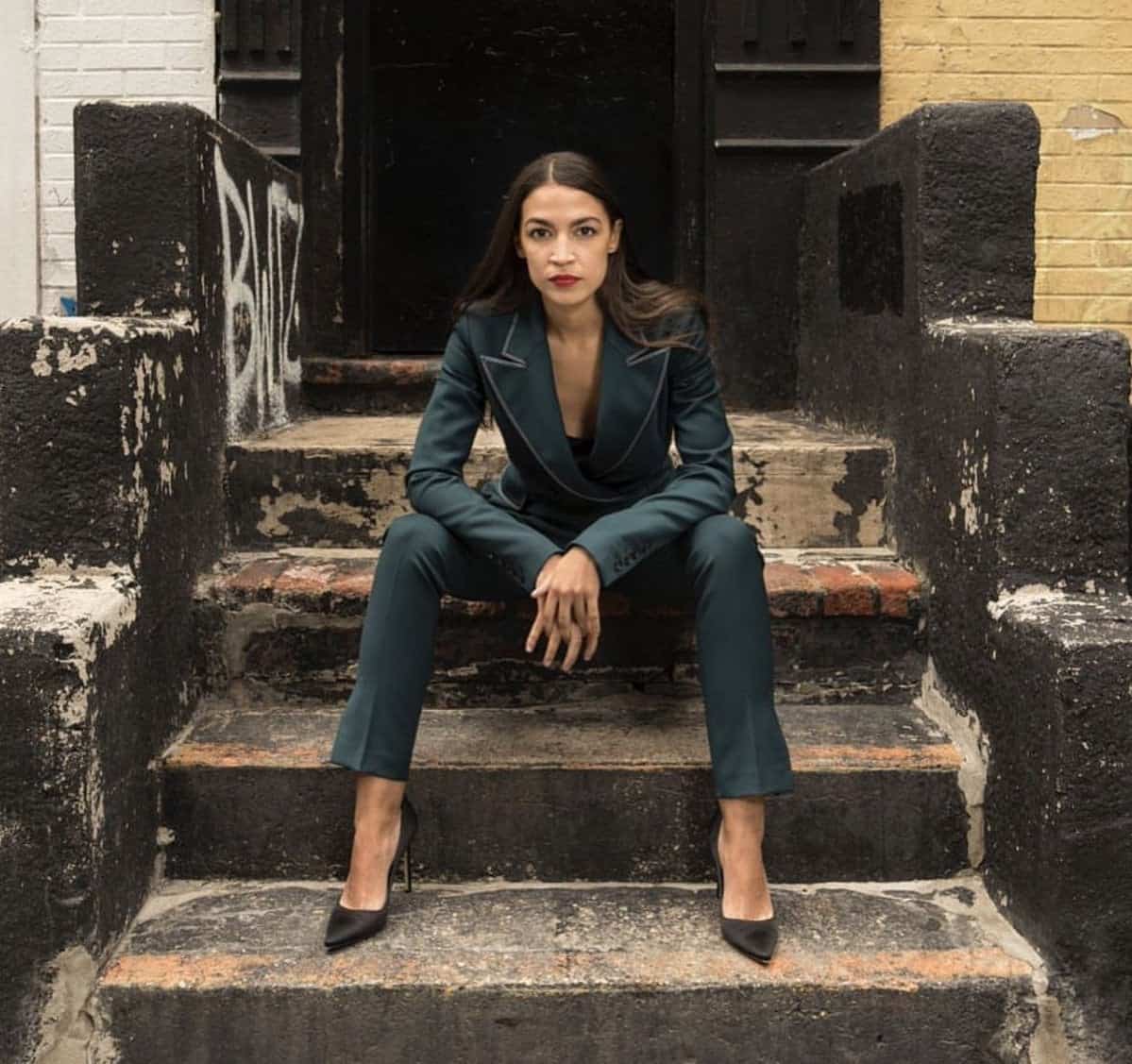
This image features AOC (Alexandria Ocasio-Cortez) sitting on a set of weathered outdoor stairs, striking a pose that is famously associated with the "I'm a human" or "I can't breathe" meme often used in Super Bowl commercials to show a character's intense or humorous side.
The graffiti painted on the wall to her left reads "BUT" and a partially visible "Z," adding to the gritty, urban aesthetic that contrasts with her polished suit.
simple-description (llama3.2-vision_11b)
The meme is a photo of Alexandria Ocasio-Cortez (AOC) sitting on the stairs of the Capitol Building, with a stern expression. The meme is likely referencing AOC's reputation as a fierce and outspoken politician, and the image is captioned "I used to work here".
detailed-analysis (gemma3-27b-vision)
Okay, here's an analysis of the photograph of Alexandria Ocasio-Cortez (AOC) based on the requested theoretical frameworks. It's important to note that applying complex theories to a single image always involves interpretation and can be layered. I'll aim for a detailed breakdown.
Visual Description
The photograph depicts Alexandria Ocasio-Cortez seated on the concrete steps of a brownstone building. She is formally dressed in a dark teal (or emerald green) pantsuit with a low-cut top underneath, paired with black high-heeled pumps. Her hair is styled in loose waves. The lighting is somewhat dramatic, casting shadows and emphasizing her features. The backdrop is a somewhat distressed urban setting – the concrete steps are weathered, and there's some graffiti visible on a nearby wall. The building's entrance is dark and recessed. She is looking directly at the camera with a confident, slightly challenging gaze. The composition emphasizes the contrast between her formal attire and the gritty, urban environment. The pose itself is deliberately assertive, with legs crossed and hands resting on her thighs, conveying a sense of power and groundedness.
Foucauldian Genealogical Discourse Analysis
This image is rich with opportunities for a Foucauldian reading. Foucault’s genealogy explores how power operates through discourse and how meaning is historically constructed.
- Discourse of Power/Representation: The image challenges traditional discourses of political representation. AOC intentionally subverts the usual visual language of power. Politicians are typically depicted in polished settings, emphasizing stability and establishment. Here, she is situated within a ‘real,’ somewhat neglected urban environment, visually aligning herself with the lived experiences of the communities she represents.
- Body as a Site of Power: Her clothing is central to this analysis. The pantsuit traditionally represents male power structures. AOC appropriates it, but subverts it with the lower cut top, introducing a sensuality that challenges the typically asexual presentation of female politicians. This embodies a “reversal of discourse” – using symbols of power to dismantle assumptions about femininity and political authority. Her body is therefore not simply represented but performs power.
- The Gaze and Panoptic Surveillance: AOC’s direct gaze is key. She returns the gaze, rather than being passively observed. This is a deliberate act of agency, refusing the objectification often imposed on women in public life.
- Historical Genealogy: One could trace the genealogy of the "power suit" and its associations with masculinity and corporate authority, then examine how AOC reframes this symbol. The photograph isn’t about timeless authority, but a specific historical moment of disruption and redefinition.
Critical Theory
A Critical Theory approach, rooted in the Frankfurt School, examines how power structures perpetuate domination and inequality.
- Commodification of the Political: The photograph, as a professionally produced image, is itself subject to the forces of commodification. It becomes a visual asset used for branding and political campaigning. This raises questions about the relationship between authenticity and image-making in contemporary politics.
- Challenge to Ideology: The image actively challenges the dominant ideology that associates political leadership with privilege, status, and distance from the everyday lives of ordinary people. AOC’s intentional positioning in a “non-ideal” environment disrupts this ideological construct.
- Representation and the Marginalized: Critical Theory focuses on whose voices are heard and who is marginalized. By situating herself within a working-class urban landscape, AOC visually aligns herself with the communities often excluded from political representation. The image asserts a claim of solidarity and visibility.
Marxist Conflict Theory
From a Marxist perspective, the photograph reveals underlying class tensions and power dynamics.
- Class Representation: The contrast between AOC's clothing and the urban environment signifies a deliberate engagement with class. Her attire signals a certain level of polish and access, while the background evokes economic hardship and neglect. This creates a tension that can be interpreted as an attempt to bridge the gap between different classes.
- Symbolic Capital: Her clothing and confident pose are forms of “symbolic capital” – resources she can leverage in the political arena. However, by juxtaposing this with the decaying urban backdrop, she complicates this notion, suggesting that her power doesn't come from traditional sources of wealth and privilege.
- Power and Control: The decaying building, and the graffiti potentially represent the societal issues that AOC campaigns for. This is a clear signal to the viewer that she acknowledges the problems affecting her constituents and the fact that she wants to change that.
Postmodernism
Postmodernism emphasizes the instability of meaning, the rejection of grand narratives, and the blurring of boundaries.
- Deconstruction of the Political Image: The photograph deconstructs the traditional political image. It doesn’t present AOC as an idealized leader, but as a complex, embodied subject who occupies multiple spaces – a politician, a woman, a person of color, a member of the working class.
- Intertextuality & Pastiche: The image echoes past imagery. The pose and composition could be seen as referencing fashion photography, or iconic images of political leaders. However, it remixes these references, creating a new meaning that is both familiar and subversive.
- Fragmentation of Identity: The image reflects a fragmentation of identity. AOC presents herself as a multifaceted individual, rejecting the idea of a fixed or essential political self.
Queer Feminist Intersectional Analysis
This analysis examines how the photograph intersects with multiple forms of oppression – gender, sexuality, race, and class – and challenges normative power structures.
- Subversion of Gender Norms: Her deliberate choice of attire – a traditionally masculine suit paired with a revealing top – disrupts binary gender norms. It asserts a right to self-expression and challenges the expectation that female politicians must conform to conservative standards of dress.
- Intersectional Identity: AOC’s identity as a Latina woman, her working-class background, and her progressive political views all intersect to create a unique perspective. The photograph visually affirms this intersectionality, challenging dominant narratives of power and representation.
- Challenging the Gaze: The way she returns the gaze disrupts the power dynamic between the viewer and the subject. It resists the objectification and sexualization that women of color often experience.
- Visibility and Resistance: The image asserts the visibility of marginalized communities and challenges the systemic barriers that prevent them from accessing political power. It’s a statement of resistance against patriarchal, racist, and classist structures.
It is important to remember that these interpretations are not definitive, but rather offer possible readings based on these complex theoretical frameworks. The power of the image lies in its ability to evoke multiple meanings and spark critical dialogue.
simple-description (llama3.2-vision)
This meme is an image of Alexandria Ocasio-Cortez, a U.S. politician, sitting on a stoop with a serious expression. The text overlay on the image reads "Me when I'm told I'm not allowed to use the stairs". The meme is likely poking fun at the idea that people are being told to use the stairs instead of the elevator, implying that they are being treated like children.
tesseract-ocr
\emes Hii f oni — — 4 i j 1 eo ae BO eS | | Mie ee rer. 2 mh pm a oe Si Ua ee ae ag ea a "hi eee : ; a i ee 3 BES Pesan ™ eee eg ae aes = * Y M P Lege Te: at ea Pa a ae as ‘ coo waa Sens ce Se. Sie Sg SE on ase Orme tenia Ss 5]