First Seen
2023-11-09T22:03:32+00:00
simple-description (qwen3.5_2b-q8_0)
Visual 1:
A large, orange carrot is completely submerged underwater, with the text "HAVING A SKILL" in bold black letters positioned next to it, aligned vertically. The text is slightly cut off at the bottom.
* Background: Dark, murky water with a hint of light filtering down from the surface.
Visual 2:
A smaller carrot with green leaves sticking out of the water, partially submerged, labeled "HAVING A DEGREE." The roots of the carrot are touching the water, while the green leaves float high above the surface.
* Background: Same dark water environment as Visual 1.
* Text: "HAVING A DEGREE" is written in bold, slightly stylized black font below the carrot.
* Additional text: "UNDERGRADUATE" is written vertically along the right edge of the carrot.
Visual 3:
A carrot fully submerged, labeled "MARRIED" in large, bold, black text.
* Additional text: "COPULA" written vertically along the right edge of the carrot.
* Background: Dark water with light filtering down.
Visual 4:
A carrot fully submerged, labeled "WIFE" in large, bold, black text.
* Additional text: "MASTER" written vertically along the right edge of the carrot.
* Background: Dark water with light filtering down.
Visual 5:
A carrot fully submerged, labeled "SCHOOL" in large, bold, black text.
* Additional text: "BACHELOR" written vertically along the right edge of the carrot.
* Background: Dark water with light filtering down.
Visual 6:
A carrot fully submerged, labeled "CAREER" in large, bold, black text.
* Additional text: "PROFESSIONAL" written vertically along the right edge of the carrot.
* Background: Dark water with light filtering down.
Visual 7:
A carrot fully submerged, labeled "SUCCESS" in large, bold, black text.
* Additional text: "SUCCESSFUL" written vertically along the right edge of the carrot.
* Background: Dark water with light filtering down.
Visual 8:
A carrot fully submerged, labeled "JOB" in large, bold, black text.
* Additional text: "EMPLOYEED" written vertically along the right edge of the carrot.
* Background: Dark water with light filtering down.
Visual 9:
A carrot fully submerged, labeled "HABITAT" in large, bold, black text.
* Additional text: "HUB" written vertically along the right edge of the carrot.
* Background: Dark water with light filtering down.
simple-description (llama3.2-vision_11b)
The meme is a play on the idea that someone with a degree in a field is not necessarily proficient in that field, just like a carrot with a green top (which is actually a parsnip) is not a carrot. The text "I have a degree in this" is often used to imply expertise, but the image shows a parsnip with a green top, implying that someone's degree doesn't necessarily mean they're an expert in the field.
detailed-analysis (gemma3-27b-vision)
Okay, let's break down this meme/image with the theoretical lenses you've requested. It's a rather pointed commentary, so we have several areas to explore.
Visual Description
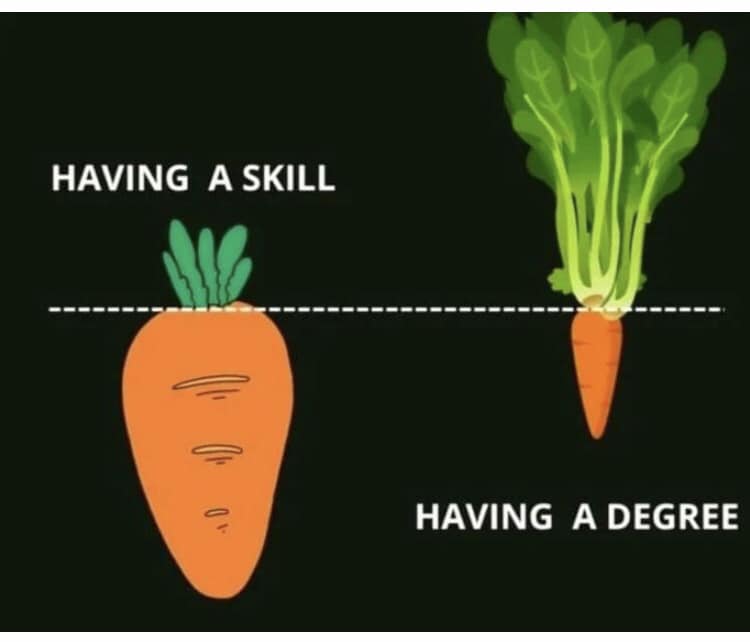
The image is a simple graphic with a stark black background. It features two carrots, horizontally aligned, divided by a dashed white line.
- Left Carrot: This carrot appears "stripped" or "pruned." It's orange, with what appear to be marks or cuts representing "experience" or "skill development." Text above it reads “HAVING A SKILL.”
- Right Carrot: This carrot is a full carrot, complete with its leafy green top. It appears "whole" and "complete." Text below it reads “HAVING A DEGREE.”
The visual contrast highlights the difference between a carrot that has been used – implying skill gained through practice – and one that is simply "fully formed" implying a complete (though potentially unused) education.
Foucauldian Genealogical Discourse Analysis
This image is rife with potential for Foucauldian analysis. Foucault would be interested in the power dynamics embedded in how we define and value knowledge.
- Discourse of Education: The image challenges the dominant discourse surrounding education as the primary or sole source of competence. The 'degree' carrot is presented as something "given" or "inherent," rather than earned through the application of knowledge. This implicitly critiques the way education has been historically presented as inherently valuable, regardless of its practical application.
- Power/Knowledge: The image illustrates how power operates through knowledge systems. The institution of "degrees" is a powerful mechanism for controlling access to opportunity and legitimizing certain forms of knowledge over others (specifically, practical knowledge). The pruned carrot represents a form of "know-how" that’s often dismissed or devalued in favor of formal credentials.
- Genealogy: A genealogical analysis would trace the historical evolution of the "degree" as a symbol of authority. The image invites us to consider how the emphasis on degrees came to be, and the historical shifts that have made them so vital in modern society. It questions whether this emphasis has eclipsed other valid forms of learning.
Critical Theory
From a critical theory perspective (drawing upon thinkers like Horkheimer and Adorno), this image can be understood as a critique of instrumental reason and the reification of education.
- Instrumental Reason: The image suggests that formal education has become a means to an end (securing a job, status), rather than an end in itself (cultivating critical thinking, knowledge for its own sake). The “whole” carrot represents this obsession with having the credential, without necessarily possessing the practical ability to do something.
- Reification: The degree is reified – treated as a tangible, inherently valuable object, rather than a symbolic representation of learning. This reification obscures the fact that true competence comes from applying knowledge, not merely possessing a piece of paper.
- Culture Industry: We could even extend this to see the degree as part of a “culture industry” that produces standardized products (degrees) that are valued more for their brand name than their actual quality.
Marxist Conflict Theory
A Marxist lens highlights the class dynamics at play.
- Capital: Degrees, as markers of "human capital," function within a capitalist system to stratify the labor market. The image suggests that those with degrees have a privileged position, even if they lack practical skills, while those with skills developed through experience may be disadvantaged.
- Class Struggle: The image could be read as a commentary on the struggle between those who have access to formal education (the bourgeoisie) and those who rely on practical skills (the proletariat). It questions whether the education system is truly a meritocracy, or whether it perpetuates existing inequalities.
- Alienation: Those who only possess a degree, without practical skills, could be seen as alienated from the true value of labor. The full carrot represents theoretical knowledge without the experience to apply it, which may be unproductive.
Postmodernism
From a postmodern perspective, this image challenges grand narratives and the notion of objective truth.
- Deconstruction: The image deconstructs the traditional notion of education as the sole path to competence. It reveals that skill, experience, and practical knowledge are equally (if not more) valuable.
- Relativism: It implies that there is no single "right" way to learn or to demonstrate competence. Both the “pruned” carrot and the “whole” carrot have their own value, depending on the context.
- Simulacra & Simulation: The degree itself can be viewed as a simulacrum – a copy without an original. It represents a symbol of knowledge, rather than actual knowledge itself. The focus shifts from the reality of competence to the representation of competence.
Queer Feminist Intersectional Analysis
This is where things get more complex, as the image isn't explicitly feminist or queer. But we can apply the principles:
- Intersectionality: A queer feminist analysis would consider how access to education (and the valuation of different forms of knowledge) intersects with other forms of oppression – race, class, gender, sexuality. For example, marginalized groups may face greater barriers to accessing formal education, and their skills and experiences may be devalued. Think about the skills historically valued in different genders and social classes.
- Challenging Norms: The image implicitly challenges the patriarchal norms that often prioritize formal credentials over lived experience. It disrupts the idea that "success" is defined by achieving a degree, and instead invites us to consider alternative definitions of competence.
- Subversion: The image subtly subverts the traditional power dynamics associated with education. It suggests that practical skills – often associated with marginalized communities – are equally valuable, and deserve recognition.
Disclaimer: These interpretations are based on the visual elements and the potential implications of the image. The meaning of a meme/image is always open to interpretation, and this is just one possible analysis.
simple-description (llama3.2-vision)
The meme is a humorous comparison between having a skill and having a degree. It depicts two carrots, one labeled "Having a Skill" and the other "Having a Degree". The "Having a Skill" carrot is shown to be a deep and complex root, whereas the "Having a Degree" carrot is only a few inches deep, implying that having a degree is not as valuable as having a real skill.
tesseract-ocr
HAVING A SKILL ) = HAVING A DEGREE