First Seen
2023-11-07T23:47:38+00:00
simple-description (qwen3.5_2b-q8_0)
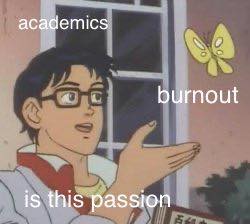
In this meme, a student character with glasses is shown holding a book, likely symbolizing "passion" as labeled by the text at the bottom. However, the word "burnout" floats near a butterfly and "academics" is simply labeled in the corner, creating an ironic contrast. The caption "is this passion" asks the viewer if studying hard and working on these projects is a worthwhile sacrifice, or if the sheer volume of coursework has drained the student's mental health.
simple-description (llama3.2-vision_11b)
The meme is a humorous representation of the struggles of being a student or academic, where the speaker is saying that "academia" is their "love/hate relationship" or "passion" that they are "obsessed" with, but also "hates" it. The text "academia" is written in a bold, playful font, and the phrase "is this love/hate relationship" is written in a smaller, more casual font above it. The image itself is likely a cartoon or illustration of a person looking frustrated or overwhelmed, with a caption or speech bubble that says "academia is my love/hate relationship".
detailed-analysis (gemma3-27b-vision)
Okay, let's break down this meme through several theoretical lenses.
Visual Description
The image is a still from an anime, depicting a young man with glasses, looking upwards with a questioning expression. His hands are open in a gesture that suggests assessment or a struggle to understand. Above his head is the word "burnout," and to the side is the word "academics". Below him is the phrase "is this passion?". The contrast between the hopeful/questioning gesture and the labeling creates an ironic effect, highlighting a feeling of disorientation. The color palette is muted, which can add to the feelings of melancholy.
Foucauldian Genealogical Discourse Analysis
This meme exemplifies a rupture in discourse around labor and self-identification within the academic sphere. Foucault would be interested in how the very concept of "passion" became entwined with academic work.
- Discourse of Passion: Examining historical practices within academia reveals how "passion" was constructed as a productive force. The rhetoric of “loving what you do” is not neutral. It functions as a disciplinary technique, internalizing the demands of research and teaching. It naturalizes precarity—the idea that academic labor should be pursued despite the difficulties, because it is driven by internal passion, not external compensation.
- Genealogy of Burnout: The label "burnout" traces a historical shift. Traditionally, exhaustion or overwork were simply recognized as the costs of labor. But the naming of burnout as a specific condition—a syndrome—is a recent phenomenon. It reflects a discursive move to individualize the problem of overwork and psychological distress. The discourse of burnout appears to address systemic issues but ultimately places the onus on the individual to "manage" stress.
- Power/Knowledge: The meme exposes the power/knowledge dynamic inherent in academia. The expectation of “passion” becomes a means of control—a way to extract maximum labor while minimizing complaints. The questioning face demonstrates a growing awareness of this dynamic—a challenge to the dominant discourse.
Critical Theory
This meme speaks directly to the concerns of the Frankfurt School's Critical Theory, particularly the concept of the "culture industry."
- False Consciousness: The meme highlights a kind of "false consciousness." The prevailing ideology within academia positions labor as inherently meaningful and fulfilling if one is "passionate" about their work. This obscures the realities of exploitative labor practices, diminishing salaries, and relentless pressure to publish.
- Commodification of Affect: "Passion" itself becomes a commodity. The expectation that academics should be driven by passion not only normalizes overwork but also transforms internal emotional states into a resource for the university/institution.
- The Illusion of Fulfillment: The meme illustrates the gap between the ideal (fulfilling work driven by passion) and the reality (burnout and exhaustion). Critical theory would argue this gap is a consequence of the capitalist system's ability to create illusions of fulfillment that mask exploitative conditions.
Marxist Conflict Theory
From a Marxist perspective, the meme encapsulates the inherent contradictions within academic labor.
- Alienation: The academic, presented in the meme, experiences alienation—a separation from the fruits of their labor. They produce knowledge, but that knowledge is not necessarily accessible or beneficial to them, and their contributions often go unrecognized or undercompensated.
- Class Struggle: The meme implicitly acknowledges the power dynamic between academics and the university system, which operates within a broader capitalist framework. The demand for "passion" serves to mask the exploitative nature of their work, reinforcing class structures.
- Surplus Value: The expectation of passion allows the university to extract "surplus value" from academic labor. They benefit from the intellectual output without adequately compensating the academics who produce it.
Postmodernism
A postmodern reading would focus on the fragmentation of meaning and the questioning of grand narratives.
- Deconstruction of "Passion": The meme deconstructs the concept of "passion" by placing it alongside "burnout." It suggests that passion is not a stable, intrinsic state but a socially constructed concept used to legitimize exploitative work conditions.
- Loss of Authenticity: The questioning expression highlights a sense of disillusionment. It challenges the notion of authentic selfhood. The "passion" label is revealed as an empty signifier.
- Simulation & Hyperreality: The expectation of passion could be seen as a simulation—a surface-level appeal that obscures the underlying realities of academic life. It creates a hyperreality where labor is presented as intrinsically fulfilling.
Queer Feminist Intersectional Analysis
This meme can be analyzed through the lens of intersectionality, considering how gender, sexuality, and other social categories intersect with academic labor and burnout.
- Gendered Expectations: Women and non-binary individuals in academia often face additional pressures to be "passionate" and "nurturing" in their roles. These expectations can contribute to higher rates of burnout.
- Emotional Labor: Academic work often requires significant emotional labor – managing student concerns, navigating institutional politics, and performing a public persona of enthusiasm. These expectations are often gendered.
- Marginalized Identities & Exhaustion: Academics from marginalized groups may face additional barriers and microaggressions, leading to increased stress and burnout. The expectation of passion can further exacerbate these issues by implying that if they are struggling, it is because they are not "passionate" enough.
- Challenging the "Ideal Worker": The meme implicitly challenges the "ideal worker" norm in academia – a norm that often prioritizes endless productivity and dedication to the job. This norm is frequently built upon gendered and racialized expectations.
Let me know if you'd like me to elaborate on any of these interpretations!
simple-description (llama3.2-vision)
The meme features a character from the anime "Cardcass " holding a butterfly. The text "academics" is written above the character's hand, and "burnout" is written above the butterfly. The character is holding the butterfly, and the text "is this passion" is written below the character's hand. The meme is a humorous commentary on the idea that academic work can be both passion- and burnout- – – – – – – – – – – – – – – – – – – – – – – – – – – – – – – – – –
tesseract-ocr
on a\y ® Sa ' A Van oa ¥¢ NC \ SS a\ ipa