First Seen
2025-04-28T01:58:55.787762+00:00
simple-description (qwen3.5_2b-q8_0)
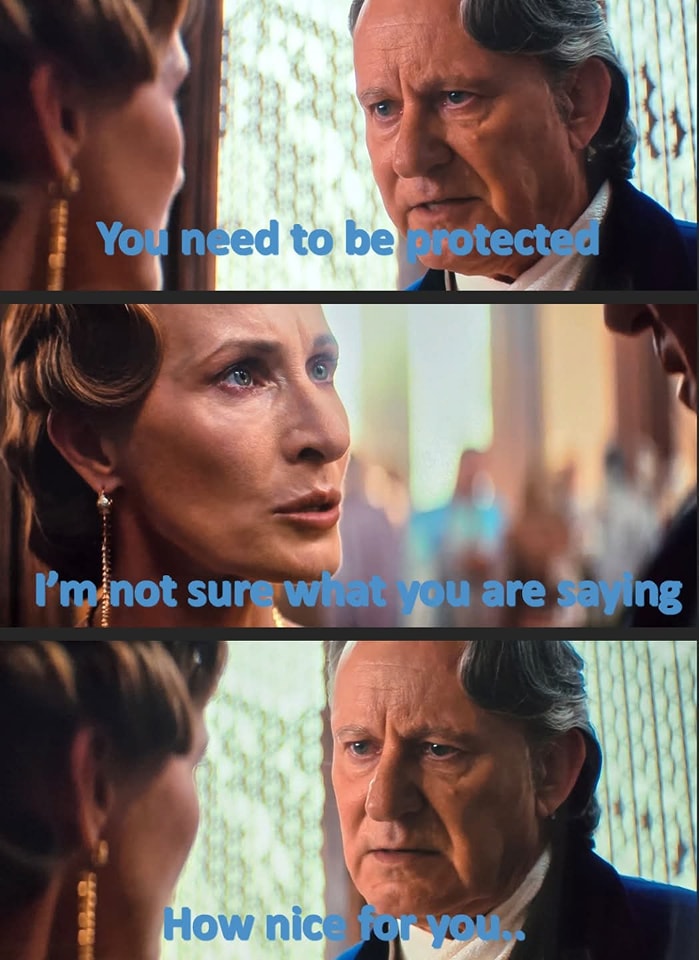
This meme illustrates the accelerationist view that society is moving inevitably toward a state of greater complexity. It depicts a figure telling someone, "You need to be protected" and "I'm not sure what you are saying," implying that to continue moving forward, one must be shielded from the present struggles. The punchline, "How nice for you..," sarcastically implies that the authority believes this transition is so superior that the current confusion of the individual is merely a "nice" thing.
detailed-analysis (gemma3_27b-it-q8_0)
Okay, let's analyze this meme from an accelerationist perspective, incorporating relevant theoretical frameworks where applicable. It’s a rich meme for this analysis, leaning heavily into ideas of engineered collapse, the inadequacy of liberal responses, and the seductive power of a radical “solution.”
Visual Description
The meme consists of three panels taken from a scene in the movie The Menu. The scene features Margot (Anya Taylor-Joy), a guest at a highly exclusive, remote restaurant, speaking with Chef Julian Slowik (Ralph Fiennes).
- Panel 1: Chef Slowik leans in close to Margot, saying “You need to be protected.” He conveys an intense, almost predatory demeanor.
- Panel 2: Margot responds with a confused, skeptical expression, stating, "I'm not sure what you are saying." She appears genuinely bewildered and resistant to his implication.
- Panel 3: Chef Slowik's expression shifts to a subtly condescending and sinister smile as he delivers the line “How nice for you.” His gaze is direct and unsettling.
Accelerationism and the Meme's Core Argument
From an accelerationist viewpoint, this meme encapsulates the futility of attempting to reason with a system that needs to break down. Accelerationism, broadly, argues that the only way to overcome capitalism (or other oppressive systems) is not through gradual reform, but by exacerbating its inherent contradictions until it collapses. The meme powerfully represents this dynamic.
Chef Slowik is the accelerative force. He isn’t offering a solution within the existing framework. He’s deliberately dismantling the established order (the elaborate, exclusive restaurant representing a microcosm of wealth and privilege). Margot represents the liberal mindset – the attempt to understand, negotiate, and find a rational solution within the system. Her response ("I’m not sure what you are saying") is a representation of the liberal inability to grasp the necessity of radical change.
Chef Slowik's final line, "How nice for you," is key. It’s not a genuine offer of kindness. It's a contemptuous dismissal of her naive position. It's a signifier of the inevitability of her destruction as a component of the system's breakdown. From an accelerationist lens, Margot shouldn't understand; her lack of understanding demonstrates her complicity in a flawed system.
Foucauldian Genealogical Discourse Analysis
Michel Foucault’s genealogical method is useful here. The meme speaks to a discourse of power and control. Chef Slowik doesn’t operate through traditional power structures (law, government). He creates his own power dynamic, a biopolitical one where he controls the lives and deaths of his guests. The restaurant, as a setting, becomes a panoptic space where his gaze exerts control.
The 'protection' Slowik offers isn’t about safety, but about control within the process of destruction. He’s not trying to prevent harm; he's directing it, managing it. This aligns with Foucault's concept of power as not simply repressive, but also productive – producing new subjectivities and relationships through discipline and surveillance. The meme demonstrates how even the appearance of care (protection) can be a tool of control in a power dynamic.
Critical Theory
Drawing on the Frankfurt School, we can see the restaurant representing a totalizing system of rationalization and reification. The "gourmet" experience and the meticulous control of the environment are examples of instrumental reason gone awry. It’s a critique of the commodification of experience and the dehumanizing effects of late-stage capitalism.
Chef Slowik's project isn’t merely about food; it's about exposing the emptiness and moral bankruptcy beneath the veneer of luxury and refinement. Margot's initial bewilderment reflects a failure to critically engage with the system – she’s absorbed the dominant ideology and cannot see its inherent flaws.
Marxist Conflict Theory
The scene clearly displays class conflict. The guests, representing the wealthy elite, are entirely disconnected from the labor and resources that sustain their lifestyle. Chef Slowik, a disillusioned artist and formerly passionate chef, enacts a violent critique of this exploitation. The 'protection' he offers is not to save them but to highlight their dependency on his labor and the system's inherent instability.
The restaurant is a microcosm of the capitalist mode of production, with the Chef as the alienated producer and the guests as the consuming class. The breakdown of the restaurant is a metaphor for the potential breakdown of the capitalist system itself.
Postmodernism
While accelerationism isn't inherently postmodern, it shares a skepticism towards grand narratives and a willingness to embrace disruptive forces. The meme’s effectiveness comes from its rejection of traditional storytelling. There isn’t a clear "hero" or a simple resolution. The chef’s actions are deliberately ambiguous and unsettling.
The dialogue relies on irony and a subversion of expectations. The phrase "You need to be protected" is typically associated with care and concern, but here it’s a prelude to destruction. This destabilization of meaning is a hallmark of postmodern thought.
In essence, the meme resonates with accelerationist thought because it captures the dynamic of a system moving towards inevitable collapse, and the futility of attempts to salvage it through conventional means. It's a dark, provocative image that revels in the destructive potential of radical change, and embraces the chaos inherent in the breakdown of the existing order.
simple-description (llama3.2-vision_11b)
The meme is a screenshot from the movie "The Princess Bride" where a character, Inigo, says "Inconceivable!" in response to a question about a specific situation. The meme is used to express the idea that a situation is so absurd or impossible that it's "inconceivable".
detailed-analysis (gemma3-27b-vision)
Okay, here's an analysis of the provided image, broken down into sections based on the requested theoretical frameworks. I'll indicate where a particular framework doesn't directly apply as well. I'll assume this is a still from a period drama (potentially Downton Abbey, based on the aesthetic), which will inform the interpretations.
Visual Description
The image is a composite of three vertically arranged frames showing a close-up conversation between two characters—an older man and a younger woman.
- Characters: The man is older, with graying hair and wearing a formal blue suit, suggesting a position of authority or wealth. The woman has reddish-brown hair and is dressed in a formal, but perhaps less opulent, style. Her facial expression is a mix of confusion and apprehension.
- Setting: The background appears to be an ornate interior—a grand hallway or drawing-room—with patterned wallpaper and architectural detailing. The lighting is somewhat soft, creating a slightly dramatic atmosphere.
- Composition: The shots focus tightly on the faces of the characters, emphasizing their emotional expressions and the intimacy (or tension) of the exchange. The vertical arrangement of the frames suggests a sequence, building in intensity.
- Text Overlays: Text has been added in blue to the image, ostensibly representing dialogue: “You need to be protected,” “I'm not sure what you are saying,” and “How nice for you.” These phrases are crucial to the interpretation.
Foucauldian Genealogical Discourse Analysis
This framework is highly applicable due to the themes of power, protection, and control embedded in the dialogue and implied dynamic.
- Discourse of Protection: The phrase "You need to be protected" isn't a simple act of kindness, but a discursive practice. It implies a power imbalance where the man positions himself as the protector and the woman as the one in need of protection. This constructs a specific understanding of gender roles, vulnerability, and agency. The discourse creates the need it purports to address.
- Power/Knowledge: The man’s assertion of needing to “protect” is an exercise of power through knowledge. He (implicitly) claims to know what dangers the woman faces and what is best for her. This reinforces a patriarchal structure where men are seen as rational protectors and women as needing guardianship.
- Genealogy of Control: Tracing the historical development of the concept of "protection" reveals how it has often been used to control women’s lives, limit their freedoms, and justify interventions in their agency. This isn’t simply about physical safety; it's about social and ideological control.
- The Cynical Response: The man’s final line, “How nice for you,” is particularly telling. It's dismissive, potentially condescending, and suggests a lack of genuine concern. It reveals the power dynamics at play—he is not truly offering care but exerting control.
Critical Theory
Critical Theory, particularly within the Frankfurt School tradition, can illuminate the broader social and political implications of this interaction.
- Ideology: The exchange can be seen as reinforcing dominant ideologies about gender, class, and power. The man's statement positions himself as the rational, controlling force, while the woman is implicitly constructed as vulnerable and needing guidance. This perpetuates a hierarchical social structure.
- Domination and Subjugation: The dialogue is indicative of a power imbalance, where the man attempts to assert control over the woman's life. This dynamic can be seen as a microcosm of broader societal patterns of domination and subjugation.
- False Consciousness: The woman’s initial confusion (“I’m not sure what you are saying”) suggests that she may not be fully aware of the power dynamics at play. The man's subtly manipulative language could be contributing to a state of “false consciousness,” preventing her from recognizing her own agency.
Marxist Conflict Theory
While not as central as the previous frameworks, Marxist Conflict Theory can offer insights, particularly if we assume a class dimension to the relationship.
- Power and Class: If the man represents a higher social class, his "protection" could be linked to maintaining the existing social order. By controlling the woman's actions and opportunities, he might be reinforcing class boundaries and preserving his own privilege.
- Exploitation: While not explicitly visible, the exchange could hint at underlying power dynamics where the man exploits his position to control the woman's life. This exploitation may not be material (economic) but social and emotional.
- Ideological Control: The “protection” rhetoric could be a form of ideological control, used to justify the man’s dominance and maintain the status quo.
Postmodernism
Postmodernism’s application is more nuanced.
- Deconstruction of Power: A postmodern reading might focus on deconstructing the seemingly straightforward power dynamic. By questioning the assumptions underlying the concepts of "protection" and "vulnerability," one could reveal the arbitrary nature of these categories.
- Unreliable Narrator: While the image is static, the dialogue implies a narrative. A postmodern analysis could focus on the unreliability of this narrative, recognizing that the words and gestures are filtered through subjective perceptions.
- Simulacra and Simulation: The idea of “protection” itself might be seen as a simulacrum – a copy without an original, a representation that obscures the underlying power dynamics.
Queer Feminist Intersectional Analysis
This framework is potentially applicable, though more reliant on contextual information beyond the image.
- Gendered Power Dynamics: The exchange clearly highlights gendered power dynamics. The man’s offer of “protection” reinforces traditional patriarchal norms and positions the woman as vulnerable and needing guidance.
- Intersectional Considerations: Without knowing more about the characters' backgrounds, it's difficult to apply intersectionality fully. However, if the woman is marginalized in other ways (e.g., by race, class, or sexuality), the power imbalance could be exacerbated.
- Challenging Protection as Control: A queer feminist perspective would likely challenge the notion of “protection” as a benevolent act, recognizing how it can be used as a tool for control and oppression. The woman's confusion might signal a resistance to this control.
In summary, the image, combined with the dialogue, is rich in meaning and can be interpreted through a variety of theoretical frameworks. The Foucauldian and Critical Theory perspectives seem particularly relevant, as they illuminate the power dynamics, ideological underpinnings, and potential for control embedded in the exchange.
simple-description (llama3.2-vision)
The meme is a quote from the 2012 film "The Dark Knight" where the character of Jor is . The quote is about how someone can be both mean and nice at the same time. The quote is: "You need to be protected. I'm not sure what you are saying. How nice for you."