First Seen
2023-08-15T00:58:04+00:00
simple-description (qwen3.5_2b-q8_0)
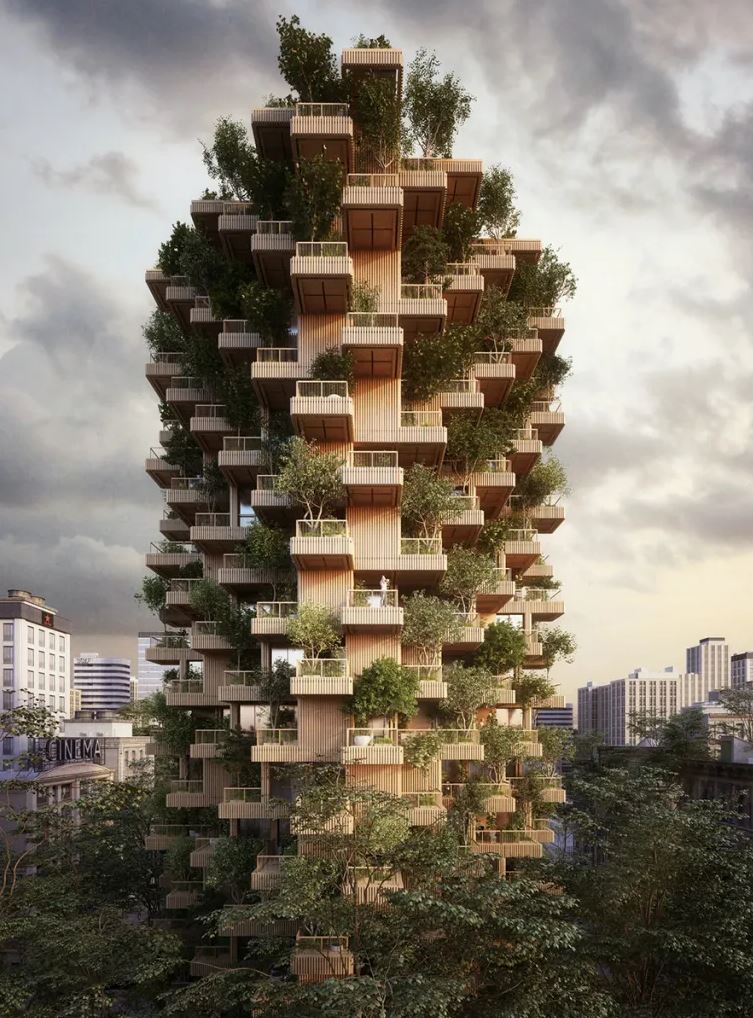
"Cottagecore" is a fantasy art style that celebrates a life close to nature, rural simplicity, and a romantic view of the countryside. The meme is illustrated by the "Forest Tower," a tall skyscraper covered in trees and wooden balconies that looks like a giant, vertical green tree. It represents the dream of living in a lush, peaceful forest city where you can watch the world grow around you, rather than just living inside a concrete building. You can also see the word "CINEMA" printed on a building to the left.
simple-description (llama3.2-vision_11b)
The meme is a picture of a futuristic, towering city made entirely of trees, with a sprawling metropolis at its base and a lush forest at its top. The image is captioned "tree of life" and features a quote from the movie "Avatar" - "I see you". The meme is a humorous commentary on the contrast between the natural world and the urban jungle, using a fantastical and futuristic cityscape to poke fun at the idea of a "tree of life" as a symbol of human connection to nature.
detailed-analysis (gemma3-27b-vision)
Okay, let's break down this image through various critical lenses. Here's an analysis divided into the sections you requested, noting where specific lenses don't strongly apply.
1. Visual Description
The image depicts a strikingly modern, high-rise residential building. Its most defining characteristic is its layered, terraced design, covered in lush vegetation. Each floor features protruding balconies or terraces, creating a stepped effect. These terraces are densely planted with various trees and shrubbery, giving the building a biophilic, almost organic aesthetic. The building’s façade appears to be constructed from warm-toned wood or a wood-like material.
The structure is juxtaposed against a gray, somewhat stormy sky and is surrounded by other urban buildings in the background, though those are significantly less visually prominent. The lighting is dramatic, with some areas of the building illuminated and others shadowed, creating a sense of depth and texture. The foreground is filled with foliage as well, further emphasizing the integration of nature. The building’s scale is impressive, indicating a substantial residential capacity. The image conveys a sense of harmonious coexistence between urban living and the natural world.
2. Foucauldian Genealogical Discourse Analysis
This building can be examined through a Foucauldian lens as an articulation of shifting discourses around housing, urban planning, and "nature." The image doesn't present nature as separate from urban space. Instead, it produces a new discourse where nature is fully integrated into the architecture.
- Power/Knowledge: Historically, urban planning operated under a specific power/knowledge regime. This regime often separated the "natural" from the "built." Parks were additions to cities, not integral components. This image disrupts that discourse. It suggests a new regime where the natural world is not simply contained within green spaces, but becomes the defining characteristic of urban dwellings.
- Disciplinary Power: We can ask: what disciplinary effect does this building have? Does it encourage a specific way of life – one centered around care for plants, a connection to nature, a specific aesthetic? It could be seen as subtly shaping the residents' behaviors and even identities.
- Genealogy: Looking at the genealogy, we might trace the origins of this design philosophy to earlier movements (like Garden Cities, Art Nouveau) and see how it breaks from earlier modernist notions of concrete and steel dominance. It represents a historical shift in how we envision urban living.
- Truth Regimes: This building can be seen as actively constructing a new “truth” about how we can (and should) live – one where sustainability and connection to nature are paramount. It challenges the historically dominant truth regime that prioritized industrial growth and separation from the natural world.
3. Critical Theory (Frankfurt School)
Applying critical theory, particularly from the Frankfurt School, we can see this building as potentially representing both progress and a form of ideological manipulation.
- Commodification of Nature: The image could be critiqued for commodifying nature. Is the integration of vegetation merely an aesthetic gesture, a way to sell "luxury eco-living," rather than a genuine commitment to ecological sustainability? This building might become a symbol of 'greenwashing.'
- Technological Rationality: The building’s construction, however "organic" in appearance, is still reliant on advanced technology and engineering. It could be argued that it perpetuates the dominance of instrumental reason – solving a problem (urban environmental degradation) through technological solutions without questioning the underlying system that created the problem.
- False Consciousness: While appearing progressive, the building might actually reinforce existing power structures. Does it address the root causes of environmental injustice? Or does it simply provide a visually appealing solution for those who can afford it, while leaving systemic inequalities untouched?
4. Marxist Conflict Theory
From a Marxist perspective, this building is fascinating:
- Class and Access: The most immediate analysis is around access. Who will be able to afford to live in such a building? It's almost certainly a luxury development, intensifying the disparity between those who have access to sustainable, aesthetically pleasing living environments and those who don't. It’s a visible symbol of class inequality.
- Capital and Nature: The building represents the capitalization of nature. The trees and vegetation aren't valued for their intrinsic ecological worth, but as aesthetic amenities that increase property value and generate profit. It embodies the ongoing commodification of the natural world.
- Control of Space: The architecture itself can be seen as an assertion of control over space – creating a desirable, exclusive environment for the wealthy while potentially displacing lower-income communities.
- Means of Production: The materials used, the construction process, and the ownership of the building are all linked to the means of production and the distribution of wealth.
5. Postmodernism
This building strongly embodies postmodern principles:
- Deconstruction of Form: The stepped, layered design rejects the rigid, monolithic forms of modernist architecture. It breaks down the traditional hierarchy of building elements.
- Hybridity: The blending of nature and architecture represents a hybridity of form and function. It's not simply a building with plants; the plants are integral to its very structure.
- Playfulness and Irony: There's a playful quality to the design. It rejects the earnestness of earlier architectural styles.
- Rejection of Grand Narratives: The building doesn't subscribe to any single, overarching vision of urban utopia. It's a fragmented, eclectic design that acknowledges the complexity and ambiguity of modern life.
- Simulacra & Simulation: It presents a simulated "natural" environment within the urban context, blurring the lines between the real and the artificial.
6. Queer Feminist Intersectional Analysis
This analysis is more nuanced, but still relevant:
- Space & Inclusivity: Does the architecture foster a sense of inclusivity and safety for diverse bodies and identities? While seemingly welcoming, the luxury aspect could automatically exclude many.
- Care & Nurturing: The emphasis on vegetation can be interpreted through a feminist lens, as a recognition of the importance of care, nurturing, and connection to the natural world – qualities historically associated with feminine roles.
- Intersectionality: Consider the intersection of class, race, and gender in access to this space. It's likely that the benefits of this design will disproportionately accrue to privileged groups.
- Challenging Traditional Structures: The non-linear, organic form of the building can be seen as challenging the rigid, patriarchal structures that have historically dominated urban planning.
I hope this detailed analysis provides a comprehensive exploration of the image from various critical perspectives! Let me know if you’d like me to elaborate on any of these points.
simple-description (llama3.2-vision)
The meme is an image of a futuristic, towering skyscraper made entirely of books, with a massive, glowing "I" in the center of the building. The image is accompanied by the text "I" and the caption "I". The meme is likely a humorous commentary on the idea that a single, self-identifying "I" can be the entire foundation of a massive, complex structure.
tesseract-ocr
> a . ” ks fe al P ja a a . pe sn mw F = + a ae ry » Cee, £ x & ell sil oh =e mi ea _ a r gs lla. ‘ a iy a i: ae a ae a gi See tli alii oo a Re lll ae Pus eee ee ead Gas oa | ) an oa “ sg! ae ee ares ‘ee oS ; ; hoe : ae = : EY (ue Se “ee See