First Seen
2023-08-15T01:00:34+00:00
simple-description (qwen3.5_2b-q8_0)
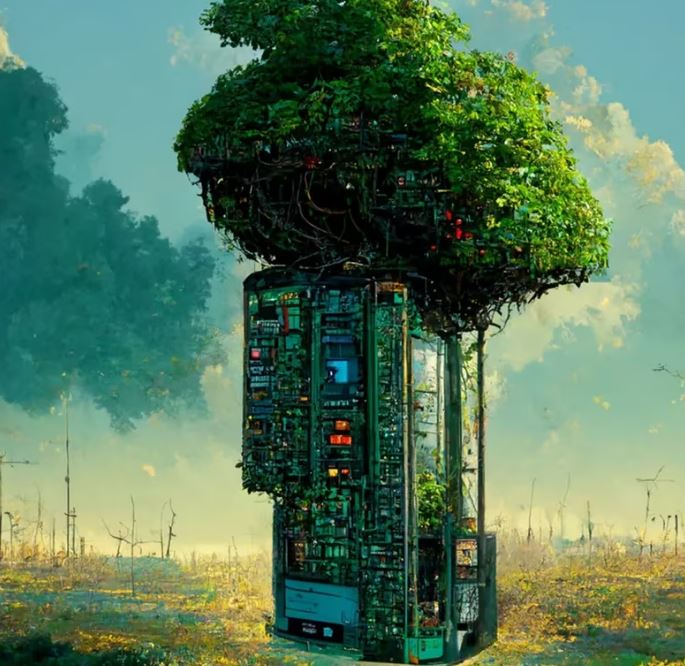
This meme plays into the cottagecore concept of merging technology with nature, turning a sleek, cold server farm into a living, organic tree. It suggests a harmony between the digital and the physical, as if the electronics are growing vines and taking over a peaceful, rural landscape. The device features glowing screens and orange lights, but now stands as a strange part of the natural world, embodying the cozy, whimsical feel of blending high tech with a fairy-tale garden.
simple-description (llama3.2-vision_11b)
The meme is an image of a cottagecore-inspired scene, featuring a whimsical, overgrown cottage surrounded by lush greenery, with a large tree growing out of the roof. The image is captioned "I'm not lazy, I'm just reforesting". This meme pokes fun at the idea of being lazy, instead embracing a more environmentally-friendly and whimsical approach to life.
detailed-analysis (gemma3-27b-vision)
Okay, let's break down this striking image through the lenses you’ve requested. It's a complex image, so not all sections will be equally robust – some will be more directly applicable than others.
Visual Description
The image depicts a towering, rectangular structure resembling a server rack or large electrical panel, rendered in shades of teal and adorned with a dense network of wiring, lights, and other electronic components. The most striking element is a fully formed, lush green tree growing out of the top of this structure. The tree appears almost organically connected, as if born directly from the technology.
The background is a desolate, barren landscape with dry, yellowish grass and skeletal remains of what could be trees or structures stretching into the distance. A cloudy, slightly ominous sky looms above. There’s a sense of industrial decay meeting organic renewal, a juxtaposition that is central to the image's power. The color palette is cool, with the teal of the technology contrasting with the vibrant green of the tree, and the warm, muted tones of the landscape. The overall effect is slightly surreal and thought-provoking.
Foucauldian Genealogical Discourse Analysis
This image lends itself well to a Foucauldian analysis. The server rack represents a system of power/knowledge. Foucault argued that power isn’t simply repressive, but productive – it creates and shapes knowledge, discourses, and even our very selves.
The server rack, as a symbol of information technology, embodies modern forms of power. It's a container of data, algorithms, and control. The tree emerging from it can be interpreted as a resistance to this control – a reclaiming of the natural from within the systems designed to dominate it.
A genealogical analysis would trace the history of the relationship between technology and nature. How has the discourse around these two concepts shifted over time? How have technological advancements been framed as “progress” while simultaneously contributing to environmental degradation? The image can be seen as revealing the contradictions inherent in this historical process.
The very visibility of this relationship – the tree growing out of the technology – destabilizes the presumed separation between nature and culture, between the “natural” and the “artificial.” It challenges the established discourses that maintain this separation.
Critical Theory
Following in the vein of the Frankfurt School's critical theory, the image is a critique of the instrumental rationality of modernity. The server rack embodies the technological drive to control and exploit nature, reducing it to a resource for human use. The tree, however, represents a challenge to this logic.
The image suggests that technology, rather than liberating humanity, may have become a form of domination – both over nature and potentially over ourselves. The desolate landscape could be interpreted as the consequence of this domination – a world depleted and scarred by technological “progress.”
The juxtaposition of technology and nature forces a reconsideration of the concept of “nature” itself. Is nature something separate from and external to humanity, or is it integral to our very being? The image implicitly argues for the latter, suggesting that the health of the planet is inextricably linked to our own well-being.
Marxist Conflict Theory
From a Marxist perspective, the image can be seen as a representation of the conflict between the forces of production (technology, represented by the server rack) and the relations of production (the environment/nature).
The server rack, in this view, symbolizes the capitalist drive for accumulation and exploitation of natural resources. The tree growing from it can be interpreted as a sign of nature resisting this exploitation, asserting its own agency.
The desolate landscape suggests the ecological consequences of capitalist production – pollution, deforestation, and climate change. The image implicitly critiques the inherent contradictions of a system that prioritizes profit over ecological sustainability.
The contrast also highlights a power imbalance. The server rack is a product of human labor and control, while the tree represents the uncompensated labor of nature. This imbalance, from a Marxist standpoint, is a key feature of capitalist exploitation.
Postmodernism
The image certainly resonates with postmodern sensibilities. The juxtaposition of technology and nature is inherently deconstructive – it challenges the traditional binary oppositions that structure our understanding of the world.
The image rejects the idea of a singular, overarching narrative of progress. The desolate landscape suggests that “progress” may come at a significant cost, and that the benefits of technology are not universally shared.
The image’s ambiguity and open-endedness also align with postmodern aesthetics. It does not offer a clear or definitive interpretation, but instead invites viewers to construct their own meaning. The lack of clear context adds to the ambiguity, making it difficult to determine the precise relationship between the technology and the tree. Is it a harmonious symbiosis, or a parasitic invasion?
Queer Feminist Intersectional Analysis
This lens is a bit more nuanced to apply directly, but still relevant. The image can be interpreted as a challenge to patriarchal, colonial structures that have historically positioned “nature” as something to be dominated and controlled, often mirroring the domination of marginalized groups. The server rack represents a technology often created and controlled by a specific demographic (historically, white, male engineers). The emergence of the tree can be seen as a disruption of this power dynamic, a reclaiming of space and agency by something that has been historically excluded.
The intersectional aspect comes into play by recognizing that environmental degradation disproportionately impacts marginalized communities. The desolate landscape can be seen as a metaphor for the ecological and social consequences of systemic inequality.
The growth of the tree can be seen as an act of resistance, a reclaiming of life and vitality in the face of oppression. The fact that this growth happens within the technological structure challenges the assumption that liberation requires separation from systems of power. It suggests that transformation can occur from within.
I hope this comprehensive breakdown is helpful. Let me know if you'd like me to elaborate on any particular aspect or perspective.
simple-description (llama3.2-vision)
The meme is a humorous image of a tree made of a computer motherboard, with a green and leafy top. The image is captioned "I told my wife I was going to reboot, she didn't understand." The joke is a play on words, using the computer term "reboot" to mean both restarting a computer and also having a romantic relationship.
tesseract-ocr
if aS mi re " iB Bat 7 Reece “3 en i e Pa as ee . ie Fos gach AR : aa F - See AS is >» aaa pe . wy, The pe Soh. ee ee ee 7 eo es PAL ee Boe! ae) |) + ee ty BS) ; ese (| | Cee. . ees H ee cs | Sen YI eon) , fates | aie | ib i bi llh TT {f eae { a i suai in Sl lll Set ara eigen ee ; BMS alia eteebes ts ch 4 Sct be cane Oe te eee So a a