First Seen
2023-08-15T01:01:12+00:00
simple-description (qwen3.5_2b-q8_0)
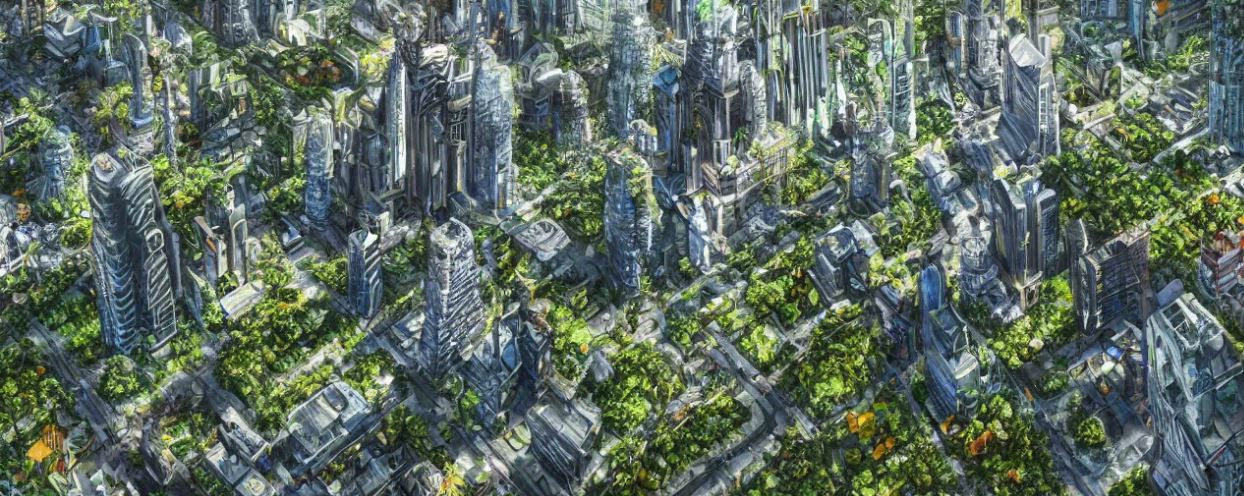
From the perspective of the Cottagecore aesthetic, this image depicts a "wild urban" dream where modern architecture has been reclaimed by nature. Just as cottagecore fans seek a harmony between human life and the wild, the city is filled with towering skyscrapers that are completely overgrown with vibrant greenery and vines. The text "Hello from the city" and "I am a citizen of the city" visible on the buildings reinforces the feeling of a peaceful life within this surreal, organic metropolis.
simple-description (llama3.2-vision_11b)
The meme depicts a sprawling, futuristic cityscape transformed into a whimsical, cottage-like environment, with lush greenery and flowers covering the skyscrapers and buildings. The text "I'm not saying we should turn the city into a garden, but..." is often accompanied by a humorous, tongue-in-cheek tone, implying that the idea of turning a bustling metropolis into a serene, natural oasis is not entirely absurd.
detailed-analysis (gemma3-27b-vision)
Okay, let's break down the image using the requested theoretical frameworks. This is a fascinating visual, and allows for a rich interpretive approach.
Visual Description
The image presents a bird's-eye view of a dense, sprawling urban landscape. It's overwhelmingly dominated by tightly packed, almost uniformly grey structures – likely buildings or infrastructure. These structures are rectilinear, suggesting a rigid, planned layout.
However, what's striking is the sporadic, but significant, interspersing of green. This green appears as concentrated patches, likely representing trees, vegetation, or possibly parks integrated into the urban fabric. There are occasional small pops of color in the green sections. The contrast between the grey and green is significant, creating a textured, almost pixelated visual effect.
The photograph’s high angle flattens the scene, de-emphasizing individual structures and emphasizing the overall pattern. It evokes a sense of scale – the city is immense, potentially impersonal, and repetitive. The image creates an impression of both control (the rigid urban plan) and resilience (the persistence of nature).
Foucauldian Genealogical Discourse Analysis
This image is incredibly potent for Foucauldian analysis. We can examine the "discourse" of urban planning and control inherent in the visual layout.
- Power/Knowledge: The rigid, geometric arrangement of buildings embodies a power/knowledge relationship. The planners know how the city should be organized, and this knowledge is materialized in the built environment, thus exerting power over the inhabitants. The uniform structures suggest a panoptic vision, a system of surveillance (whether literal or implied) and normalization.
- Discipline & Biopower: The grid-like structure is inherently disciplining. It imposes a system of order, directing movement and behavior. The green spaces, however, represent a potential disruption to this control. They represent a claim to space, a “heterotopia” that exists within the regulated urban environment. This can be interpreted as a reclaiming of nature, a display of resilience, or a site where alternative forms of sociality can emerge.
- Genealogy: A genealogical analysis would investigate the historical contingencies that led to this urban form. What social, economic, and political forces shaped this landscape? How has it evolved over time? The image is a materialization of a complex history of power relations.
Critical Theory
From a Critical Theory perspective, this image can be interpreted as a reflection of the alienation inherent in modern urban life.
- Commodification: The buildings are treated as commodities, units within a system of exchange and production. The uniformity suggests a standardization and loss of individuality.
- The Culture Industry: The image can be seen as a manifestation of the culture industry, producing standardized environments that reinforce dominant ideologies. The emphasis on order and control suppresses spontaneity and creativity.
- The Spectacle: Drawing from Debord, the image might be considered a part of the "spectacle" – an image-saturated environment that separates individuals from authentic experience. The focus on the macro-level view obscures the lived experiences of those within the city.
However, the pockets of green offer a subtle critique. They suggest a resistance to complete commodification, a reclaiming of natural space, and a potential for alternative ways of life.
Marxist Conflict Theory
The image is ripe for a Marxist analysis.
- Class Struggle: The uniform buildings represent the built environment created by and for the dominant class. The rigid structure reinforces existing power imbalances.
- Means of Production: The buildings are the means of production – factories, offices, housing that support the capitalist system.
- Alienation: The scale and uniformity of the buildings contribute to a sense of alienation and dehumanization. Individuals are reduced to cogs in a machine, living in standardized environments.
- Contradiction: The inclusion of green spaces presents a contradiction within the capitalist system. Nature is often exploited for profit, but the presence of parks or greenery represents a potential site of resistance – a space where individuals can connect with nature and each other, outside of the logic of capital.
Postmodernism
This image aligns with several aspects of postmodern thought.
- Simulacra and Simulation: The image could be interpreted as a “simulacrum” – a copy without an original. The urban landscape is a constructed reality that has become divorced from nature.
- Deconstruction: The image can be "deconstructed" by questioning the underlying assumptions of urban planning and control. The grid-like structure can be seen as a form of power, and the green spaces as a disruption of that power.
- Fragmentation & Hyperreality: The image's high angle flattens the scene, creating a sense of fragmentation. The overwhelming scale and uniformity contribute to a feeling of hyperreality – a simulation of reality that is more real than real.
Queer Feminist Intersectional Analysis
This is where it gets more nuanced.
- Spatial Politics: How does this urban design impact different groups? Who has access to the green spaces? Who is excluded? The built environment can be explicitly or implicitly gendered, racialized, and class-based. The uniform structure might reinforce normative expectations of space and behavior, marginalizing those who deviate from those norms.
- The Public/Private Divide: How does the urban environment regulate bodies and behaviors? Is there a clear distinction between public and private space? Who is considered "out of place" in certain areas?
- Resilience and Reclaiming Space: The green spaces, again, are significant. They can be interpreted as sites of resistance – spaces where marginalized groups can gather, build community, and reclaim their bodies and identities.
- Intersectionality: It is essential to consider how different forms of oppression intersect in this space. For example, how does gender intersect with race and class to shape the experiences of those who live and work in this city?
I hope this detailed breakdown is helpful! Let me know if you'd like me to expand on any of these points, or explore additional theoretical frameworks.
simple-description (llama3.2-vision)
The meme is a humorous image of a city, but it's actually a giant forest, with skyscrapers and buildings completely overgrown with vines and trees. The image is captioned "When you finally get that 1st job, but you still live in the parent's basement".
tesseract-ocr
CAL. urs) ae a i ee) I a TS a ee) Se ee 1 eer Be and eee Oe, SR ae pee SNe A nie) aT wl 4 esa ena Na WY \ hE tee id NP aes ST A See ng: hare ay aeenas ae ae ‘eS ea ae CR ere ne | a ea 1 Sie ar i ReN Cl EL. wu { Z é Wes tse AN SF ets » ae) ete SF eles | as UE Pk day ee = A ae Fe Ree co Wy, Gece am LAS as a De Ce i Caer cae Bl 1 | ieee eae matte oo ROB ee hs A ae, ae ee Pe eect Oe | OEE N | es ‘nt: SN Ae Lee cal pene ot tee pw TINS a: SU gece SA oer | ee ZS, KS as er N TA Oy BS ~ ee om ‘ ete ee oo eee BOR hn RS a igs SN SRN EAE, SE Ra IASB, ORS aS, WORE SRO WINER) © oad | PRS Pree eh att eS Ra his WR pee oa eS TNE rs NON, aaa ct ae eS sas NE NA) o> ae IX dele aa Thr as Py AAC Rae \O Re PARE DRS SAARI NESS ER WT A £Gby EO NY ee I es NA BPA SN SE eo RY OIE ES, ROE YM ee cal ON i