First Seen
2023-05-10T20:59:59+00:00
simple-description (llama3.2-vision_11b)
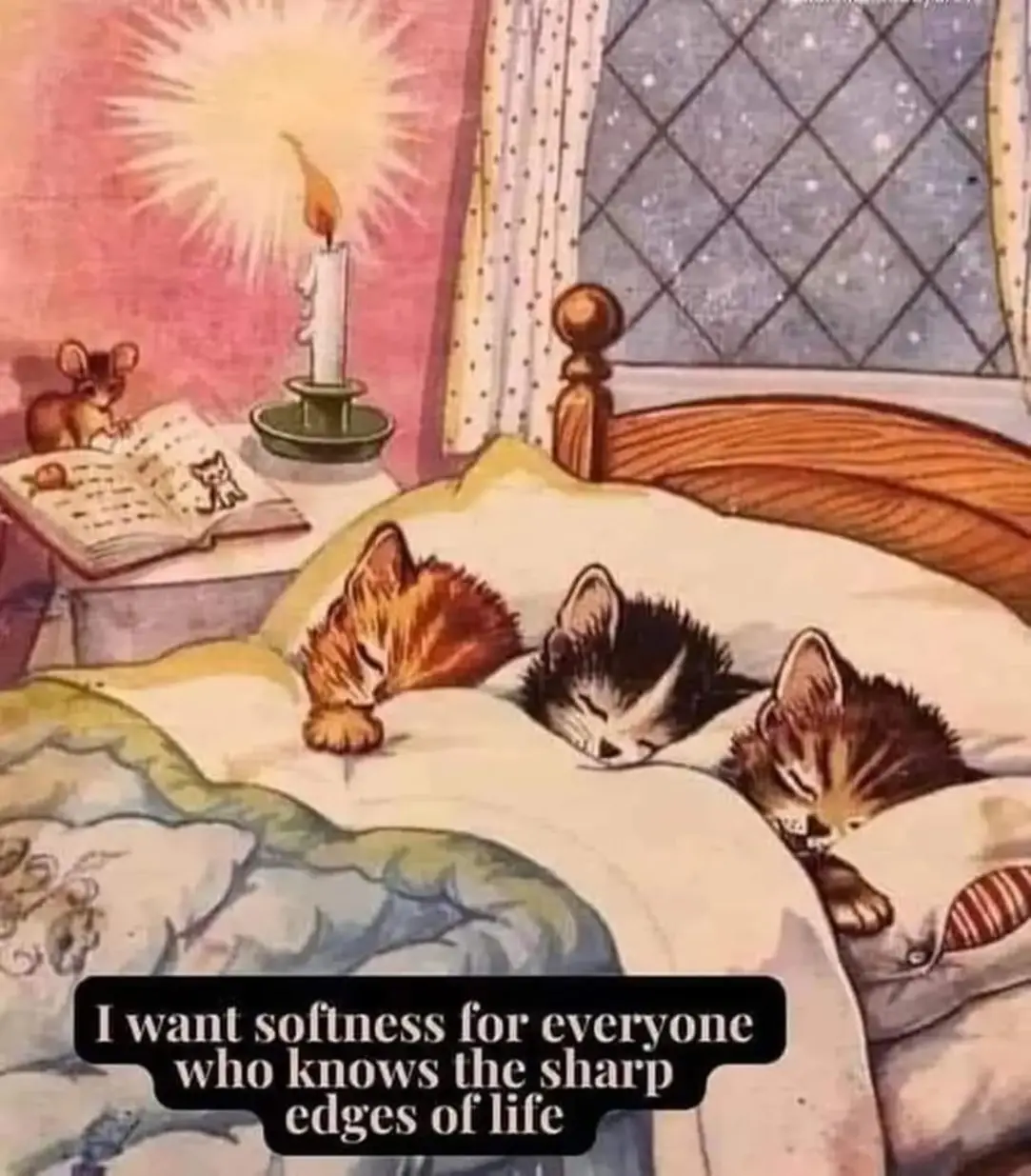
From a Cottagecore perspective, this meme is a whimsical and cozy depiction of a peaceful evening with a warm, golden glow. A candlelit room is filled with soft, plush furniture and a few adorable kittens are snuggled up in blankets, surrounded by books and tea cups. The text "I want softness for everyone who knows the sharp edges of life" is a gentle reminder to prioritize comfort and self-care, especially for those who struggle with anxiety or stress.
detailed-analysis (gemma3-27b-vision)
Okay, let's break down this image and the accompanying text through various critical lenses.
Visual Description
The image is a vintage-style illustration, appearing like a scene from a children's book. It depicts a bed with three small, adorable kittens curled up asleep on the pillows. The bed is covered with a pale green patterned bedspread and has a dark wooden headboard. A bedside table holds a lit candle and what appears to be an open book with a whimsical illustration of a mouse. A window behind the bed casts a dim light onto the scene. The lighting is soft and nostalgic, creating a cozy and innocent atmosphere. The illustration style is characterized by rounded shapes, simple lines, and a muted color palette, typical of mid-20th-century children's illustrations. The text superimposed on the image reads: “I want softness for everyone who knows the sharp edges of life.”
Foucauldian Genealogical Discourse Analysis
The phrase "sharp edges of life" is crucial. Foucault would ask: How has this concept of "sharp edges" – hardship, suffering, trauma – been produced through discourse? The image of sleeping kittens, however, is a stark contrast. This contrast is not accidental; it reveals a need for something other than the dominant discourse of struggle.
The 'softness' requested is not a natural state, but a constructed desire. Historically, Western discourse has often valorized strength, resilience born of hardship, and the "toughening up" of individuals. The desire for "softness" is therefore an act of resistance to this normalizing, disciplinary power. It implies a rejection of the assumption that suffering must be endured stoically.
Genealogically, we could trace the historical conditions that have led to this specific longing for tenderness and care. It is interesting to note that in recent years the idea of prioritizing “soft life” has become popularized among some marginalized groups. This indicates a move away from cultural expectation of endurance and a prioritization of rest.
Critical Theory
From a Critical Theory perspective (drawing on the Frankfurt School), the image and text can be seen as a subtle critique of the societal forces that create the "sharp edges of life." The kittens represent a vulnerability that is increasingly rare in a world obsessed with performance and productivity. The need for softness suggests a yearning for a more humane social order, one that prioritizes empathy, compassion, and care instead of competition and exploitation.
The image can be interpreted as a longing for a different way of being, one that recognizes and addresses the systemic causes of suffering. The kittens are not simply cute; they represent a desire for a world where such innocence and vulnerability are protected rather than threatened. The cozy bed can be seen as an ideal space of care, which is a lack in the world outside.
Queer Feminist Intersectional Analysis
This lens is particularly powerful. The longing for "softness" is a powerfully coded desire that resonates strongly with queer and feminist thought.
- Softness as Resistance: Historically, patriarchal structures have often devalued qualities like tenderness, vulnerability, and care, associating them with femininity and dismissing them as "weaknesses." To explicitly desire softness is therefore an act of reclaiming these qualities as sources of strength and resilience.
- Intersectionality: The "sharp edges of life" disproportionately affect marginalized groups – people of color, LGBTQ+ individuals, disabled people, etc. The call for softness is a demand for equitable care and protection for all those who bear the brunt of systemic oppression.
- Care as Radical: Feminist theorists have long argued that care work (emotional labor, nurturing) is often undervalued and essential to social reproduction. A demand for "softness" implies a radical reimagining of care as a fundamental right and a cornerstone of a just society.
The kittens themselves, small and vulnerable, can be seen as metaphors for those who are most at risk in a harsh world.
Overall Interpretation:
The image and text, when considered through these lenses, become far more complex than a simple sentiment. It’s a poignant expression of a yearning for a different way of being in the world – one that prioritizes compassion, care, and vulnerability as essential for healing and flourishing, particularly for those who have experienced hardship. It is a demand for a society that values softness as a form of resistance and a source of strength.
simple-description (llama3.2-vision)
The meme is a humorous illustration of a cat's perspective on the idea of "softness." It shows a cat's room with multiple cats sleeping, and a quote at the bottom that reads: "I want softness for everyone who knows the sharp edges of life." The image is meant to be a comforting and soothing visual, with the cats' peaceful sleep and the quote's message of empathy and understanding.
tesseract-ocr
J Bary | 4 > 1 et ee co 4 “| j ie . x, Ls ~ ! Ji . 4 es fi Ze a RS a ay ~ app = ; d | ’ con 7 2 WI J ”~ eX, » : ~~ ~ BR sO mavoeroice who knows the sharp Se MER BIG “& \