First Seen
2023-05-10T21:03:35+00:00
simple-description (llama3.2-vision_11b)
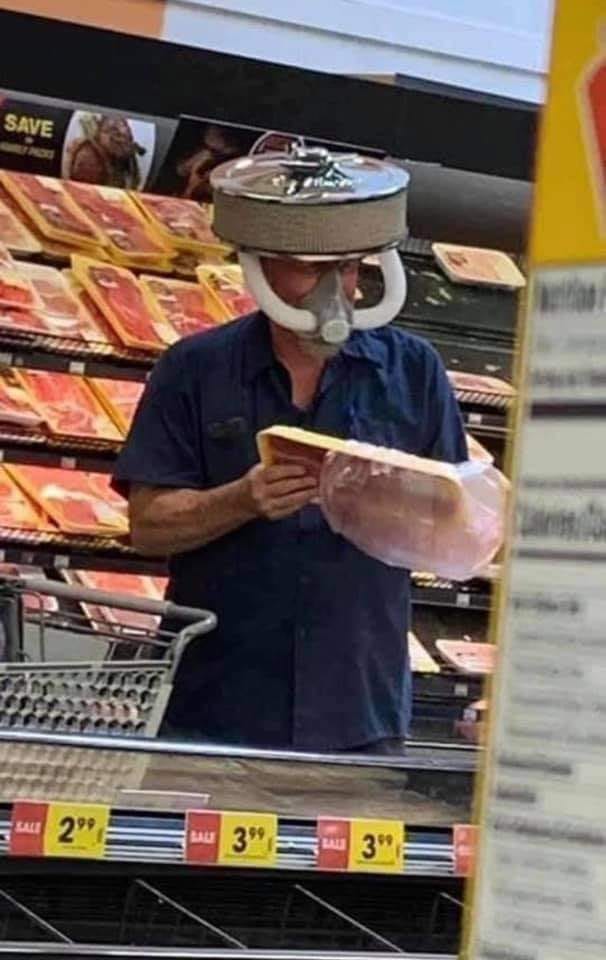
This meme features a person, likely a store employee, wearing a bizarre and unsettling combination of a diving mask and a helmet, which is a parody of the "dive helmet" used by some store employees to keep their hair clean. The image is likely from a store's "dive helmet" policy, which is a humorous and relatable example of a workplace absurdity.
detailed-analysis (gemma3-27b-vision)
Here's an analysis of the image, structured with the requested headings. It's a rather unusual image, so some sections will be more developed than others.
Visual Description
The image shows a man shopping in what appears to be the meat section of a supermarket. He is wearing a dark blue shirt and appears to be middle-aged. The most striking element is the elaborate contraption on his head. It consists of a clear plastic dome connected to what looks like a repurposed kitchen pot, with tubing running from the apparatus down to his face. He is holding a small plastic bag in his hand and looking down, presumably at a shopping list or the meat options. The background features rows of packaged meat and price tags indicating sales. The image quality is somewhat grainy, suggesting it was captured quickly or from a distance.
Foucauldian Genealogical Discourse Analysis
This image immediately triggers a Foucauldian reading, specifically around the themes of biopower, discipline, and normalization. The headgear is a clear manifestation of a technology designed to control and regulate bodily functions - specifically, breathing. This isn’t simply about physical necessity, but about the discourses that define necessity and the conditions under which it is met.
- The history of medical technology: Tracing the genealogy of this apparatus – from early respiratory devices to modern CPAP machines – reveals how the concept of "health" and "disease" is historically constructed. What constitutes a "normal" respiratory function is determined by medical and scientific discourse.
- The Panopticon and the body: The apparatus can be seen as an extension of the Panoptic impulse. While not literally a tower of surveillance, it embodies a constant self-monitoring and self-regulation of the body. The man is visibly "performing" a certain health status.
- Discipline and normalization: The headgear disciplines the body, forcing it to conform to a standard of "healthy" breathing. It simultaneously normalizes this intervention, making it appear as a routine part of shopping or public life.
- The Discourse of Vulnerability: The public display of medical technology presents a vulnerability, yet the man continues to engage in everyday life. This challenges and redefines notions of health, ability, and public display.
Critical Theory
From a critical theory perspective, this image speaks to the commodification of the body and the influence of technology on human experience.
- The body as a project: The headgear is not simply a tool for breathing, but an extension of a broader cultural obsession with self-improvement and the "optimization" of the body. It embodies the idea that the body is not a given, but a project to be engineered and perfected.
- Technological alienation: While intended to improve life, the apparatus might also represent a form of alienation, separating the man from a "natural" state of being. It highlights the increasing dependence on technology to perform basic bodily functions.
- The spectacle of illness: The image presents a visual paradox. The man is performing the everyday task of grocery shopping while visibly dependent on medical technology. This invites a voyeuristic gaze and raises questions about the spectacle of illness and disability.
- Consumerism and the Medical Industry: The setting within a supermarket emphasizes the intertwining of consumerism and healthcare. The image subtly highlights the enormous financial and political power of the medical industry and how it permeates all aspects of life.
Marxist Conflict Theory
From a Marxist perspective, the image can be interpreted as a representation of class disparities in access to healthcare and technology.
- Privilege and Access: The technology required for this apparatus is likely expensive, indicating a level of economic privilege. The man’s ability to access and maintain this technology sets him apart from those who may not be able to afford it, leading to health inequalities.
- The Commodification of Healthcare: The setting in a supermarket, a site of commodity exchange, emphasizes how healthcare has become increasingly commodified. The man's health is maintained through a purchased product, reinforcing a capitalist system where basic needs are met through market transactions.
- The Production of Need: The dependence on this technology could be seen as a consequence of social and environmental conditions (pollution, stress, etc.) that contribute to respiratory illness. In this sense, the technology doesn’t simply solve a problem but addresses a need created by the capitalist mode of production.
- Alienation and Labor: One could argue that the man’s reliance on the apparatus represents a broader form of alienation from his body and natural processes, mirroring the alienation experienced by workers in a capitalist system.
Postmodernism
From a postmodern perspective, the image embodies a blurring of boundaries and a questioning of authenticity.
- The Simulated Body: The headgear can be seen as a form of "prosthetic reality," extending the body but also creating a layer of artificiality. It challenges the notion of a "natural" or "authentic" self.
- The Fragmentation of Identity: The image presents a fragmented identity. The man is simultaneously a shopper, a patient, and a cyborg-like figure. It challenges the idea of a unified, coherent self.
- Irony and Parody: The absurdity of the situation – a man wearing a kitchen pot on his head while shopping – invites an ironic reading. It can be seen as a parody of medical technology and the culture of self-optimization.
- The Loss of Grand Narratives: The image resists easy interpretation. It doesn't fit into any clear-cut narrative about health, technology, or identity. This reflects a postmodern skepticism toward grand narratives and universal truths.
Queer Feminist Intersectional Analysis
This is the trickiest section, as the image doesn't immediately lend itself to a queer feminist reading. However, we can explore it through the lens of disability studies and the politics of visibility.
- Disability as a Social Construct: The image invites us to consider disability not as an inherent condition but as a social construct. The man is rendered “disabled” by the need for the apparatus, but also empowered by its ability to allow him to participate in everyday life.
- Visibility and Stigma: The man's visibility is complicated. He is publicly displaying a medical device, which could lead to stares, questions, or even judgment. This raises questions about the stigma associated with disability and the importance of creating inclusive spaces.
- Challenging Normative Bodies: The image challenges normative notions of what constitutes a “healthy” or “able” body. The man’s body is different, but it is still capable of participating in society.
- Intersectional Vulnerability: Intersectionality reminds us that vulnerability is shaped by multiple factors, including class, race, gender, and ability. The man’s experience of disability is likely different depending on his other social identities. A queer feminist lens asks: how might the display of vulnerability be gendered? Are there specific pressures on men to appear “strong” or “independent” that might shape how they navigate their disability?
It's important to note that these analyses are all interpretations. The image is open to multiple readings, and different viewers will likely bring their own perspectives and biases to it.
simple-description (llama3.2-vision)
This meme features a person wearing a ridiculous outfit, including a helmet with a large, bulbous nose and a mouthguard, as if they're about to play a sport. The text "I'm not arguing, I'm just explaining why I'm right" appears at the top of the image. The image is likely meant to be humorous and ironic, poking fun at the idea of someone trying to be overly persuasive or condescending.
tesseract-ocr
yd = | = Peay a so — moe ~ i 7 Sars be a . <e alt ~ Ss = cs Sein Vem - A Sa : a Gi rf 7 ‘1 NG ot = q = E Pp - a Noa 5 2 ents jam," ess 4 WS = —s a ] im, Ooo ~ ii | iE r = ~ = tS