First Seen
2023-05-10T21:03:35+00:00
simple-description (llama3.2-vision_11b)
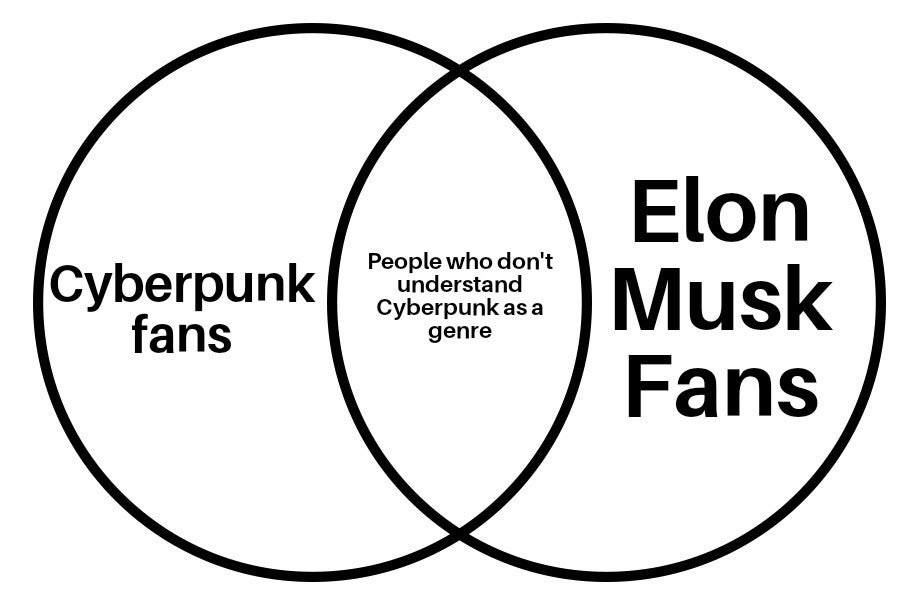
The meme juxtaposes two seemingly incompatible groups: fans of cyberpunk, a genre known for its futuristic, high-tech, and often dystopian themes, and fans of Elon Musk, the billionaire entrepreneur and CEO of SpaceX and Tesla. The meme humorously implies that the two groups are so distinct that they might as well be from different planets, with the text "People who don't understand Cyberpunk as a genre" serving as a humorous bridge between the two groups, implying that they have nothing in common.
detailed-analysis (gemma3-27b-vision)
Okay, let's break down this Venn Diagram, applying the requested theoretical lenses.
Visual Description
The image is a classic Venn diagram consisting of two overlapping circles. The left circle is labeled "Cyberpunk fans," and the right circle is labeled "Elon Musk Fans." The overlapping section, where the circles intersect, contains the text "People who don't understand Cyberpunk as a genre." The background is a neutral shade of grey. The diagram is intentionally simple in its design, using black text on a grey background and relying heavily on the conceptual framing of the labels.
Critical Theory
Critical Theory, broadly speaking, examines power structures and societal inequalities. This Venn diagram immediately invites a critical reading around these themes.
- The Overlap as a Power Dynamic: The intersection, "People who don't understand Cyberpunk as a genre," is the key to this analysis. Cyberpunk, as a genre, often (though not always) critiques the power of corporations, the dangers of unchecked technological advancement, and the resulting social stratification. It's a genre frequently concerned with dystopian futures stemming from capitalist excess. Framing those who don't understand this core thematic element as existing within the intersection of Cyberpunk fans and Elon Musk fans suggests a cognitive dissonance. These are individuals who seemingly enjoy the aesthetics of Cyberpunk without grasping its critical roots, potentially even supporting a figure (Elon Musk) who embodies many of the same power structures and technological drives the genre often critiques.
- Commodification of Resistance: The diagram can be seen as a commentary on the appropriation of counter-cultural aesthetics. Cyberpunk's visual style and themes have become mainstream, often divorced from their original critical intent. Elon Musk, as a tech entrepreneur, embodies the very forces Cyberpunk frequently questions, yet he benefits from the cultural cachet of the aesthetic, and his fans may be drawn to that aesthetic without understanding the genre’s intent.
- Ideological Hegemony: This Venn Diagram can be seen as a statement on the power of marketing and branding. It suggests that the aesthetics of resistance can be co-opted and used to bolster support for systems of power. By highlighting those who do not understand the critical intent of the Cyberpunk genre and their connection to Elon Musk, the image implies that those systems are successful in maintaining their dominance through the appropriation of counter-cultural aesthetics.
Marxist Conflict Theory
From a Marxist perspective, this diagram highlights a core conflict: the relationship between ideology and material conditions.
- False Consciousness: The intersection of "Cyberpunk fans" and "Elon Musk Fans" represents a possible instance of false consciousness. Individuals might be attracted to the style of Cyberpunk, which visually portrays a world of rebellion and resistance, but simultaneously support a figure (Musk) who perpetuates the capitalist systems that the genre critiques. Their attraction to the aesthetic masks a lack of critical engagement with the underlying ideology.
- Commodity Fetishism: Cyberpunk’s aesthetic, divorced from its critical intent, becomes a commodity – an appealing surface-level style. This relates to Marx’s concept of commodity fetishism – where the social relations of production are obscured, and the focus shifts to the object itself (the aesthetic) rather than its origins or implications.
- Class Dynamics: Elon Musk, as a prominent capitalist, represents the very forces Cyberpunk often portrays as oppressive. The overlap suggests a segment of the population who are simultaneously drawn to a critique of power structures and supportive of those who wield that power – potentially indicating a complex relationship with class and economic inequality.
Postmodernism
The diagram has a clear connection to Postmodern thought, especially concerning the blurring of boundaries and the questioning of grand narratives.
- Simulacra and Simulation: The co-option of Cyberpunk aesthetics by figures like Musk can be seen as an example of Baudrillard’s concept of simulacra and simulation. The aesthetic becomes a copy of a copy, divorced from its original meaning, and ultimately becomes more "real" than the critique it once represented.
- Deconstruction of Meaning: The diagram deconstructs the traditional relationship between aesthetics and ideology. It suggests that the aesthetic of resistance can be used to support systems of power, undermining the idea that aesthetics inherently carry a specific political meaning.
- Irony and Pastiche: The intersection can be read as an ironic commentary on contemporary culture. It highlights the tendency to embrace superficial aesthetics without engaging with the underlying critiques. It’s a form of cultural pastiche—appropriating elements of different styles and combining them in a way that lacks a coherent narrative.
Let me know if you’d like me to elaborate on any of these points or explore additional theoretical frameworks.
simple-description (llama3.2-vision)
This meme is a Venn diagram with two overlapping circles, one labeled "Cyberpunk fans" and the other labeled "Elon Musk fans". The intersection of the two circles contains the text "People who don't understand Cyberpunk as a genre". The meme is suggesting that there is a common ground between fans of Cyberpunk and fans of Elon Musk, but that both groups are also connected by a shared lack of understanding of the Cyberpunk genre.
tesseract-ocr
People who don't Cyberpunk | ,unsestare | f ans genre