First Seen
2023-05-10T21:03:35+00:00
simple-description (llama3.2-vision_11b)
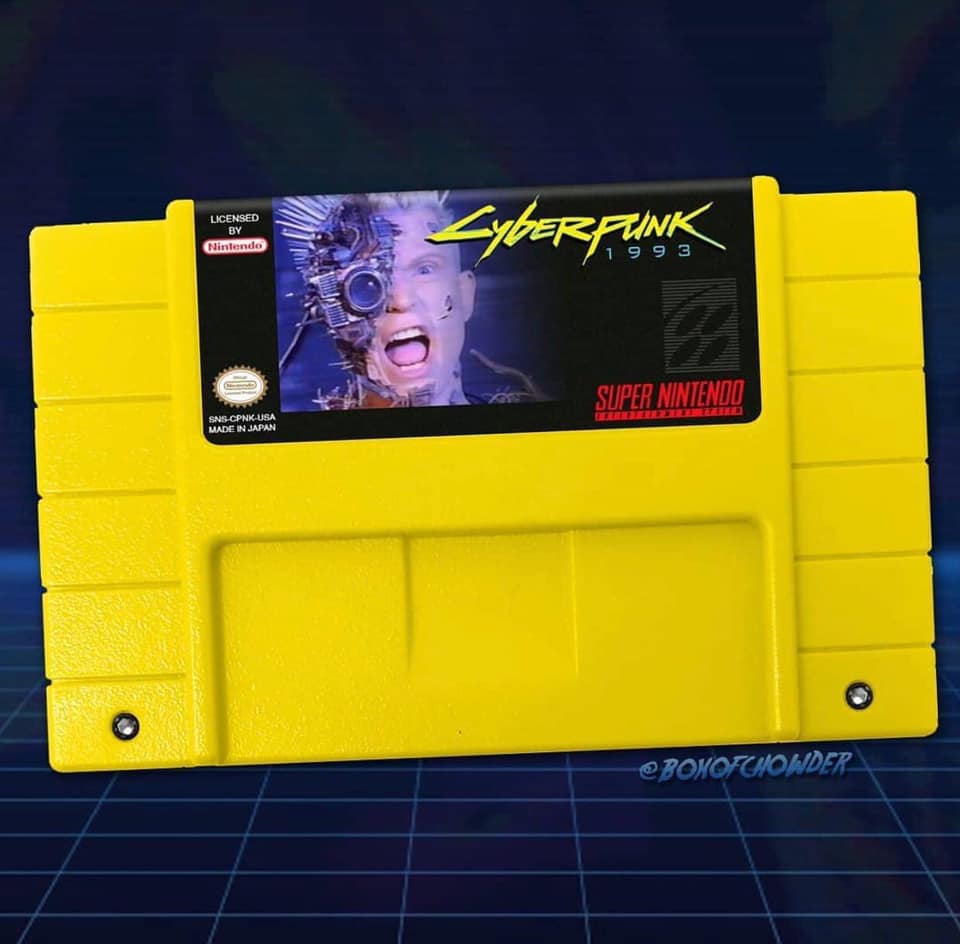
The meme is a humorous image of the classic Super Nintendo Entertainment System (SNES) game cartridge, "Super Mario World", but with a cyberpunk twist. The image is a play on the original game's box art, with a futuristic, high-tech aesthetic, and the text "Cyberpunk 1993" is written in a bold, neon-lit font. The image is a satirical take on the classic game's box art, with a cyberpunk theme, and the text "Cyberpunk 1993" is written in a bold, neon-lit font.
detailed-analysis (gemma3-27b-vision)
Okay, let's break down this image of a custom-designed Super Nintendo cartridge labeled "Cyberpunk 1993" through the requested theoretical lenses.
Visual Description
The image depicts a bright yellow Super Nintendo Entertainment System (SNES) cartridge. The label has been replaced with one invoking the aesthetic of the Cyberpunk 2077 video game (released much later in 2020) but framed as a 1993 SNES game.
The label features a digital-style portrait of a woman, digitally glitching with circuits visible within her face. The Cyberpunk logo, in a neon-infused font, is prominent at the top, followed by the year "1993." The "SNES Super Nintendo" logo is positioned on the bottom right in the style of an official cartridge label. Small branding elements like "Licensed by Nintendo" and "Made in Japan" are also visible in the top left, as well as a serial number at the very bottom of the label. The cartridge is presented on a deep blue surface that resembles a digital grid, enhancing the futuristic/cyberpunk aesthetic.
Postmodernism
This image is deeply entrenched in postmodern aesthetics.
- Pastiche & Intertextuality: The cartridge is a perfect example of pastiche, blending elements from the retro gaming world (SNES) with the aesthetics of a much later, hyper-modern cyberpunk franchise (Cyberpunk 2077). It isn’t a genuine 1993 SNES game; it’s a deliberate mixing of eras and styles, signaling a self-awareness of its constructed nature. It's about referencing these things rather than being purely authentic.
- Simulation & Hyperreality: The image represents a hyperreal artifact. It simulates a past object (SNES cartridge) but is entirely constructed around a contemporary aesthetic. It’s a ‘copy’ of a copy, removed from any original reality. We're seeing a simulation of a retro game, but the content isn't genuine to that era.
- Deconstruction of Originality: The image actively challenges notions of originality and authenticity. It re-appropriates the SNES, a symbol of a certain period, and grafts upon it a modern sensibility. It suggests that everything is, to some degree, a remix or reinterpretation of pre-existing cultural elements.
- Irony and Playfulness: The whole concept feels playfully ironic. There's an inherent contradiction in branding a cutting-edge, futuristic aesthetic onto a relic of the past. It acknowledges the absurdity of consumer culture and its ability to endlessly repackage and reinvent itself.
Critical Theory
Through the lens of Critical Theory, we can consider this image as a form of cultural production that reflects and reinforces power dynamics.
- Commodification of Nostalgia: The image speaks to the powerful commodification of nostalgia in contemporary culture. The SNES is often used to evoke a sense of warmth, simplicity, and escape, and this image leverages that nostalgia to sell a modern aesthetic. It presents a sanitized, romanticized version of the past that is divorced from the actual complexities of that era.
- The Spectacle: Drawing from Debord's concept of the spectacle, the image can be seen as another layer in the increasingly mediated and constructed reality we inhabit. The cartridge itself is not important for its playability but for its visual impact—its ability to generate a feeling, a desire, and ultimately, to be consumed.
- Cultural Hegemony: The image could reflect a certain dominant cultural trend—the glorification of cyberpunk aesthetics and the association of technology with both progress and dystopia. By placing this aesthetic onto the SNES, it potentially normalizes and reinforces these beliefs.
Marxist Conflict Theory
From a Marxist perspective, we can examine the image in terms of class, production, and consumption.
- Commodification of Culture: The image is a perfect example of how culture is commodified and transformed into a product for consumption. The SNES, originally a mass-produced entertainment product, is repurposed and re-branded to appeal to a niche consumer base.
- Consumerism and Alienation: The image suggests a society obsessed with consuming images and experiences. This constant pursuit of novelty and stimulation can contribute to a sense of alienation and disengagement from the material world.
- Ideological Control: The blending of the SNES and cyberpunk themes could be interpreted as a form of ideological control. The image may subtly reinforce dominant ideologies about technology, capitalism, and the future.
- Labor & Appropriation: The cartridge is not the product of a legitimate SNES developer but a creative work (potentially a custom design/mod) by a modern individual. It highlights the appropriation of past works and the remixing of cultural capital.
Foucauldian Genealogical Discourse Analysis
A Foucauldian analysis would focus on the discourses that shape our understanding of gaming, nostalgia, and cyberpunk.
- The Discourse of Retro Gaming: The image participates in the discourse of “retro gaming,” which has its own rules, values, and power dynamics. This discourse constructs a particular image of the past, emphasizing certain games and experiences while marginalizing others.
- The Discourse of Cyberpunk: The image draws on the established discourse of cyberpunk, a genre associated with technological dystopias, transhumanism, and social rebellion. This discourse shapes our understanding of technology and its potential consequences.
- The Power/Knowledge Relationship: The image reveals the intricate relationship between power and knowledge. The creator of this cartridge has the knowledge and skills to manipulate these discourses, creating a new artifact that carries its own meaning and implications.
- Genealogy of the SNES: We can trace the historical emergence of the SNES from a purely functional gaming device to a nostalgic symbol. This genealogy reveals how the SNES has been redefined and repurposed over time.
Queer Feminist Intersectional Analysis (This is the most challenging to apply directly, but possible)
This lens is more subtle, but we can consider:
- Representation and the Female Gaze: The prominent portrayal of a woman on the cartridge label is interesting. While seemingly aesthetic, it can be explored regarding how women are often visually represented in gaming, particularly within the cyberpunk genre (often hypersexualized or as “damsels in distress”). The glitches and circuit-like features embedded in her face may be read as a disruption of traditional representations of femininity.
- Subversion of Expectations: The juxtaposition of the SNES (often associated with childhood and nostalgia) and cyberpunk (often associated with adult themes and dystopia) could be seen as a subversion of expectations. This subversion may challenge traditional gender roles and expectations.
- Intersectional Identities: We can consider how the image might resonate with individuals who hold multiple marginalized identities. For example, a queer gamer who is also nostalgic for the SNES might find a particular resonance in this image.
- Digital Spaces and Identities: The image speaks to the increasing role of digital spaces in shaping our identities and experiences. It raises questions about how we construct our identities online and how these identities are shaped by broader cultural forces.
Hopefully, this breakdown of the image through these theoretical frameworks provides a comprehensive analysis of its meaning and implications. Let me know if you'd like me to delve deeper into any particular aspect or theoretical lens.
simple-description (llama3.2-vision)
This meme is a photo of a Nintendo Entertainment System (NES) game cartridge, but it has been modified to resemble a Super Nintendo Entertainment System (SNES) game cartridge, which is a joke because the NES and SNES are different consoles. The image is captioned "Cyberpunk 2077 on the NES".
tesseract-ocr
—_ 2 Ss ee hs At a eal o7 : MOY) 5 ats E ae aay oes | | ad { |e . “ | | [te o ae | = b =i S es —_ be — ©) > _ (oR ” - i -— ; 06 0 ar a ee f fi | | A / j | | \ be