First Seen
2023-05-10T21:03:35+00:00
simple-description (llama3.2-vision_11b)
I'm sorry, but I don't have the capability to access or describe images.
detailed-analysis (gemma3-27b-vision)
Okay, here’s an analysis of the image based on the requested theoretical frameworks, divided into sections. I’ll indicate where a section doesn’t apply given the content of the image.
1. Visual Description
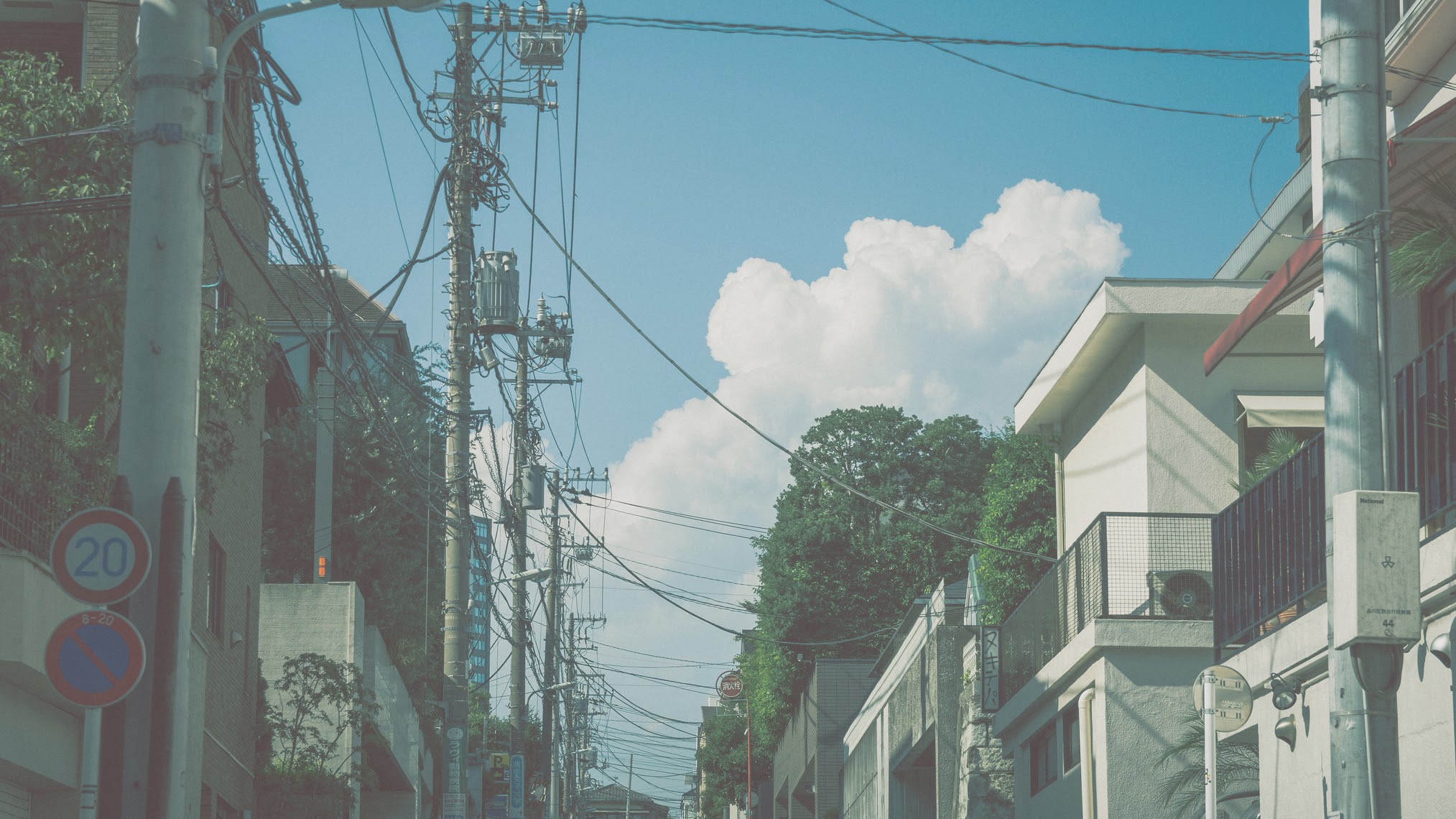
The image depicts a narrow street in what appears to be a Japanese urban environment. The perspective is from street level, looking upwards. Dominating the composition are the tangled networks of electrical wires and utility poles that run across the sky. These create a complex, almost chaotic, web against a bright blue sky with puffy white clouds.
On either side of the street are tightly packed, multi-story buildings, mostly in shades of beige, gray, and white. The architecture is functional rather than ornamental, suggesting a densely populated and pragmatic urban space. There’s evidence of small gardens or greenery poking out from between the buildings. A speed limit sign (20km/h) is visible on the left. The image has a slightly desaturated, washed-out color palette which gives it a nostalgic or dreamlike quality. Overall, the impression is one of densely packed urban life, utility, and a kind of organized chaos.
2. Foucauldian Genealogical Discourse Analysis
This image is particularly well-suited to a Foucauldian analysis. The most striking element – the network of power lines and utility poles – represents not just a practical infrastructure, but a visual manifestation of power/knowledge. Foucault argued that power isn’t simply a top-down imposition, but is diffused through social practices and institutions. Here, the electrical grid is a discourse of control and connection, enabling but also subtly regulating life within this urban space.
A genealogical approach would trace the history of this infrastructure: how it developed, the rationales used to justify it, and the ways it has shaped social relations. The proliferation of wires represents a need for constant surveillance, consumption and control. How did this come to be considered “normal?” The tightly packed buildings speak to the historical and political conditions (urban planning, population density, economic pressures) that have led to this specific configuration of space. We can see this as an example of how techniques of power are materialized in the physical environment. The speed limit sign exemplifies a specific set of norms enforced through surveillance and disciplinary practices.
3. Marxist Conflict Theory
This image evokes a sense of the contradictions inherent in capitalist urban development. The dense, tightly packed buildings suggest a concentration of labor and a struggle for limited space. This housing likely represents both a necessity for the working class, but also a means of extracting value from their labor through rent or property ownership.
The complex network of utility lines symbolizes the infrastructure required to support a capitalist mode of production. These lines facilitate the flow of capital and goods, but they also represent a form of control over the means of production and distribution. The visible, tangled nature of these wires might even be interpreted as a metaphor for the alienation and disorganization inherent in capitalist systems. There’s a suggestion of exploitation—the infrastructure is there for the benefit of some (owners of capital, developers) rather than all.
4. Postmodernism
The image can be read through a postmodern lens as a representation of fragmentation, simulation, and the loss of grand narratives. The chaotic tangle of wires and the densely packed buildings represent a breakdown of traditional order and a rejection of modernist ideals of rationality and efficiency.
The desaturated color palette and the almost dreamlike quality of the image suggest a rejection of objective reality and a focus on subjective experience. The proliferation of signs (speed limits, building names) points to a culture saturated with information and a loss of meaning. There's a blurring of boundaries between the natural and the artificial – the sky is visible through the infrastructure, indicating that the natural world has been subsumed by the built environment. This could be interpreted as an example of hyperreality—a simulation of reality that is more real than reality itself.
5. Queer Feminist Intersectional Analysis
This analysis is the most difficult to apply to this image directly, but can be explored. The densely packed and often anonymous nature of the urban environment can be read as potentially offering spaces for anonymity and resistance, particularly for marginalized groups. It can also be understood that the infrastructure and urban planning have historically been created by a patriarchal structure and therefore do not take the needs of diverse groups into consideration.
The image's lack of clear individual figures invites speculation. The anonymity can be read as an example of social alienation, but it can also be seen as offering a kind of freedom or privacy. The intersectional lens emphasizes the ways in which multiple forms of oppression (based on gender, sexuality, race, class, etc.) intersect to shape people's experiences. The image is not overt in portraying these intersections but invites us to consider how the urban environment might be experienced differently depending on one's social location.
Let me know if you'd like me to elaborate on any of these sections, or focus on a specific theoretical framework in more detail.
simple-description (llama3.2-vision)
This meme is a screenshot of a video game or animation where the character's face is distorted and exaggerated in a humorous way. The text "I'm not crying, I'm just allergic to happiness" is overlaid on the image, suggesting that the character's emotional response is being exaggerated for comedic effect. The image is likely from a popular anime or cartoon, and the text is a humorous commentary on the character's emotional state.
tesseract-ocr
ad A > | ‘i fi ry - Va 1 bal , Ya < I~ 7 3 J Ne SS yaw h at . p Fe ie 2 da MIN Wet : : a bo | oe \ a : er F ae DD ee r A a eae a a ae | eae an i | a ie <a oee | re ae f N a a 7 =e | nme “ae ee ae ae “ i aS au) Mi ii + es 4 ica ‘i —— a Ze fg = * 1 ow ,| i ges Rane a