First Seen
2023-05-10T21:03:35+00:00
simple-description (llama3.2-vision_11b)
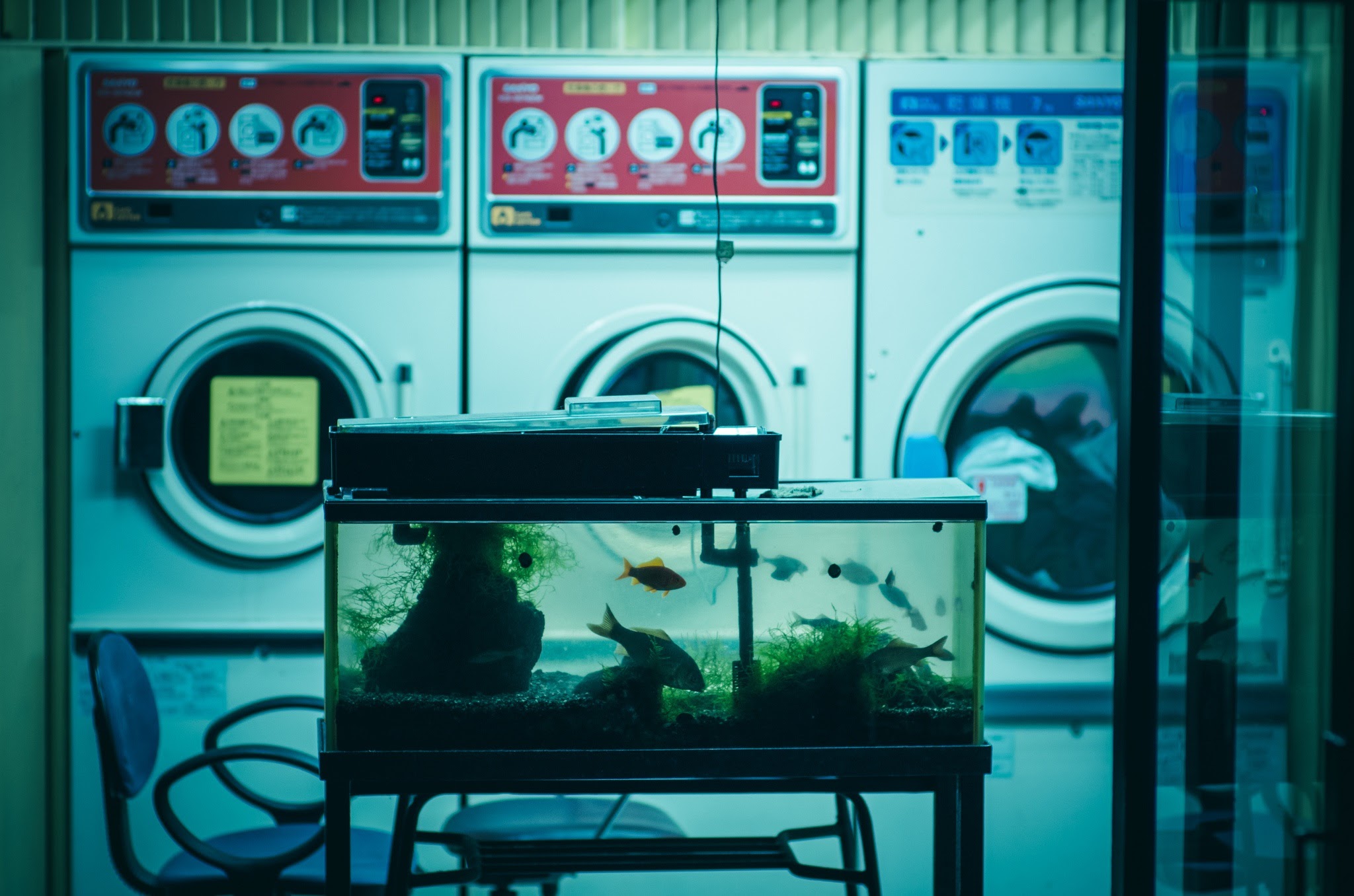
The meme is a darkly humorous image of a public laundromat with a fish tank in the corner, featuring a sign that reads "Free Wi-Fi" but also "Please Do Not Feed the Fish... Or the Wi-Fi Password". The image is a play on the common public laundromat experience, but with a cyberpunk twist, implying that the laundromat is also a hub for online activity and the fish tank is a metaphor for the internet.
detailed-analysis (gemma3-27b-vision)
Okay, here's an analysis of the image broken down into the sections you requested, noting where sections are not applicable.
Visual Description
The image presents a striking juxtaposition of domestic utility and the natural world. The focal point is a rectangular fish tank, positioned in front of a row of commercial washing machines. The tank is filled with water, aquatic plants, gravel, and several small fish, including a brightly colored orange fish. The fish are swimming in the tank. The background is dominated by white and grey commercial washing machines, aligned in a row. These machines have digital display panels and appear to be within a laundromat. A metallic stand supports the fish tank, and faint figures can be seen through the glass of the laundromat. The color palette is dominated by cool tones – blues and greys – creating a slightly melancholic or sterile atmosphere. The image is partially obscured by reflections on the glass, adding to a sense of distance or observation.
Foucauldian Genealogical Discourse Analysis
This image lends itself well to a Foucauldian lens. The laundromat, as a site of normalization, is key. Laundromats exist to standardize cleanliness, to regulate the body via the ritual of washing. The focus on washing and sanitation relates to the historical emergence of discourses on hygiene and public health – discourses that are inherently linked to power and control.
The fish tank, placed within the space of this normalization, creates a counter-discourse. The natural world, even in its artificial containment, represents a force outside the logic of cleanliness and order. It’s a miniature, contained “other,” a reminder of forces beyond human regulation. The fish themselves become objects of surveillance within the surveillance of the laundromat.
A genealogical analysis might trace how the concepts of “cleanliness” and “naturalness” have been historically constructed and related to power dynamics – how the need to control the body and contain nature has been interwoven in social practices. The image can be read as a visual statement on the historical production of these categories.
Critical Theory
From a Critical Theory perspective, the image raises questions about the commodification of life and the alienation of modern experience. The laundromat represents a space of instrumental rationality – a place where time and resources are exchanged for a functional purpose (clean clothes).
The fish tank, in this context, can be seen as a poignant symbol of the domination of nature. It’s a miniaturized ecosystem, separated from its natural context and placed within a sterile, commercial environment. This speaks to a larger trend of reducing natural processes to mere objects of consumption and control. The fish tank is a spectacle, an aesthetic object that obscures the larger ecological issues at play.
The image could be interpreted as a critique of the modern tendency to compartmentalize life – separating work, leisure, and nature into distinct spheres, and ultimately alienating us from the natural world.
Marxist Conflict Theory
This image presents an interesting juxtaposition that can be analyzed through a Marxist lens. The laundromat represents a site of labor and capital – the machines are tools of production, and the services provided cater to the working class. The fish tank, however, is a non-productive element, a form of “superstructure” – a cultural artifact that serves to distract or decorate the space of labor.
The image hints at a contradiction between use value and exchange value. Clothes are a necessity (use value), while the laundromat functions primarily as a means of generating profit (exchange value). The fish tank doesn't contribute to either of these, it's purely aesthetic, potentially indicating a surplus of capital being used for decorative purposes within a space of working-class utility.
Postmodernism
The image is ripe with postmodern characteristics. The juxtaposition of disparate elements (washing machines and a fish tank) is a hallmark of postmodern aesthetics. There is a blurring of boundaries between the natural and the artificial, the functional and the aesthetic, the domestic and the public.
The image also plays with simulacra and simulation. The fish tank is not a natural ecosystem but a carefully constructed representation of one. The washing machines, as mass-produced objects, are themselves simulations of cleanliness. The image can be read as a commentary on the increasingly mediated nature of modern experience and the loss of authentic connection to the natural world. There's an underlying sense of fragmentation and irony.
Queer Feminist Intersectional Analysis
While not immediately apparent, a Queer Feminist Intersectional reading can be applied to the image by considering the hidden labor often associated with care and domesticity. Laundromats, while seemingly neutral, are often heavily used by women and marginalized communities. The labor of washing clothes, historically seen as "women's work," is outsourced to this commercial space.
The fish tank, as a miniature ecosystem, can be seen as a metaphor for care work. Maintaining the tank requires constant attention and nurturing, often unpaid labor mirroring the expectations placed on women.
The artificiality of the tank can also be connected to the performativity of gender. The "natural" order of the tank is carefully constructed and maintained, just as gender roles are often performed and reinforced. Furthermore, the sterile, commercial environment of the laundromat contrasts sharply with the nurturing environment a healthy ecosystem needs, reflecting the ways in which capitalist systems often undermine care.
I hope this analysis is helpful! Let me know if you’d like any section elaborated upon.
simple-description (llama3.2-vision)
The meme is an image of a laundry room with a washing machine and a sign that says "Please do not leave your fish in the washing machine". The image is humorous because it's a common mistake to leave a fish in a washing machine, but in this case, it's a laundry room with a fish tank in the background, implying that someone has left their fish in the washing machine.
tesseract-ocr
: / : r , { ae ie a = aw = = : a oe —. - = oe - A=. s bd Y ~ ; , f Wie | | j \ o Bi E<| ans. fem inl en Co ial ra ‘ : hw : ee » .i ee _ Sc all i a i C . =e | ff g ese i , or q : ee