First Seen
2023-05-10T21:03:35+00:00
simple-description (llama3.2-vision_11b)
The meme is a screenshot of a video game's lobby, specifically a cyberpunk-inspired setting with a neon-lit, futuristic atmosphere. The image is captioned "The lobby is empty" and features a deserted, dimly lit room with a few chairs and a table, with a single, empty chair in the center of the room. The image is meant to be humorous, implying that the game's developers have been so focused on creating a realistic, immersive experience that they've forgotten to populate the game with any actual players.
detailed-analysis (gemma3-27b-vision)
Okay, let's break down this image through several theoretical lenses. Due to the nature of the image (a stylized, almost digital/virtual space), some interpretations will be more robust than others.
Visual Description
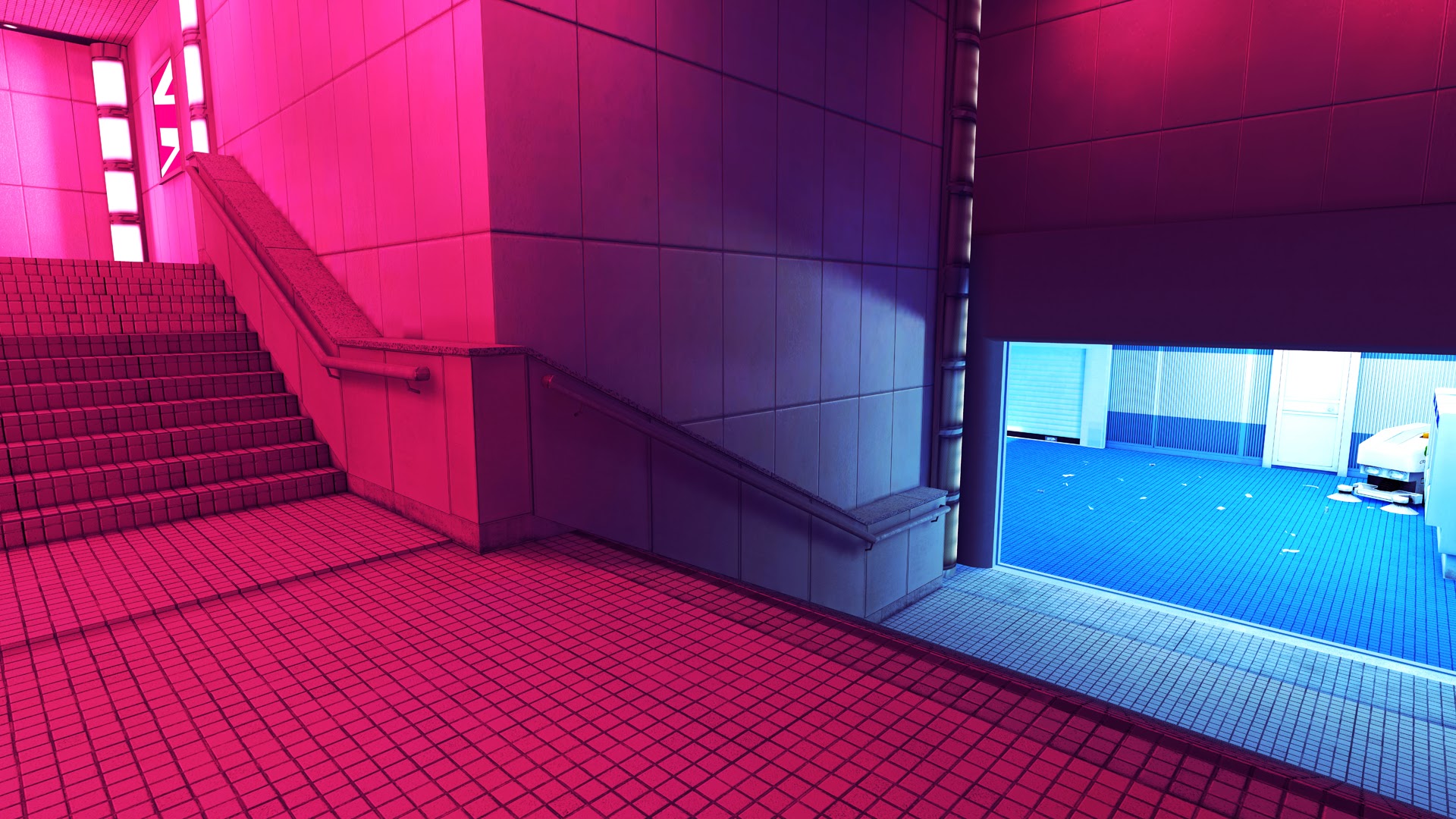
The image depicts an interior space, seemingly an institutional one – possibly a parking garage or service area, but with a strong, deliberate stylization. The dominant features are strong lines and a grid-like tiling that covers nearly all surfaces (floors, walls, stairs). The color palette is striking and artificial: intense pink/magenta and cool blue are the primary colors, creating a stark contrast and a sense of unreality.
The space is defined by angular geometry. A staircase ascends on the left, leading to a high, dimly lit area. The stairs and surrounding walls are bathed in pink light. A large opening on the right reveals a different section of the space, illuminated with a bright, almost sterile blue. Within this blue-lit area, a white vehicle (possibly a van or small truck) is visible.
The lighting is dramatic, creating deep shadows and highlighting the geometric forms. The overall effect is of a clean, modern, but somewhat unsettling environment. The space lacks any organic or natural elements; it is entirely constructed and artificial. It is visually reminiscent of the aesthetic found in certain video games or vaporwave art.
Foucauldian Genealogical Discourse Analysis
This image lends itself well to a Foucauldian analysis, particularly through the concept of heterotopia. Heterotopias are "counter-sites"—spaces that exist alongside and in opposition to the everyday, normalized spaces of society. They are "spaces of otherness," often associated with deviance, marginalization, or experimentation.
This space, with its stark and artificial design, could be considered a heterotopia. It is a space defined by its deviation from natural or organic forms. It lacks the typical markers of 'lived-in' space. The tiled grid, the angularity, the intense, unnatural lighting – these all contribute to a sense of it being a space operating according to its own rules and logic, separate from the everyday world.
Foucault’s work on panopticism also has relevance. While not a direct visual analogue of a panopticon (a circular prison with central observation), the clean, geometric structure, and the clear delineation of space could suggest a subtle form of surveillance and control. The space feels organized to a degree that suggests it is designed to manage movement and monitor activity, even without visible cameras or guards. The stark lighting could serve to illuminate and expose, creating a sense of constant visibility.
The tiled grid itself could be seen as a metaphor for a system of categorization and control, organizing and defining the space and potentially the people within it.
Postmodernism
The image strongly embodies several characteristics of Postmodern aesthetics.
- Simulacra and Simulation: The space feels less like a real place and more like a representation of a place. It evokes parking garages, institutional spaces, or even virtual environments, but it doesn’t fully commit to any of those. It’s a hyperreal construction—a simulation that is more intense and visually striking than the reality it may be referencing.
- Deconstruction of Form: The very deliberate, stylized forms and lack of ornamentation reject traditional architectural principles. It doesn’t aim to mimic or represent reality accurately.
- Blurring of Boundaries: The abrupt color shift and spatial arrangement contribute to a sense of disorientation and the disruption of traditional spatial logic.
- Irony and Parody: The aesthetic leans toward a parody of institutional or industrial spaces, exaggerating their features and presenting them in an unnerving, artificial light.
The overall effect is one of artificiality, simulation, and a deliberate rejection of grand narratives and traditional aesthetics.
Critical Theory
From a Critical Theory perspective (drawing on the Frankfurt School and thinkers like Adorno and Horkheimer), the image can be interpreted as reflecting the dehumanizing aspects of modern society.
The sterile, geometric architecture embodies the rationalization and standardization of modern life. The lack of warmth, organic materials, or personal touches suggests a focus on efficiency and control over human experience. The artificial lighting and intense colors contribute to a sense of alienation and detachment.
The image may symbolize the dominance of instrumental reason—the tendency to view everything in terms of its utility or function—and the resulting loss of subjectivity and authenticity. It reflects a society where spaces are designed for purposes other than human flourishing.
Queer Feminist Intersectional Analysis
While less immediately obvious, a Queer Feminist Intersectional reading can be approached by examining the spatial politics within the image.
The stark, rigidly defined space can be seen as a metaphor for the confining and restrictive systems that often govern marginalized bodies. The clear delineation of spaces and the lack of fluidity or ambiguity can reflect the societal pressures to conform to prescribed roles and identities.
The blue and pink coloring, while aesthetically striking, can be read as a coded allusion to traditional gender binaries. However, the sharp, artificial nature of these colors undermines any natural association. This creates a tension—a disruption of traditional gendered spaces—that can be interpreted as a challenge to heteronormative structures.
The sterile, impersonal nature of the space can also be seen as reflecting the lack of safe and affirming spaces for queer and marginalized individuals. The rigid geometry and lack of warmth can symbolize the emotional and psychological toll of navigating a society that often marginalizes and silences them.
Important Note: These are interpretations based on a single image. Context (e.g., where the image originated, the artist’s intent) would provide further layers of meaning. The strength of each theoretical interpretation varies, and these analyses can be combined and nuanced.
simple-description (llama3.2-vision)
The meme is an image of a blank, empty room. The text "I'M GONNA SPEND THE REST OF MY LIFE IN THIS ROOM" appears in a bold, graffiti-style font on the wall. The image is often used to express frustration or desperation, implying that the person feels trapped and unable to escape their current situation.
tesseract-ocr
a | |] a ie mt | ot | J