First Seen
2024-02-12T06:39:41.440231+00:00
simple-description (qwen3.5_2b-q8_0)
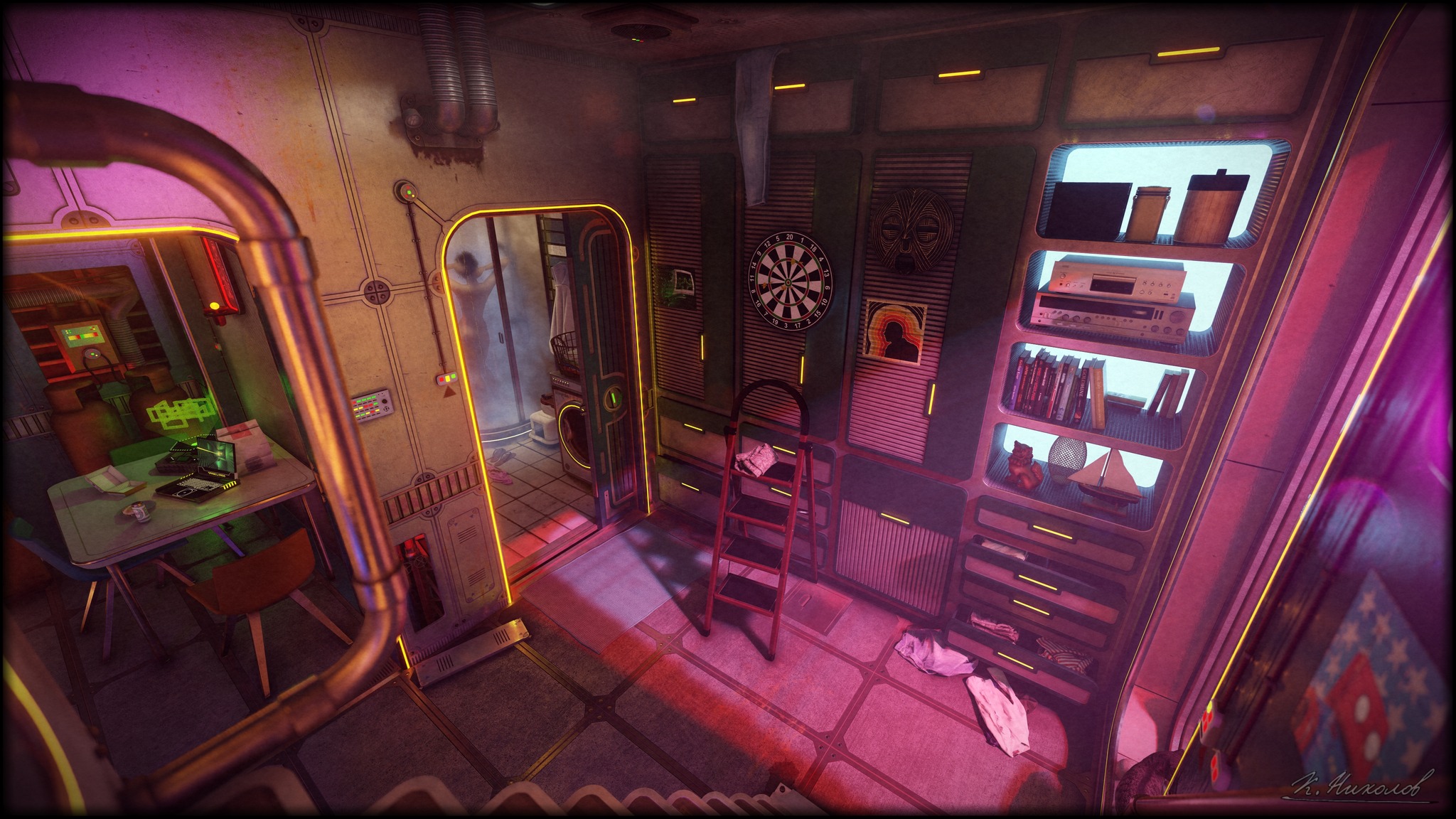
This image functions as a meme representing the "glam" or "high life" aesthetic often associated with Cyberpunk culture. It plays on the contrast between the gritty, industrial interior design and personal clutter, symbolizing the juxtaposition of futuristic technology and mundane domestic spaces. The humor comes from the text in the bottom right corner—the artist's signature, "K. Nikkhov"—which is used as a fake caption, making it look like an attempt to describe the room, though the text is just a random identifier.
simple-description (llama3.2-vision_11b)
The meme is a screenshot from a cyberpunk-themed video game, specifically from the game "Cyberpunk 2077". The image shows a dimly lit, futuristic room with a desk and a chair, but the most striking aspect is the large, ornate mirror that dominates the center of the room. The mirror is surrounded by a halo of light, giving it an otherworldly appearance, and the text "I can see your house and I can see your house and I can see your house" is written in a futuristic font at the top of the screen.
detailed-analysis (gemma3-27b-vision)
Okay, let's break down this image using the requested theoretical frameworks. It's a complex and intriguing space, lending itself to layered analysis.
Visual Description
The image depicts a small, intensely cluttered living space, seemingly within some kind of metallic or industrial structure. It's a high-angle, slightly skewed view, making it feel claustrophobic. The predominant color scheme is a strong, almost overpowering combination of purple/magenta and glowing yellow/gold.
Key features:
- Interior Construction: Walls and visible structure appear metallic, possibly the inside of a large tube or compartment. A network of pipes, both thick and thin, runs along the walls and ceiling, lit with glowing yellow highlights.
- Cluttered Furnishings: The space is packed with an eclectic mix of objects: a small desk with electronics, a dartboard, bookshelves crammed with books and knick-knacks, a small stove/burner, and random items strewn on the floor (possibly trash). There’s a ladder leading to an unseen upper level.
- Retro/Industrial Aesthetic: Many of the electronics look decidedly retro – a boombox, old computer, and what might be a cassette player. This blends with the industrial feel of the metal structure.
- Lighting: The lighting is artificial and stark. The yellow glow from the pipes and embedded lights contrasts strongly with the purple/magenta walls, creating a sense of unease and artificiality.
- Framing: The strong framing of the doorway and the pipework directs our gaze into the space and accentuates the contained, enclosed atmosphere.
Foucauldian Genealogical Discourse Analysis
This image is deeply amenable to a Foucauldian reading. The space isn’t merely a “room”; it’s a site of power relations.
- Discipline and Surveillance: The very structure of the space – the enclosed, tubular nature, the network of pipes (potentially carrying utilities or monitoring systems) – evokes the panoptic gaze. Even if there's no visible camera, the layout implies potential surveillance. The arrangement of objects, almost like a controlled display, suggests that the occupant’s life is organized and potentially scrutinized.
- The Archive & Knowledge: The books are a key element. They aren’t merely decorations; they represent accumulated knowledge, and therefore, power. The specific books (though we can’t see titles) are part of a historical archive of discourse, shaping how the occupant understands the world.
- Normalization: The extreme clutter and seemingly disordered arrangement could be interpreted as a form of resistance against the normalizing forces of modern life. However, it could also be a manifestation of the ways in which power operates through disorder, shaping acceptable forms of eccentricity. The lack of space could indicate being ‘boxed in’ by structures of power.
- Genealogy of the Space: Tracing the “genealogy” of this space—its history and how it came to be—reveals the power dynamics inherent in its construction. Who designed it? For what purpose? The industrial aesthetic hints at a history of labor, production, and control.
Critical Theory
From a critical theory perspective, this space embodies several key themes:
- Alienation: The cramped, cluttered environment suggests a sense of alienation from nature and from genuine human connection. The occupant is surrounded by objects, but potentially isolated.
- Commodification: The objects themselves, even the books, can be seen as commodities—items that have been assigned economic value and contribute to the capitalist system. The occupant’s identity is partially constructed through their possessions.
- Reification: The objects within the space can be understood as “reified”—they have become detached from their original meaning and function and are treated as things in themselves. This process contributes to a sense of dehumanization.
- The Manufactured Self: The occupant is positioned as a product of societal forces and expectations. The space is a carefully constructed environment that reflects and reinforces these forces.
Marxist Conflict Theory
A Marxist analysis would focus on the material conditions of the occupant and the inherent class conflicts reflected in the space.
- Proletarian Existence: The cramped living conditions and cluttered environment suggest a life of economic hardship. It’s likely the occupant is a member of the working class, forced to live in a small, inefficient space.
- Alienation of Labor: The industrial aesthetic and the presence of electronics suggest a connection to the means of production. However, the occupant is likely not the owner of these means, but rather a worker alienated from the fruits of their labor.
- Commodity Fetishism: The objects in the space represent commodities, and the occupant’s attachment to them reflects the ideology of consumerism. This obscures the exploitative labor practices that produced these commodities.
- Ideological Control: The space itself can be seen as a tool of ideological control, reinforcing the dominant capitalist worldview.
Postmodernism
The image resonates with key postmodern themes:
- Fragmentation & Pastiche: The eclectic mix of objects and styles creates a fragmented and chaotic aesthetic. There’s a sense of pastiche—the blending of different eras and cultural references.
- Simulacra & Simulation: The space feels artificial and constructed. The objects may be simulacra—copies without originals—that have lost their connection to reality.
- Deconstruction of Meaning: The cluttered environment and the lack of clear organization undermine any attempt to impose a fixed meaning on the space.
- Irony & Self-Referentiality: The retro aesthetic and the juxtaposition of different styles suggest a degree of irony and self-referentiality.
Queer Feminist Intersectional Analysis
This analysis is more nuanced given the limited visual information, but we can make some observations:
- Domestic Space and Gender: Traditionally, domestic spaces are gendered. The clutter might be interpreted as a rejection of traditional, hyper-organized feminine ideals of domesticity. It could suggest a fluidity of gender expression and a challenge to stereotypical gender roles.
- Spatial Confinement & Oppression: The cramped space could be interpreted as a metaphor for the social confinement experienced by marginalized groups. This is particularly relevant considering the history of spatial control and policing of bodies, especially queer and feminist bodies.
- Intersectional Identity: The accumulation of objects could reflect the occupant’s multifaceted identity, incorporating elements of different cultures, interests, and experiences. The space becomes a site of self-expression and resistance.
- Challenge to Normative Space: The space's unconventional layout and clutter reject the normative expectation of how a living space "should" look. This can be seen as an act of resistance against heteronormative and patriarchal structures that dictate how space is organized and occupied.
Important Note: These analyses are interpretations based on visual cues. Without further context, these readings are necessarily speculative. The beauty of the image lies in its ambiguity and its capacity to evoke multiple meanings.
Hopefully, this breakdown provides a comprehensive analysis of the image using the requested theoretical frameworks. Let me know if you'd like me to elaborate on any specific point.
simple-description (llama3.2-vision)
This meme is an image of a room with a desk, a chair, and a door, but everything is distorted and warped. The text "I can see your house" is written on the wall, implying that the speaker is watching the person's home. The image is likely a reference to the popular TV show "The X-Files," which often featured a character named "The C-File" who was a villainous character.
tesseract-ocr
= y = — \ % Pe esi \ ry Z /} y ; \ © — A yd J y g eS Ss \ \) 7 a = | / y & f / = SN ee eS | See | =" \ : \ \% \ < l é 7 ayy - f = —e a j; a) We A x — Ff . = ne if f ees A | e P | ') Mm m™ an au a ij W , = \ ae” —_— i il] | fe ; f / a Sea [es \ 5 c~ SSL SS ee a