First Seen
2024-02-12T06:39:22.948760+00:00
simple-description (qwen3.5_2b-q8_0)
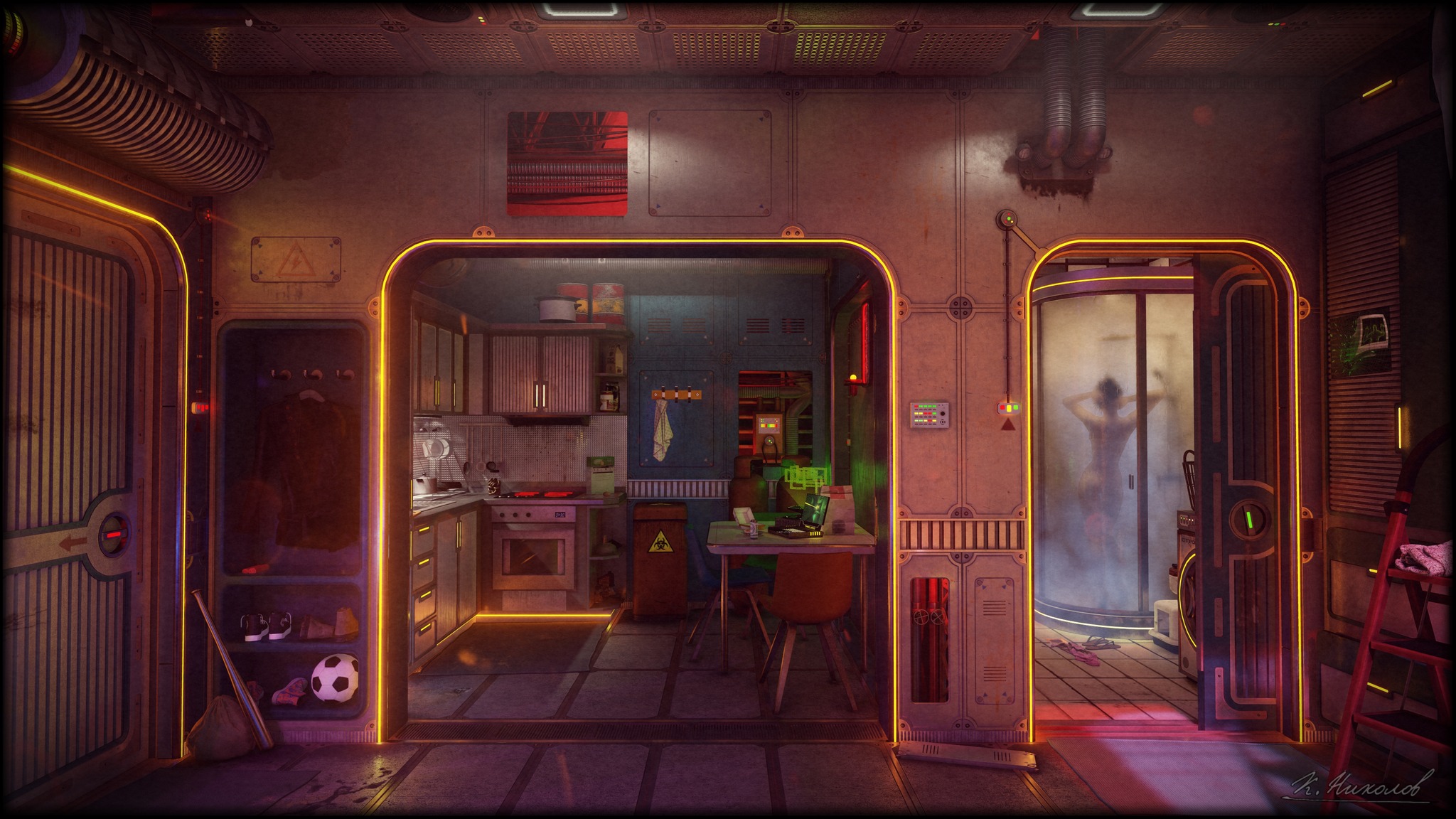
This image illustrates the common internet joke regarding Retro-Futurism or Cyberpunk aesthetics, where highly detailed digital renderings look incredibly cool and neon-heavy, but in reality, they are often just a static wall with a flickering yellow sign and background fan noise. The signature K. Nikholov is visible in the bottom right corner, attributing this specific "lo-fi" digital creation to the artist behind it.
simple-description (llama3.2-vision_11b)
The meme is a screenshot of a 3D rendering of a cyberpunk-themed room, with a neon-lit computer terminal in the center. The image is captioned "I can see your pixels, and I can see your code." The meme is a humorous commentary on the aesthetic of cyberpunk, highlighting the contrast between the futuristic, high-tech environment and the mundane, human-like computer terminal.
detailed-analysis (gemma3-27b-vision)
Okay, here's an analysis of the image broken down into sections, attempting to address the requested theoretical frameworks. I’ll indicate where a framework doesn’t strongly apply. Keep in mind this is an interpretation based on visual evidence and is open to other readings.
I. Visual Description
The image depicts a highly stylized, seemingly utilitarian interior space. It strongly evokes a retro-futuristic or cyberpunk aesthetic, likely a section of a spaceship, submarine, or isolated research facility.
- Spatial Configuration: The scene is framed by two doorways leading into the central kitchen space. The doorways themselves emphasize a sense of containment and division. The central space is relatively compact, dominated by metal cabinetry and equipment.
- Color Palette & Lighting: Predominantly saturated reds and oranges create a warm but claustrophobic atmosphere. Neon yellow/orange lighting lines the structural elements, highlighting the geometric forms. A cooler, bluish tone emanates from one of the doorways, suggesting another space or a source of moisture/condensation.
- Details & Objects: The kitchen is equipped with stainless steel appliances, metal shelving, and what appear to be scientific or monitoring devices. A strange object encased in glass hangs on a wall. The inclusion of objects like a child's toy (the robotic figure) and a doll head add a disconcerting layer. Pipes and ducts are visibly integrated into the architecture. A fog/mist hangs in the doorway on the right.
- Style & Atmosphere: The image is digitally rendered with a high degree of detail, leaning towards a graphic, stylized realism. It feels sterile, controlled, and potentially unsettling. The combination of domestic elements with technological and industrial design creates a sense of hybridity.
II. Foucauldian Genealogical Discourse Analysis
This image readily lends itself to Foucauldian analysis. The space, with its emphasis on control, monitoring, and division, can be read as a microcosm of power relations.
- Discipline & Surveillance: The architecture itself disciplines the inhabitants. The metal construction, tight space, and implied surveillance (monitoring equipment) create an environment of constant visibility. This is analogous to Foucault’s concept of the panopticon. The doorways, acting as thresholds, define boundaries and regulate movement, contributing to a system of control.
- Genealogy of the Kitchen: Historically, the kitchen has been a site of domestic power dynamics. This image subverts that, removing it from a purely domestic context and embedding it within a larger, potentially institutional, network. The genealogy of the kitchen, as a site of nourishment and care, is thus reconfigured to one of control and observation.
- Regimes of Truth: The visible technology implies a focus on measurement, analysis, and categorization – hallmarks of modern scientific regimes of truth. What is being measured, analyzed, or controlled within this space remains ambiguous, adding to the unsettling atmosphere.
- Normalization: The space’s organization suggests an attempt to create a normalized, predictable environment. However, the inclusion of seemingly random or incongruous objects (doll head, robotic figure) subtly disrupts that normalization, hinting at the failures or cracks within the system.
III. Marxist Conflict Theory
While not immediately overt, Marxist themes can be explored.
- Alienation: The sterile, functional nature of the space suggests a degree of alienation from labor and natural life. The inhabitants are reduced to operating within a highly controlled environment, divorced from the process of production or creation.
- Control of Resources: The enclosed, technologically advanced setting suggests a concentration of resources and power. The space is likely operated by a controlling entity, and the inhabitants are subject to its authority. The control of the food production/preparation within the kitchen implies control over the very basis of life.
- Class Division: The technological sophistication of the environment suggests a hierarchical structure, with those who control the technology wielding power over those who are subject to it. This could be read as a metaphor for class division.
- Commodity Fetishism: The focus on technology and manufactured objects obscures the labor and resources required to create them. The space celebrates the products of labor rather than the labor itself.
IV. Postmodernism
The image exhibits several postmodern characteristics:
- Pastiche & Hybridity: The fusion of domestic (kitchen), industrial (metal construction), and technological elements creates a jarring hybridity. This mixing of styles and contexts is characteristic of postmodern pastiche.
- Fragmentation & Discontinuity: The ambiguous nature of the space and the incongruous objects (doll head, toy) create a sense of fragmentation and discontinuity. The image resists a single, coherent interpretation.
- Simulacra & Simulation: The highly stylized, rendered nature of the image suggests a move away from "reality" towards simulation. The space is not a "real" kitchen but a representation of one, existing within a constructed reality.
- Rejection of Grand Narratives: The image does not offer a clear, unifying narrative. It resists easy explanation, embracing ambiguity and multiple interpretations.
V. Queer Feminist Intersectional Analysis
This framework is more subtle but potentially present.
- Domestic Sphere & Control: Historically, the domestic sphere (represented by the kitchen) has been a site of control over women's bodies and labor. The hyper-controlled, sterile environment here could be interpreted as an intensification of that control.
- De-naturalization of the Domestic: The removal of the kitchen from a traditional domestic setting challenges the naturalization of gender roles and expectations. This space disrupts the notion of a "natural" or "harmonious" domestic order.
- Intersection of Power Dynamics: The image subtly suggests an intersection of power dynamics—control over the body, control over resources, and the control of the environment. This could be interpreted through a queer feminist lens, recognizing how different forms of oppression intersect and reinforce each other.
- Disrupted Normative Spaces: The slightly unsettling, non-normative quality of the space disrupts conventional understandings of domesticity and challenges the idea of a "safe" or "comforting" home environment.
Disclaimer: This is an interpretation, and other readings are certainly possible. The image is complex and open to multiple layers of meaning. I’ve attempted to apply the theoretical frameworks in a way that feels relevant to the visual evidence, but subjectivity is inherent in any analysis.
simple-description (llama3.2-vision)
The meme is a screenshot of a video game's menu screen, specifically the "Help" section. The screen displays a list of humorous and absurdly specific instructions, such as "If you're stuck, try not to be." The text also includes a "Help" section that says "If you're stuck, try not to be. If you're not stuck, try to not be."
tesseract-ocr
pi} = ao cis Ti ai See a Z La —yy} es eT: a <A} r it iy a LD E “il, : ; ie ? " a E 2 ZYy C—E_ ae ' ps = ——————— ee oe j i pera : | zi CE tl 2, 9 ke | HWA tii, (ti | ; 2 Hee ll eee i ae Ot aa | oa Fj i | | aa a) ak a) | ) 1] ; a a i ee iN | | pail es a | tt \ i j | és |e aor = 2 es oe os ; : Ge a = ao | oa 4 ae MTT if : 5 = Mm iT 7 Es | MD ices | (awl al sae HT Hill oo a eeu | i oa || =| 4h | i ee _ fe | ~~ “ie A ee Barn srr ~~ = hi Be / fF we Soo : Nc “ss \ AC