First Seen
2024-04-02T21:52:35.911350+00:00
simple-description (qwen3.5_2b-q8_0)
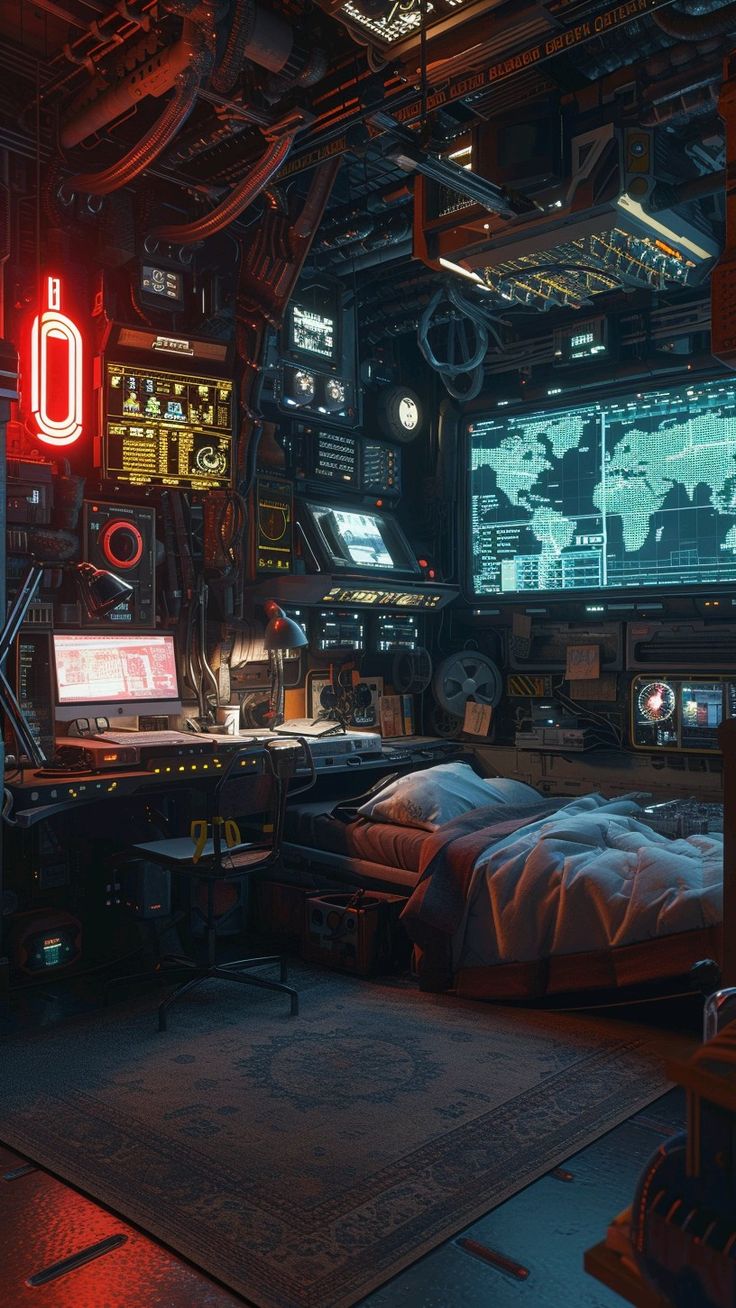
This meme typically plays on the contrast between the incredibly detailed, gritty, and "hyper-realistic" Cyberpunk aesthetic and the mundane reality of a simple room. For a person who cannot see it, the image depicts a high-tech command center cluttered with massive digital screens, a glowing red neon sign, and a simple bed tucked into the corner, all illuminated by the cool blue and red lighting of the room. The text "This image is bad" appears to mock the fact that despite the excessive technical detail, the scene lacks the chaotic, recognizable "fun" angle usually expected from this style of generation.
simple-description (llama3.2-vision_11b)
In the context of Cyberpunk aesthetics, the meme is a visual representation of a cluttered, high-tech workspace. The image depicts a cramped, dimly lit room filled with screens, wires, and machinery, with a bed in the center. The text "I can sleep when I'm dead" is often associated with this meme, implying a focus on work and productivity to the point of neglecting one's own well-being.
detailed-analysis (gemma3-27b-vision)
Okay, here's an analysis of the image, broken down into the requested sections, drawing on the theoretical frameworks you provided. It's a complex image, rich in potential readings. I will include disclaimers when a section doesn't fully apply.
Visual Description
The image depicts a highly technological, futuristic control room or surveillance center. The aesthetic is strongly cyberpunk, drawing on the tropes of neon lighting, exposed circuitry, and dense, claustrophobic spaces. The color palette is dominated by deep blues, blacks, and accents of neon red and teal. The room is filled with numerous computer monitors, consoles, and digital displays showing complex data visualizations, including a world map covered in data points.
The perspective suggests a low vantage point, looking up into the complexity of the control center. In the foreground, there are what appear to be medical or examination tables, unoccupied. The overall impression is one of intense surveillance, technological control, and a somewhat unsettling atmosphere. The room has a strong sense of depth and detail, creating a feeling of being immersed in this technological world. The cables and hardware are very visible, implying a lack of concern for presentation or 'cleanliness' - it’s raw power and function prioritized over aesthetics.
Foucauldian Genealogical Discourse Analysis
This image is highly suitable for Foucauldian analysis. The space screams of panopticism. The layout – numerous screens, the suggestion of observation (even without currently visible observers), and the placement of the medical-looking tables – evokes a space dedicated to monitoring, classifying, and potentially controlling individuals.
- Power/Knowledge: The technology itself is power. The screens aren’t simply displaying information; they create knowledge that can be used to exert control. The data visualized becomes a tool for defining, categorizing, and managing populations. The ability to collect, process, and display this data grants significant power to those who control it.
- Discipline and Normalization: The medical tables suggest a space for assessment, categorization, and potential intervention. This feeds into a Foucauldian notion of normalizing individuals – assessing their "deviance" from accepted norms, and subjecting them to processes (perhaps medical, behavioral, or otherwise) to bring them back into line.
- Genealogy of Control: We can imagine a genealogy of this space—a historical development of surveillance technologies from early forms of monitoring to the hyper-connected, data-driven system depicted here. The genealogy reveals how the methods of control have evolved, becoming increasingly pervasive and subtle.
- The Absence of the Observed: The fact the tables are empty is key. The power isn't necessarily about actively watching right now. It's the potential for observation, the knowledge that one could be watched at any time, which instills self-discipline.
Critical Theory
The image aligns well with some tenets of Critical Theory, specifically focusing on the role of technology in social control and the critique of instrumental reason.
- Instrumental Reason (Horkheimer & Adorno): The control room exemplifies instrumental reason – the focus on efficiency and effectiveness, devoid of ethical considerations. The technology is not being used for any explicitly stated good; it's simply a tool for gathering and processing information, regardless of its consequences.
- Technological Determinism (Soft Version): While not necessarily fully deterministic, the image suggests technology shapes social relations. The sheer amount of technology implies a society obsessed with control, data, and surveillance.
- Commodification of Data: The information displayed on the screens can be seen as a form of commodified data – harvested from individuals and turned into a resource for control. This aligns with critical analysis of the data economy and the exploitation of personal information.
- Loss of Autonomy: The potential for constant surveillance can erode individual autonomy and freedom. The image evokes a sense of being watched, managed, and controlled by an invisible power.
Marxist Conflict Theory
The connection to Marxist conflict theory is more nuanced, but present.
- Power Dynamics: The control room represents a clear power imbalance. Those who operate the technology have significant control over information and, potentially, the lives of those being monitored. This power is tied to the ownership of the means of technological production and control.
- Class Struggle (Potential): One could interpret the monitored population as a "proletariat" being surveilled by a "bourgeoisie" that controls the technology. This is more allegorical than explicit.
- Alienation: Constant surveillance could contribute to alienation, as individuals become objects of observation and control, losing their sense of agency and individuality.
- Control of Resources: The information gathered through the surveillance system can be used to control access to resources and maintain social order (or, conversely, to exploit and oppress).
Postmodernism
This image is saturated with postmodern elements.
- Simulacra and Simulation (Baudrillard): The data on the screens isn't necessarily "real" in any traditional sense; it’s a representation of reality, a simulation that has become detached from its original referent. We are seeing a hyperreality, where the simulations are more real than the real.
- Fragmentation & Deconstruction: The sheer complexity of the room, with its layers of screens and data, reflects a postmodern emphasis on fragmentation and the breakdown of grand narratives.
- Loss of Meaning & The Gaze: The focus is on the system of surveillance, not on any particular purpose or meaning. The gaze is impersonal, detached, and lacks any clear moral compass.
- Blurring of Boundaries: The image blurs the boundaries between the physical and the virtual, the real and the simulated, the observer and the observed.
Queer Feminist Intersectional Analysis
This is the weakest connection of all the frameworks, but still potentially relevant.
- Surveillance and Control of Bodies: Historically, surveillance and control systems have disproportionately targeted marginalized groups, particularly those who deviate from societal norms. The control room could be interpreted as a space dedicated to policing bodies and regulating behaviors.
- Intersectionality: If we imagine the monitored population, the control system would likely intersect with existing power structures to further marginalize those who already face discrimination based on gender, sexuality, race, class, etc. (This requires imaginative extrapolation, as the image doesn't show this explicitly).
- The Panoptic Gaze & Gender/Sexuality: The constant possibility of being watched, as articulated by Foucault, can be particularly oppressive for individuals who are already subject to scrutiny and judgment based on their gender identity or sexual orientation.
- Deconstruction of Normative Systems: One could argue that the deconstruction of reality in a postmodern sense can also disrupt traditional power structures and create space for alternative ways of being.
Let me know if you’d like me to expand on any of these analyses or focus on a specific theoretical framework in more detail!
simple-description (llama3.2-vision)
The meme is a screenshot of a 1990s-style computer desktop, with a Windows 95 interface and various system files and programs open. The desktop is cluttered with icons, windows, and error messages, and the text on the screen reads "Blue Screen of Death" and "System 32 Has Stopped". The image is a humorous representation of a computer user's nightmare, with the desktop completely frozen and unresponsive.
tesseract-ocr
ei Uz BESO iS ‘ es Ro We i) eee Tbe 4 ge | 5 AND : =p (| ees AY Gee pf Ae ee = SS WE a) pee = G _ ae —_ O\ Geen» oneal | a cee = ia 4 ‘iia & 3 i é Sa ™~