First Seen
2024-02-10T00:05:21.740582+00:00
simple-description (qwen3.5_2b-q8_0)
For someone who cannot see it:
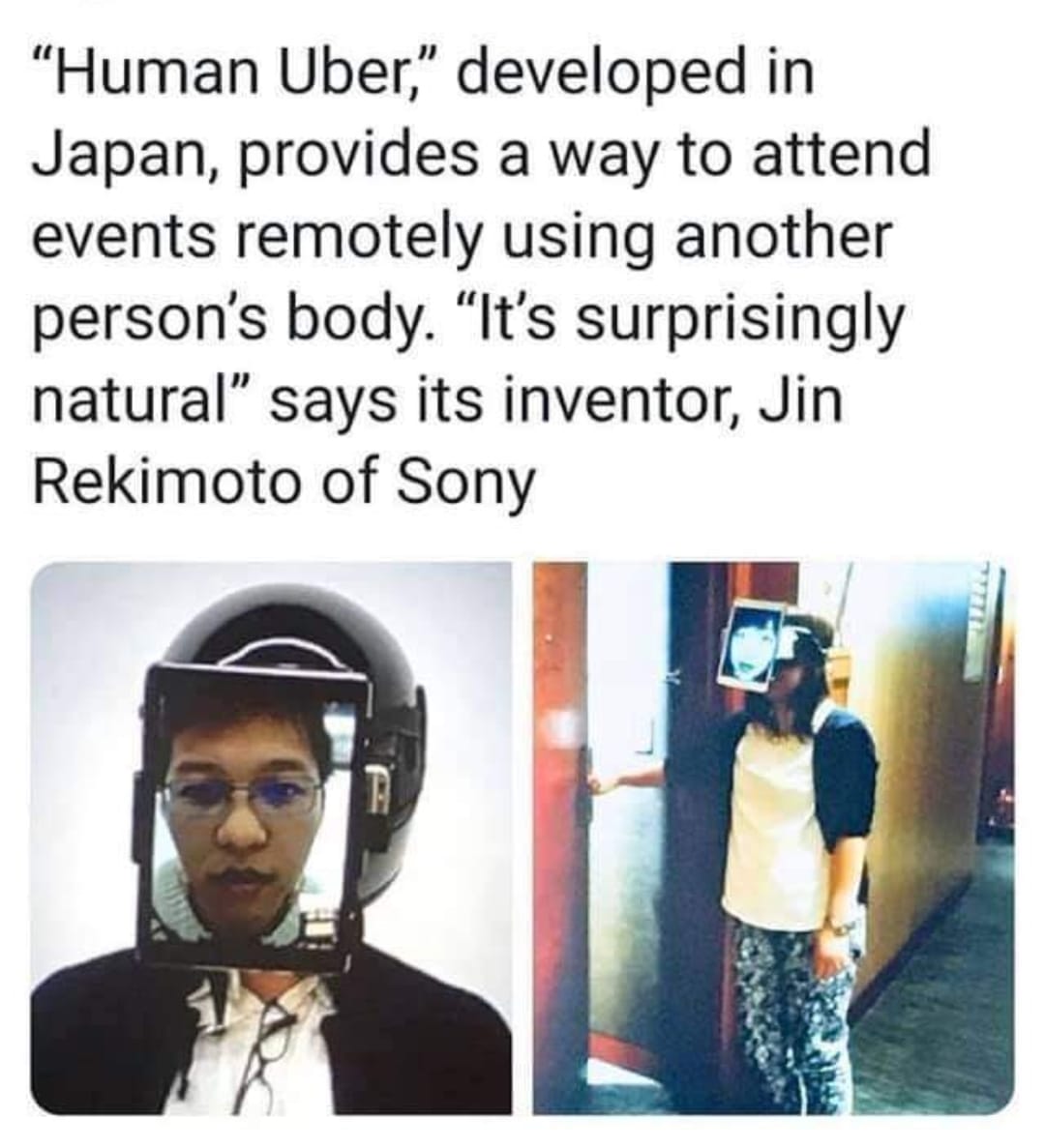
This image is a humorous explanation of a "telepresence" device. The text describes how the inventor created a mask called "Human Uber" that lets people act for others remotely. The pictures show a person wearing the bulky, black device with a small screen inserted into their face, and the other person using the device as a mirror to see their own face.
For the "Aesthetics - Cyberpunk" category:
This meme leans into the gritty, futuristic tone of the genre by treating a standard headset as a high-tech interface. The black, bulky mask worn by the subject resembles a bulky HUD (Heads-Up Display) that reveals their face through a small rectangular screen. The second image evokes the "glitchy" aesthetic common in Cyberpunk by showing a person using a "mirror block," suggesting a world where physical reality is blurring with digital simulation.
simple-description (llama3.2-vision_11b)
The meme is a humorous take on the concept of "human-robot" interactions, where a person is wearing a futuristic-looking helmet with a screen that displays a robotic face, making them look like a cyborg. The text "I'm not a robot" is a common phrase used to reassure humans that they are not machines, but in this case, it's a playful jab at the idea of humans becoming more like robots. The meme pokes fun at the idea of humans becoming more like machines, with the robot-like helmet and screen display, implying that even humans can be "robot-ized" in a humorous way.
detailed-analysis (gemma3-27b-vision)
Okay, here's an analysis of the image and concept of "Human Uber" through the lenses of the requested theoretical frameworks. Some frameworks are more applicable than others, so I've included only those that truly illuminate the subject.
Visual Description
The image presents two portraits. The left displays a man, likely Jin Rekimoto, wearing a large, black helmet-like device with a screen showing a view. He is formally dressed in a suit and tie, wearing glasses. The right side depicts a person wearing a similar device while walking down a hallway, seemingly operating a remote body. The device obscures their face, giving a sense of anonymity and potentially dehumanization. The setting appears to be an office or institutional building. The aesthetic is a blend of late 90s/early 2000s tech and a slightly unsettling feeling of surveillance.
Foucauldian Genealogical Discourse Analysis
This technology, "Human Uber," is a fascinating site for Foucauldian analysis.
- Power/Knowledge: The device embodies a relationship between power and knowledge. The 'operator' (person controlling the remote body) gains access and control over a physical space and experience without being physically present, wielding a unique form of power. This power is produced by the technological knowledge used to create the device.
- Discipline & Surveillance: While not overtly a system of panoptic surveillance, the technology subtly incorporates elements of it. The remote body is, in a sense, a proxy, and its actions can be monitored and potentially controlled by the operator. There's a feeling of disembodied observation. The operator also allows their body to be "observed" through the helmet.
- Genealogy of Presence: We can trace a 'genealogy' of the concept of presence. Historically, being present at an event required physical co-location. Then came telephone, then video conferencing. This device represents a further abstraction, dissolving the boundaries of the physical body and offering a new, mediated form of presence.
- Normalization of Control: The inventor's statement “It’s surprisingly natural” is critical. It suggests a process of normalization. The technology is presented as not radically different from existing modes of interaction, subtly making the idea of remote embodiment and control more acceptable.
Critical Theory (Frankfurt School)
"Human Uber" raises concerns central to Critical Theory:
- Instrumental Reason: The technology exemplifies the pursuit of efficiency and control through technology (instrumental reason). The purpose isn’t necessarily to enhance human connection but to solve a practical problem—remote attendance—by maximizing technological capability.
- Dehumanization and Alienation: By separating the mind (operator) from the body (avatar), the technology risks exacerbating the alienation inherent in modern life. It fragments the experience of being human and raises questions about the integrity of the self. Is the body simply a tool, a vehicle for the mind?
- Commodification of Experience: The technology could be expanded to allow people to “rent” their bodies for others to experience things, potentially turning the human body into a commodity, a resource to be exploited for profit.
- Loss of Authenticity: This system creates a mediated, artificial experience. It raises questions about the authenticity of experience and the erosion of genuine human connection.
Marxist Conflict Theory
The image and technology prompt several Marxist observations:
- Technological Determinism & Capital: The device could be viewed as a product of capitalist drive to maximize efficiency and control, potentially leading to a further commodification of time and experience.
- Exploitation: A potential extension of this technology could create a class of "body renters" who exploit their physical bodies for the benefit of those who can afford to remotely experience events. This creates a clear power imbalance and a new form of labor exploitation.
- Alienation from Labor & Self: The concept of outsourcing bodily experience further alienates individuals from their own bodies and from the physical world.
Postmodernism
"Human Uber" perfectly embodies several key Postmodern themes:
- Simulacra and Simulation: The technology creates a simulation of presence, blurring the lines between real and representation. The remote body is a simulacrum—a copy without an original.
- Fragmentation of the Self: The separation of mind and body represents a fragmentation of the self, a rejection of the notion of a unified subject.
- Hyperreality: The experience mediated by the device could be more intense or appealing than real-life experiences, leading to a state of hyperreality where the simulation is preferred to the 'real'.
- Deconstruction of Boundaries: The device actively deconstructs the traditional boundaries between self and other, present and absent, mind and body.
Let me know if you'd like me to elaborate on any of these analyses!
simple-description (llama3.2-vision)
This meme is a humorous image that shows a person wearing a "Human Uber" helmet, a device that allows people to attend events remotely using another person's body. The image shows a person wearing a helmet with a screen in front of their face, and a quote from the inventor of the device, saying "It's surprisingly natural". The meme is likely to be humorous because it pokes fun at the idea of using a device to attend events remotely, and the quote suggests that it's not as natural as it seems.
tesseract-ocr
“Human Uber,” developed in Japan, provides a way to attend events remotely using another person's body. “It’s surprisingly natural” says its inventor, Jin Rekimoto of Sony