First Seen
2024-02-12T05:30:53.174358+00:00
simple-description (qwen3.5_2b-q8_0)
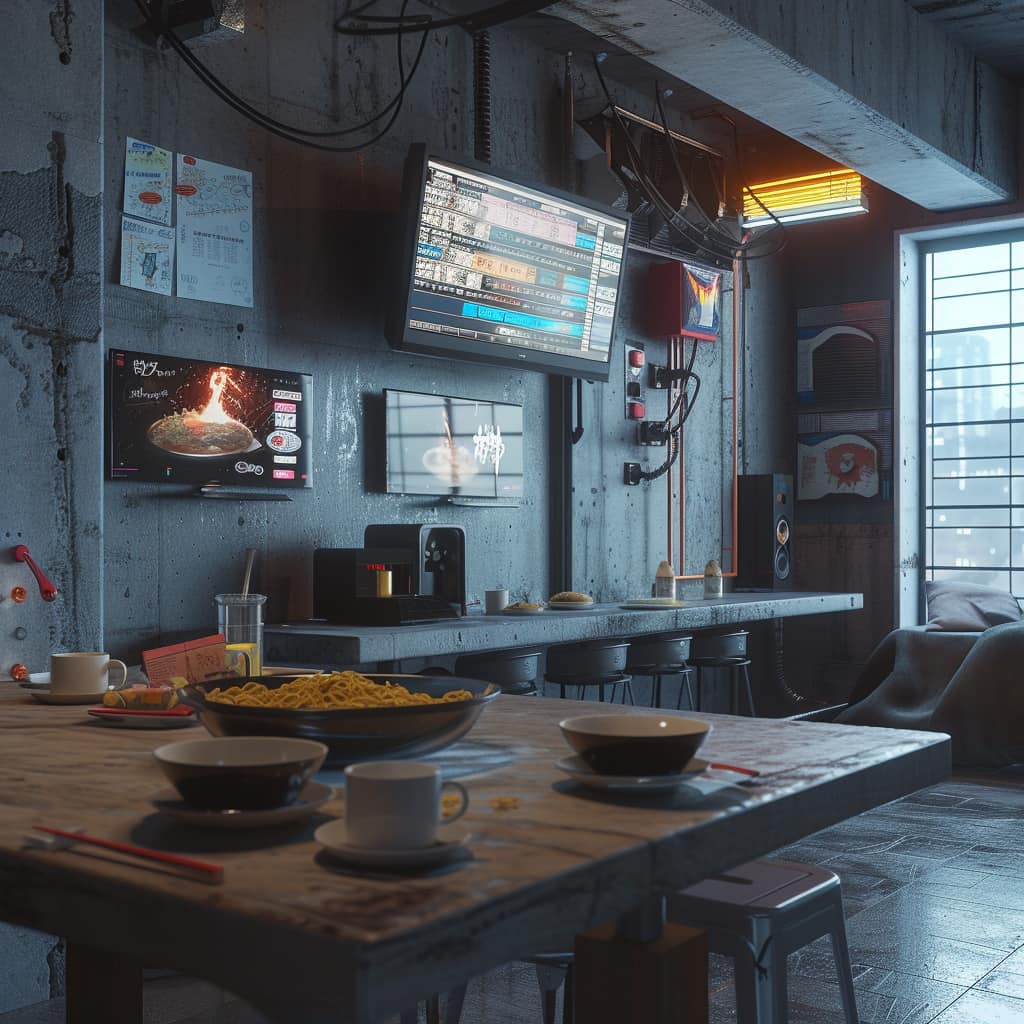
This atmospheric cyberpunk diner features exposed concrete walls and neon lighting, creating a gritty, futuristic environment. The "I ordered noodles" meme is played on the large bowl of noodles in the foreground and the standard "Noodle Bowl" poster on the wall, accompanied by a TV screen displaying the text "YUMMY", implying that the meal itself is the only thing of value.
simple-description (llama3.2-vision_11b)
The meme is a screenshot of a cyberpunk-themed virtual reality game, where a player's character is stuck in a loop of taking selfies in a dimly lit, futuristic nightclub. The image shows a character's avatar staring blankly into a camera, with a "Selfie Mode" notification on the screen. The text overlay on the image reads, "Stuck in VR and can't escape."
detailed-analysis (gemma3-27b-vision)
Okay, here's an analysis of the image, broken down into the requested sections. I'll indicate sections that aren't strongly applicable. It's important to remember these are interpretations based on visual cues, and can be debated.
Visual Description
The image depicts a dimly lit, seemingly Asian-inspired noodle shop or diner. The aesthetic is heavily industrial and somewhat gritty, suggesting an urban location and perhaps a lived-in, unpretentious atmosphere.
- Setting: The space has exposed concrete walls and ceiling, with visible pipes and wiring. This emphasizes a utilitarian, functional rather than decorative environment. The large window, overlooking what seems to be a rainy city street, provides a sense of place.
- Objects: The foreground is dominated by a worn wooden table cluttered with empty bowls and remnants of a meal. Behind this, a long counter with stools extends into the midground. A large television screen displaying a menu and promotional content is the focal point. The space is peppered with posters, signage, and what appear to be red fire extinguishers, adding to the cluttered and functional aesthetic.
- Lighting & Mood: The lighting is predominantly cool-toned, with neon hints and shadows. This creates a moody, somewhat melancholic atmosphere. The overall effect is a sense of authenticity and perhaps a hint of urban loneliness.
- Color Palette: Predominantly blues, grays, and browns with pops of red and orange from signage and perhaps food. This gives a subdued and slightly desaturated color scheme, contributing to the sense of age and wear.
Foucauldian Genealogical Discourse Analysis
This image provides rich grounds for a Foucauldian analysis focusing on the discourses surrounding food, labor, and urban space.
- Disciplinary Power: The arrangement of the space itself (counter seating, visible surveillance through the window, even the ordering process as implied by the television screen menu) establishes a framework of control. The diner operates within norms of consumption, speed, and efficiency. Customers are implicitly disciplined to consume within this system.
- The Panopticon: The large window, while offering a view of the city, also allows for a form of surveillance. Those inside are visible, and the space feels observed. This echoes the panoptic principle, where individuals self-regulate knowing they could be watched.
- Discourse of "Authenticity": The worn aesthetic – concrete walls, exposed wiring, mismatched furniture – invokes a discourse of authenticity. It suggests this is a "real" place, unpretentious and genuine, in contrast to overly polished or sanitized environments. This authenticity is constructed through these visual cues. The choice of a noodle shop, often associated with street food and working-class culture, reinforces this discourse.
- Genealogy of the Menu: The television screen functions as a modern form of menu display. Tracing the genealogy of the menu from handwritten boards to printed slips to digital displays reveals changes in economic practices, the commodification of food, and the acceleration of consumer culture.
Critical Theory
The image invites analysis through the lens of Critical Theory, specifically addressing the ways in which power structures and ideology manifest in everyday spaces.
- Commodification of Everyday Life: The noodle shop, as a commercial space, represents the commodification of basic needs. Even the seemingly "authentic" atmosphere is part of the branding and contributes to the marketability of the experience.
- Alienation & Urban Space: The dim lighting, exposed concrete, and solitary table setting evoke a sense of alienation. The shop provides sustenance, but it does not foster community or connection. It reinforces the isolating effects of modern urban life. The viewer is positioned as an outside observer, furthering the sense of distance.
- The Spectacle: The large television screen acts as a form of spectacle. It distracts from the labor involved in preparing the food, the actual experience of eating, and the social connections that might occur. It turns the act of consumption into a passive experience.
- Reification: The image can be seen as a reification of the urban landscape – a depiction of a specific place divorced from its social and historical context, presented as a static object for observation.
Marxist Conflict Theory
A Marxist reading of the image centers on the inherent class conflict embedded within the space.
- Labor & Exploitation: Though not visible, the preparation of the food relies on the labor of workers. The shop is a site of economic exchange where value is extracted from labor. The aesthetic emphasizes the result of labor (the food) but obscures the process and the conditions under which it is produced.
- Commodification of Culture: The noodle shop represents a specific cultural tradition (likely East Asian). The commodification of this culture, within a capitalist system, can lead to its appropriation and distortion.
- Urban Segregation: The location (indicated by the rainy city street) and the functional, unpolished aesthetic may suggest a working-class neighborhood or a marginalized area. The shop caters to a specific demographic, reinforcing existing social divisions.
- Alienation from Production: The diners are alienated from the production of their food. They are consumers, not producers, and have no control over the process that brings the food to their table.
Postmodernism
The image embodies several hallmarks of postmodern aesthetic and thought.
- Pastiche & Simulation: The blending of industrial and cultural elements (exposed concrete alongside Asian signage) creates a sense of pastiche. The atmosphere feels constructed, simulated, rather than genuinely authentic.
- Blurring of Boundaries: The image blurs the boundaries between public and private space, between consumption and experience. The diner is both a functional space and a stage for constructing identity.
- Deconstruction of Authenticity: The use of worn and aged materials is a deliberate deconstruction of traditional notions of authenticity. The “realness” is a carefully constructed illusion.
- Fragmentation & Disconnection: The solitary table setting, the dim lighting, and the fragmented visual elements contribute to a sense of disconnection and alienation – a hallmark of the postmodern condition.
Queer Feminist Intersectional Analysis
While the image doesn't explicitly depict individuals, a Queer Feminist Intersectional analysis can address the implicit power dynamics and cultural expectations at play.
- Spatial Politics: The diner, as a public space, is subject to gendered and racialized expectations. The arrangement of seating, the types of foods offered, and the overall atmosphere may implicitly exclude or marginalize certain groups.
- Labor & Care Work: The unseen labor involved in preparing the food is often performed by women and/or marginalized communities. This labor is often undervalued and underpaid, reflecting systemic inequalities. The diner’s function as a source of nourishment can be seen through the lens of care work.
- Commodification of the Body: The presentation of food can be linked to the commodification of the body, particularly in relation to dieting, beauty standards, and social pressures.
- Absence & Representation: The absence of diverse bodies and experiences within the image is itself significant. This reinforces dominant narratives and reinforces the invisibility of marginalized groups.
Let me know if you'd like me to elaborate on any of these points, or focus on a specific theoretical lens!
simple-description (llama3.2-vision)
The image depicts a dark, dimly lit room with a single, flickering computer screen displaying a popular video game's menu. The text on the screen reads "Soul Reaver 2: The Final Requiem". The image is likely referencing the game's infamous "The Final Requiem" cutscene, which is often mocked for its awkwardness.
tesseract-ocr
| ee ~~ = ee. a aE i = ' : a : [ s 7 [ = en , Sa Cl)” | : — cae = 4 Ss ree a 4 i : Wy) i: | re al ttt Ee i { a) a [ oF i i: Oe. 2) «ty = eae ~ 3 a | a ® 8 % . ——— re al ~