First Seen
2024-03-29T07:04:59.895846+00:00
simple-description (qwen3.5_2b-q8_0)
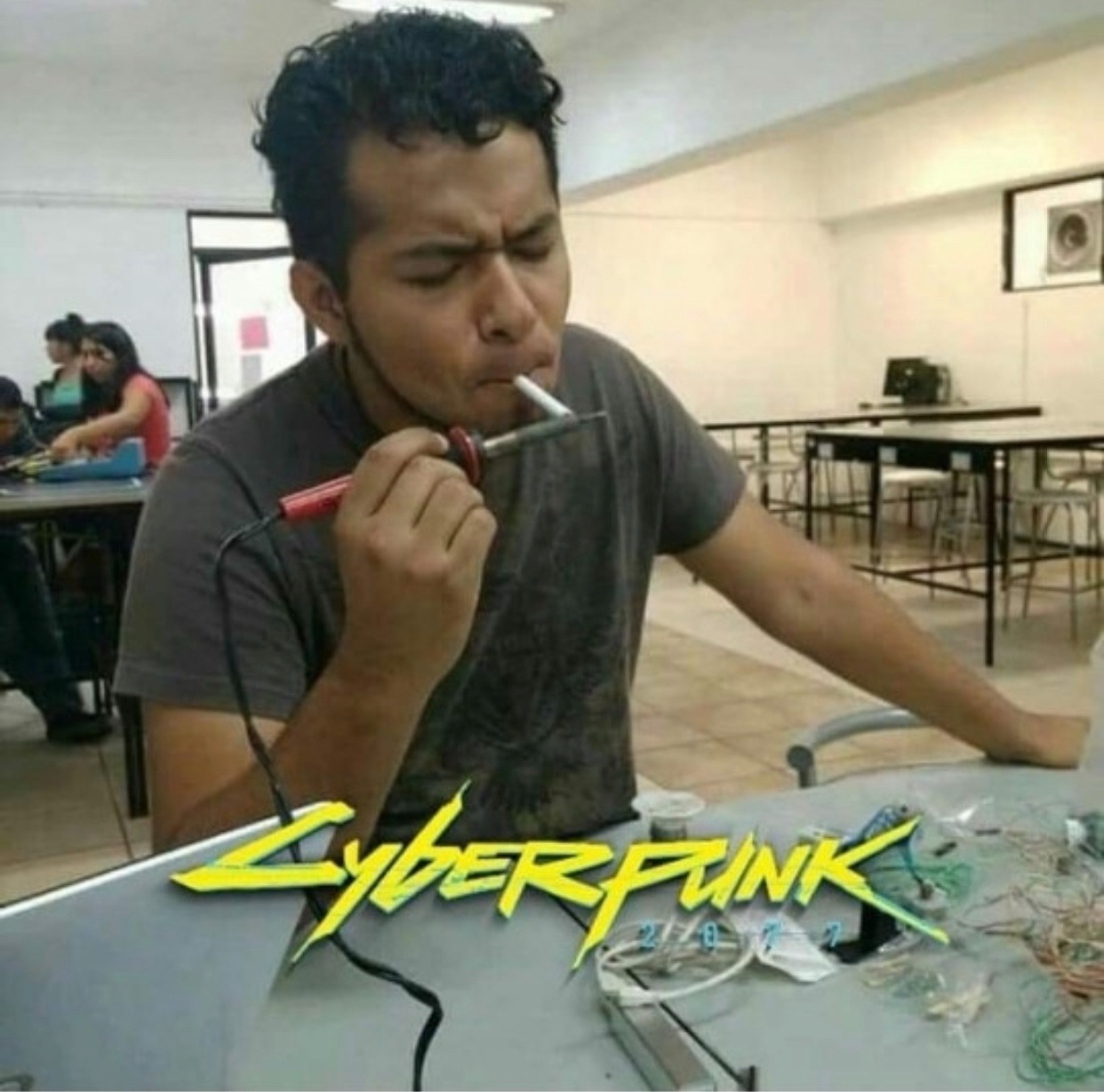
This meme celebrates the specific visual identity of the "Cyberpunk" aesthetic. It shows a young man smugly licking his soldering iron, a gesture associated with the cool, high-tech culture of the anime Cyberpunk: Edgerunners. The text "CYBERPUNK" appears in its iconic bright yellow, neon-style font with a black outline, evoking the franchise's signature look, while the smaller "2017" text below it suggests it is a retro internet meme.
simple-description (llama3.2-vision_11b)
The meme is an image of a person with a messy, cyberpunk-inspired workspace, surrounded by wires and gadgets. The text "Cyberpunk" is written in a futuristic font, but it's overlaid on a photo of someone eating a donut, making it a humorous juxtaposition of the high-tech aesthetic with a mundane, everyday activity.
detailed-analysis (gemma3-27b-vision)
Okay, let's break down this image through the lenses you've provided, applying relevant analysis where appropriate. It's a challenging image to analyze deeply, as it's a fairly mundane snapshot with the "Cyberpunk" logo overlaid, but we can still unpack its potential meanings.
Visual Description
The image depicts a man seated at a table in what appears to be a classroom or workshop. He's focused on a task involving a small, partially disassembled electronic device (possibly a circuit board or similar). He's holding a pen-like tool and a small screwdriver, suggesting repair or modification. The room is sparsely furnished with tables and chairs. Other people are faintly visible in the background, seemingly engaged in similar activities. The lighting is somewhat dim and fluorescent, giving a functional, institutional feel. The "Cyberpunk" logo is prominently placed in the foreground, overlaid on a section of the table and the device. The man appears to be of Latin American or indigenous descent.
Foucauldian Genealogical Discourse Analysis
The setting—a workshop or classroom—immediately evokes systems of knowledge and power. Foucault's ideas on discourse can be applied here by considering how technical skill and repair are constructed as forms of knowledge. The act of taking apart and reassembling an electronic device isn't neutral; it's embedded within a discourse of engineering, technology, and troubleshooting.
The "Cyberpunk" overlay creates an interesting disruption. Cyberpunk, as a genre, often positions technology as both liberating and oppressive, a tool of control and resistance. By placing this label over a seemingly mundane scene of technical tinkering, it invites us to question the relationship between everyday technical skill and broader systems of power. Is this person a rebel hacker, or just someone fixing a broken appliance? The image encourages us to question the construction of “expert” and “novice” within this technical domain and the power dynamics associated with technical knowledge.
Critical Theory
The image invites scrutiny through a critical lens, particularly regarding representation. The image can be examined through the lens of the "gaze." The viewer’s gaze may be directed at the subject, positioning them as an object of study, potentially essentializing their identity. This invites us to question whose knowledge is valued in the realm of technology and how that knowledge is disseminated. The fact that the man is performing an act of repair/modification—something typically associated with agency—could be seen as a subtle subversion of power structures, especially considering the potential for marginalized communities to be excluded from technical education and the digital world.
Marxist Conflict Theory
From a Marxist perspective, the image can be interpreted through the lens of labor and technology. The act of repair/modification can be seen as a form of "immaterial labor" – a task that contributes to the production and maintenance of technology, but isn't necessarily tied to traditional industrial production. In a capitalist system, the ability to repair and modify technology can be a source of economic empowerment, but also a means of exploitation if that skill is appropriated or undervalued.
The "Cyberpunk" overlay hints at the potential for technology to be used as a tool of control and surveillance, which aligns with Marxist concerns about the concentration of power in the hands of capitalist elites.
Postmodernism
The image lends itself to a postmodern reading because of the juxtaposition of a mundane scene with the hyper-stylized aesthetic of the "Cyberpunk" genre. This creates a sense of irony and fragmentation, disrupting traditional notions of authenticity and reality. The overlay itself can be seen as a form of "pastiche" or "simulation" – a deliberate blending of styles and references that challenges the idea of originality. The image doesn't offer a clear narrative or meaning; instead, it invites the viewer to interpret it in their own way. This ambiguity and fluidity are hallmarks of postmodern thought.
Does Queer Feminist Intersectional Analysis apply?
In this particular image, a robust Queer Feminist Intersectional analysis doesn't immediately present itself. The image doesn’t inherently showcase issues of gender, sexuality, or intersectional oppression. However, a nuanced analysis could be built around the historical exclusion of women and marginalized genders from STEM fields. One could argue that the image, even in its simplicity, challenges the stereotypical image of the tech worker (often depicted as white and male). The visible presence of another person of color in the background hints at a broader, more diverse community engaged in technical work.
Overall
This image is fascinating because of the overlay of the "Cyberpunk" logo. It transforms an otherwise ordinary scene into a potential commentary on technology, power, and resistance. While some of the analytical frameworks don’t fit seamlessly, they offer a range of perspectives for understanding the image's potential meanings.
Disclaimer: This analysis is based on the visual information available and is open to interpretation. Without further context, it's difficult to draw definitive conclusions about the image's intent or meaning.
simple-description (llama3.2-vision)
This meme is a picture of a person with a confused expression, sitting at a desk with a computer and various electronics scattered around them. The image is captioned "Cyberpunk 2077" and features the game's logo, which is a stylized, futuristic font. The meme is likely a humorous commentary on the game's notorious bugs and technical issues, with the image implying that the person is struggling to fix a problem with their computer.
tesseract-ocr
) — [se . ' N f } a. “ao ern LT ea / ‘hae v Se a 4 Y ‘ . Ss CA _ bo = 2 : - <— £7 4N, <<“ = “ Km T S