First Seen
2024-04-11T06:05:42.372740+00:00
simple-description (qwen3.5_2b-q8_0)
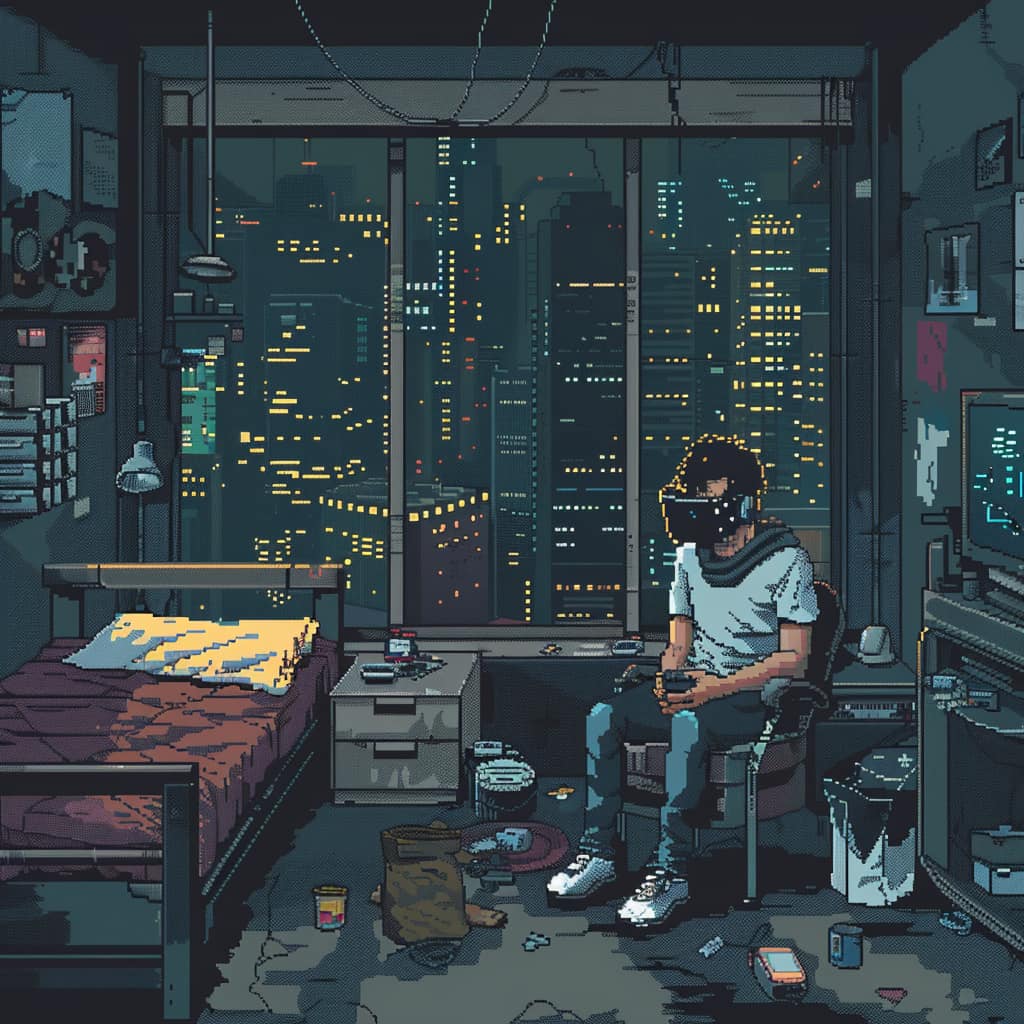
This image is the classic internet meme known as "Meme 8-bit," which features a scene set in a "dying room" with a messy bed and scattered items. On the right side of the image, a person is sitting in a chair wearing a VR headset and holding controllers, looking intently at a screen. The meme captures the feeling of being so engrossed in a virtual reality game that the chaotic, neglected physical reality of their surroundings is completely ignored.
simple-description (llama3.2-vision_11b)
The meme depicts a person in a cyberpunk-inspired bedroom, surrounded by clutter and trash. The image is captioned "I just spent 10 hours playing video games and I still have 10 hours left". This meme is relatable to anyone who has spent countless hours immersed in virtual worlds, only to emerge feeling disconnected from reality.
detailed-analysis (gemma3-27b-vision)
Okay, here’s an analysis of the image, broken down into the requested sections. I'll flag where a section is not applicable based on the image content.
Visual Description
The image is a pixel art rendering of a cluttered, small bedroom at night. Dominating the background is a large window showcasing a densely populated cityscape ablaze with lights. The room itself is cramped, showing signs of disarray: clothes, discarded containers, and various objects litter the floor. A single, unmade bed occupies one side of the room, covered with a red blanket and a crumpled white sheet.
In the foreground, a person (appearing to be male) sits at a desk, wearing headphones and seemingly focused on a device (possibly a gaming console or computer). The room is dimly lit by the city lights filtering in and a small desk lamp. The color palette is muted, consisting primarily of dark blues, reds, and grays, creating a melancholic and isolating atmosphere. The pixelated style gives it a retro gaming aesthetic, reminiscent of early video games or vaporwave art. The scene evokes a sense of solitude, modern isolation, and potential escapism.
Foucauldian Genealogical Discourse Analysis
This image is ripe for a Foucauldian analysis. The room functions as a heterotopia – a space that is simultaneously real and unreal, a space of deviation and otherness. Within the confines of the bedroom, power dynamics are subtly at play, particularly in relation to discipline and biopower.
- Surveillance & Self-Regulation: The person's immersion in a digital world (suggested by the headphones and illuminated screen) can be seen as a form of internalized surveillance. They are actively consuming and potentially being influenced by external discourses. The messy room could also be read as a refusal to conform to norms of order and cleanliness – a subtle act of resistance or a demonstration of a different mode of living.
- The Discourse of Technology & Isolation: The technology within the room doesn’t necessarily connect the person to others; rather it can be seen as a tool for self-containment. The image speaks to a discourse surrounding modern life, where digital interaction increasingly replaces physical connection, and individuals become more isolated despite being hyper-connected.
- Genealogy of the "Gamer": A genealogical analysis could trace the history of the "gamer" identity, examining how the practices, technologies, and discourses surrounding gaming have evolved, and how this figure is now subject to certain norms, expectations, and even forms of control (e.g., through algorithmic targeting, online communities, or consumerism).
Critical Theory
This image lends itself well to Critical Theory, especially concerning the impact of modern life and the alienation it can produce.
- Alienation & The Commodification of Experience: The person is physically present in a space, but mentally immersed in a digital world. This disconnect represents a form of alienation – a separation from self, others, and reality. The "experience" of gaming or online interaction becomes a commodity, something consumed rather than lived.
- The Culture Industry: The image echoes themes central to Adorno and Horkheimer’s work on the Culture Industry. The bedroom, filled with the products of mass culture (the console, headphones, etc.), functions as a microcosm of this industry. The person is passively consuming these products, potentially reinforcing dominant ideologies.
- The Loss of Authenticity: The image can be seen as commenting on the loss of authenticity in modern life. The individual's identity becomes increasingly shaped by external forces—the media, consumer culture, and the digital realm—leading to a sense of inauthenticity and disconnection from one's true self.
Marxist Conflict Theory
While not overtly focused on class struggle, a Marxist interpretation can be applied.
- Commodity Fetishism: The room is filled with objects (console, headphones, etc.) that represent capital. These objects aren't simply functional; they hold symbolic value and contribute to the individual's sense of identity. This exemplifies commodity fetishism – the assigning of value to objects beyond their inherent use-value.
- Capital and Leisure: The ability to spend time and resources on leisure activities (like gaming) is a privilege rooted in economic status. The image implicitly highlights the disparity between those who can afford such indulgences and those who cannot.
- Alienation from Labor: One could also interpret the individual's immersion in a digital world as a form of escapism from the realities of labor. The bedroom represents a space where they can temporarily disconnect from the pressures and alienation of work.
Postmodernism
The image is arguably deeply postmodern in its aesthetics and themes.
- Simulacra and Simulation: The city lights viewed through the window may be read as a simulacrum – a copy without an original. The individual’s engagement with the digital world is further removed from “reality.” The image blurs the boundaries between the real and the simulated.
- Fragmentation and Disconnection: The cluttered room and the individual’s isolated posture reflect a sense of fragmentation and disconnection – hallmarks of postmodern experience. There is no coherent narrative or overarching meaning; instead, the image presents a fragmented, disjointed view of modern life.
- The Death of the Subject: The individual’s immersion in the digital world could be interpreted as a loss of subjectivity – a dissolution of the self into a sea of information and stimuli.
Queer Feminist Intersectional Analysis
This is the least directly applicable framework but can be explored with some nuance.
- The Gendered Space of the Bedroom: The bedroom is historically a gendered space, often associated with femininity and domesticity. The image subverts this by presenting a masculine figure within this space, but one who is engaged in a typically "masculine" leisure activity (gaming).
- The Performance of Masculinity: The individual’s posture and the technological setting could be interpreted as a performance of a particular type of modern masculinity—one that is isolated, introspective, and technologically driven.
- Intersectionality of Isolation: While not explicitly visible, the image prompts consideration of how various forms of social marginalization (race, class, sexual orientation, etc.) might intersect to exacerbate feelings of isolation and alienation. The person's experience is likely shaped by their specific social location.
I hope this detailed analysis is helpful! Let me know if you'd like me to elaborate on any particular aspect.
simple-description (llama3.2-vision)
This meme is an image of a person sitting in a messy room, surrounded by trash and broken electronics, with a VR headset on and a controller in their hand. The text "I'm not lazy, I'm just on a different level" appears in a speech bubble above the person's head. The image is a humorous take on the stereotype that people who play video games all day are lazy, but in this case, the person is actually immersed in a virtual reality game.
tesseract-ocr
H x y I PA Ee ea Le = Be 4 A CH. | = Pee (Geer ie le yer = Se od : = a fee icon fee iJ [== q ay Roc —— =th Sin S214 js ye a(S ie ores Bae ee y : er eee i aot is ‘ : Fe ‘ ait © F ei 1 Si | . = LE or 2 os 4 > ed EE. —— - ae SS = k le ¢. ong a Fe rar gaa) =k “A SS oe i eal ie | es ia a Wiienete Wek “ee | la N a f Fi ee omg —-