First Seen
2024-04-21T20:07:26.465428+00:00
simple-description (qwen3.5_2b-q8_0)
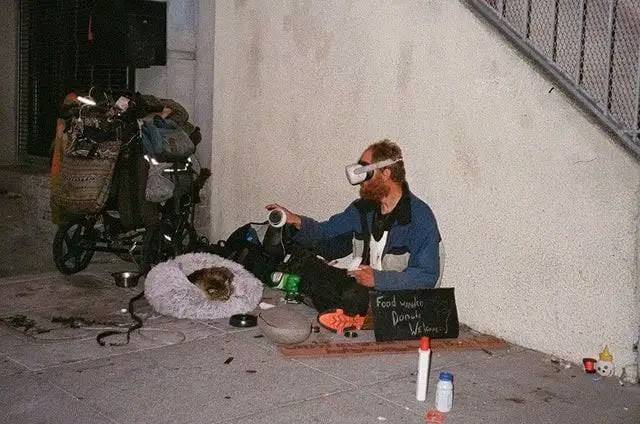
The image depicts a satirical meme where a homeless man is using a VR headset, appearing to be deeply lost in a virtual world while physically homeless. The humor lies in the juxtaposition of high-tech entertainment with a desperate, real-world struggle for food and shelter.
Next to him, a small black sign displays the handwritten text "Food made Donate Me," emphasizing the irony of trying to escape reality through digital screens when basic human needs are still unmet.
simple-description (llama3.2-vision_11b)
The meme is a photo of a homeless person sitting on the sidewalk with a sign that reads "Cyberpunk Artist" and a laptop open in front of them. The image is meant to be humorous and ironic, poking fun at the idea of a homeless person being a "cyberpunk artist" and the contrast between their living situation and the high-tech, futuristic aesthetic of cyberpunk.
detailed-analysis (gemma3-27b-vision)
Okay, here's an analysis of the image, broken down into the sections you requested. I'll indicate where sections don't apply, as well, to be thorough.
Visual Description
The image depicts a man seated on the ground in what appears to be an urban underpass or parking garage. He’s wearing a VR headset and gesturing with his hands, seemingly engaged in a virtual environment. He's wearing a blue jumpsuit and has a red beard. Next to him is a small, fluffy dog in a circular, cushioned bed. The immediate surroundings are somewhat cluttered with various items: a scooter/moped laden with bags, metal tools, bottles, cans, and a small chalkboard sign. The lighting is dim and somewhat grainy, giving a slightly unsettling and stark atmosphere. The chalkboard reads “Food, Drink, Welcome!”
Foucauldian Genealogical Discourse Analysis
This image is rich for Foucauldian analysis. We can trace the discourses at play and how they construct power/knowledge formations.
-
Discourse of Technology/Virtual Reality: The VR headset is central. Foucault would ask how the discourse of virtual reality has been constructed as escapism, progress, or even a solution to societal ills. The image disrupts this, placing the technology not in a sleek, utopian space, but in the gritty reality of an urban environment. It raises questions about who has access to this technology and what purposes it serves. Is it a genuine expansion of experience or a means of control, detachment, and normalization?
-
Discourse of Homelessness/Precarity: The man’s location—a rough, potentially unstable public space—and the scattered belongings suggest precarity and potentially homelessness. This discourse constructs ‘the homeless’ as ‘other’, often through the lens of individual failings. This image disrupts that narrative by positioning the man as a tech-user, engaging in a seemingly “advanced” activity.
-
Power/Knowledge: The man, in his VR world, appears to be exercising some agency. However, we must ask: Is this true agency, or is he being subjected to the power structures embedded within the virtual reality itself (algorithms, data collection, commercial interests)? His placement in the underpass, juxtaposed with the technology, shows a power imbalance.
-
Genealogical Tracking: One could trace the historical development of how the discourses around both technology and homelessness have been constructed and how they have come to define the categories of "user" and "homeless person."
Critical Theory
This image invites analysis through the lens of Critical Theory, specifically around concepts of alienation and commodification.
-
Alienation: The man’s immersion in VR could be seen as an extreme form of alienation from physical reality, from social connection, and from his own body. While engaging with a “virtual world,” he's simultaneously spatially and perhaps socially isolated. The underpass suggests a world of societal disconnection, amplified by the individual's virtual detachment.
-
Commodification of Experience: The chalkboard sign ("Food, Drink, Welcome!") hints at a potential exchange—perhaps he's offering a VR experience to passersby in exchange for sustenance. This commodifies experience, turning it into a marketable product. The VR headset becomes a tool for survival, a means of generating income.
-
The Culture Industry: We could view this as a microcosm of the “culture industry” (Adorno & Horkheimer). The technology, originally designed for entertainment or perhaps connection, is now being repurposed as a tool for survival in a capitalist system, highlighting the contradictions within the culture industry.
Marxist Conflict Theory
This image is strongly amenable to Marxist analysis.
-
Class Conflict: The setting and the man's apparent circumstances underscore class divisions. The juxtaposition of advanced technology and precarious living conditions embodies the inherent contradictions of capitalism. The man is forced to exploit the novelty of VR to survive.
-
Means of Production: The moped and its cargo can be seen as tools of labor, but the man isn’t using them for traditional employment. He’s using the VR technology to create a new, informal means of production – an experience he offers to others.
-
Superstructure & Base: The technology (VR) represents part of the superstructure (ideas, culture) built upon the economic base (the material conditions of life). In this image, the superstructure appears detached from the base, creating a stark contrast and highlighting the inequalities within the system.
-
Exploitation: Is this man exploiting a niche market for survival, or being exploited by the market forces that led him to such a situation?
Postmodernism
This image embodies several key themes within postmodern thought:
-
Simulation & Hyperreality: The VR headset creates a simulated reality, blurring the lines between what is “real” and what is “virtual.” This evokes Baudrillard's concept of hyperreality—a state where simulations have become more real than reality itself.
-
Fragmentation & Deconstruction: The cluttered surroundings, the juxtaposition of high and low technology, and the blurring of boundaries between physical and virtual spaces create a sense of fragmentation and deconstruction. Traditional categories and narratives are destabilized.
-
Loss of Grand Narratives: The image doesn't offer a clear or optimistic narrative. It’s a fragmented snapshot of a complex reality, resisting any attempts to impose a grand, overarching meaning.
-
Irony and Pastiche: The combination of seemingly incongruous elements—a futuristic VR headset in a derelict urban setting—creates a sense of ironic detachment.
Queer Feminist Intersectional Analysis
This section is harder to apply directly without more information about the individual, but possibilities exist:
-
Precarity & Marginalization: The man's situation likely intersects with various forms of marginalization (class, possibly race, health status). A queer or feminist analysis would ask how these intersections contribute to his precarity. Is he subjected to social stigma or discrimination that contributes to his unstable living situation?
-
Technological Access & Equity: A feminist analysis might question who benefits from and who is excluded from technological advancements like VR. Does the availability of this technology exacerbate existing inequalities?
-
Deconstruction of Binary Oppositions: The image challenges traditional binary oppositions (real/virtual, high tech/low tech, inside/outside). A queer feminist analysis might explore how these destabilizations resonate with the deconstruction of other binaries (male/female, masculine/feminine).
-
Vulnerability & Resilience: The man’s vulnerability is apparent, but his attempt to create a life for himself using technology also demonstrates resilience. A queer feminist perspective would recognize the strength and agency that can emerge from marginalized communities.
I hope this thorough analysis is helpful! Let me know if you'd like me to elaborate on any particular section.
simple-description (llama3.2-vision)
The meme is a photo of a person sitting on the street with a sign that says "Food stamps don't cover dental." The person is wearing a VR headset and has a dog sitting next to them. The image is likely meant to be humorous, implying that the person is using the VR headset to escape the harsh realities of their life on the street.
tesseract-ocr
ae Re bass sc Pee ee Me = be i # oo BN id AY a st Fst, ou ee ae a, — a ft mn cae yy 5 1 co & ¥ a ee i — ee : aay : Be ea ‘ eee iB Ss Bee 8 PO ee, al ee < iy =e