First Seen
2024-04-18T04:26:21.740788+00:00
simple-description (qwen3.5_2b-q8_0)
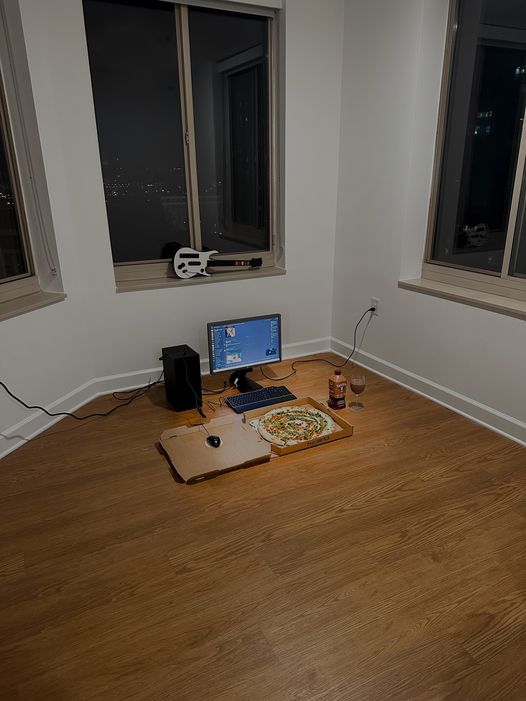
The "Aesthetics - Cyberpunk" meme satirizes the genre by contrasting the typical high-concept, tech-fantasy titles (like cybernetically augmented humans and sci-fi) with this low-budget reality of a guy chilling on a wooden floor. The text visible in the image, such as the local time "15:34" on the window and a slice of pizza on a tray, highlights the disconnect between the gritty aesthetic name and the simple, mundane act of playing a guitar and eating dinner late at night.
simple-description (llama3.2-vision_11b)
This meme is a photo of a dimly lit, cluttered room with a computer setup, but it's missing a crucial element: a keyboard and mouse. The caption "I can see for miles" is a reference to the classic song by The Proclaimers, but in this context, it's ironic because the room is actually very cluttered and messy, making it hard to see for miles.
detailed-analysis (gemma3-27b-vision)
Okay, here’s an analysis of the image, broken down into the requested theoretical lenses. I'll indicate when a section isn't applicable.
Visual Description
The image depicts a corner of a room with a minimalist aesthetic. The floors are covered in a laminate wood finish, the walls painted white, and a window on either side. The room is illuminated by the street lights visible outside, and potentially from the computer screen.
The primary focus is a computer setup on the floor. A monitor, keyboard, and mouse are visible, along with a speaker. Instead of a desk or table, the computer is placed directly on the floor.
Scattered around the computer are remnants of a meal: empty pizza boxes, a half-empty bottle of sauce, and a wine glass, suggesting a recent meal consumed in this space. The overall impression is one of solitary, possibly prolonged, use of the computer with the comfort of food nearby. The lighting and the scene’s composition create a somewhat melancholic or lonely atmosphere.
Foucauldian Genealogical Discourse Analysis
This image is rife with potential for Foucauldian analysis. The room itself can be seen as a site of power/knowledge. The floor-level computer setup is a telling detail. It diverges from the traditional, hierarchical placement of technology on a desk—a symbol of professional, productive work. Placing it on the floor subverts this, suggesting a dismantling of that traditional power dynamic. It's a space of personal, possibly unregulated, knowledge production.
The pizza boxes and wine bottle point towards a discourse of self-care/comfort, or perhaps self-indulgence. These practices aren’t inherently negative, but their prominence alongside the computer suggest a reliance on these comforts to sustain a prolonged engagement with digital space.
Genealogically, we might ask: How has the concept of "work" evolved? How have technologies like computers shaped our understandings of leisure, productivity, and even the body (being on the floor rather than in a chair)? The lack of a traditional workspace speaks to a breakdown of the separation between work and leisure. The screen, as a site for accessing and generating information, is now often intertwined with all facets of daily life.
Critical Theory
The scene embodies several key tenets of Critical Theory. It illustrates the concept of reification - the treatment of abstract concepts (like work, productivity, even self-care) as concrete objects or necessities. The computer is not simply a tool; it seems to have become a central element of the inhabitant's life, almost defining the space itself.
The deliberate placement of the computer on the floor could be interpreted as a resistance to traditional, normalized forms of work and labor. It's a physical rejection of the hierarchical organization of a traditional workspace. However, it’s crucial to ask: is this truly resistance, or merely a different form of accommodation within a late-capitalist system? Is this an act of rebellion, or just another way to integrate work into all aspects of life, blurring the boundaries between public and private, labor and leisure?
Furthermore, the image hints at alienation. The individual appears solitary, immersed in the digital world, possibly disconnected from meaningful social interaction. The food serves as a placeholder for connection but ultimately can't fill the void.
Marxist Conflict Theory
From a Marxist perspective, this scene encapsulates the contradictions of late-stage capitalism. The computer represents the means of production, but its presence on the floor, alongside the remnants of a meal, suggests a blurring of the lines between labor and consumption.
The individual is engaged in what could be either productive work (perhaps a remote job) or exploitative "immaterial labor" (creating content, engaging in social media, etc.) for minimal compensation. The pizza and wine represent the commodities used to pacify and maintain the individual’s participation in this system.
The spatial arrangement reveals a power imbalance: the individual is reduced to a consumer of information/entertainment, and a worker within the digital sphere, all within a small, confining space. The "comfort" provided by food and drink serves to mask the underlying conditions of exploitation and alienation. The situation could represent the precarity of digital labor and the erosion of traditional working class solidarity.
Postmodernism
The image is brimming with postmodern themes. The most striking is the decentering of traditional spaces and hierarchies. The computer isn’t on a desk, but on the floor, undermining the expected organization of work and leisure. This embodies the postmodern rejection of grand narratives and fixed structures.
The blurring of boundaries between work and life, public and private, is another key element. The comfort food signifies a search for meaning in a fragmented, consumerist culture. The image resists easy categorization; it's not a traditional office, a living room, or a dedicated entertainment space.
The scene also speaks to the simulacra and simulation described by Baudrillard. The comfort offered by the food and the digital world are substitutes for authentic connection and fulfillment. They are representations of experiences, divorced from any underlying reality.
Queer Feminist Intersectional Analysis
This image, while not overtly sexual or gendered, can be read through a Queer Feminist lens by examining the spaces of isolation and self-creation. The corner of the room, the deliberate placement of the computer, suggests a desire for a self-defined space—a retreat from normative societal expectations.
The solitary nature of the scene can be interpreted as a form of self-care and boundary setting, a reclaiming of personal space in a world that often demands constant productivity and visibility. The prioritization of individual comfort (food, wine) could be seen as an act of resistance against the demands placed on individuals – especially women and marginalized genders – to constantly prioritize the needs of others.
The image can also reflect the precarity of digital spaces for queer and marginalized individuals, who may rely on online communities for support but also face harassment and discrimination. The isolation of the scene could be a response to this precariousness, a withdrawal into a more controlled, self-defined environment. The lack of visible signifiers relating to gender or sexuality leaves room for intersectional readings relating to broader issues of social power and exclusion.
Let me know if you'd like me to elaborate on any of these interpretations, or explore a different theoretical framework!
simple-description (llama3.2-vision)
This meme depicts a dark and empty room with a computer setup, including a monitor, keyboard, and mouse. The text "I'm not lazy, I'm just on energy-saving mode" is displayed on the screen, implying that the person is not actually working, but rather conserving energy.
tesseract-ocr
\ | fi | ir ™ 4 8 = kaw! Le ee =