First Seen
2024-07-17T21:31:15.456992+00:00
simple-description (qwen3.5_2b-q8_0)
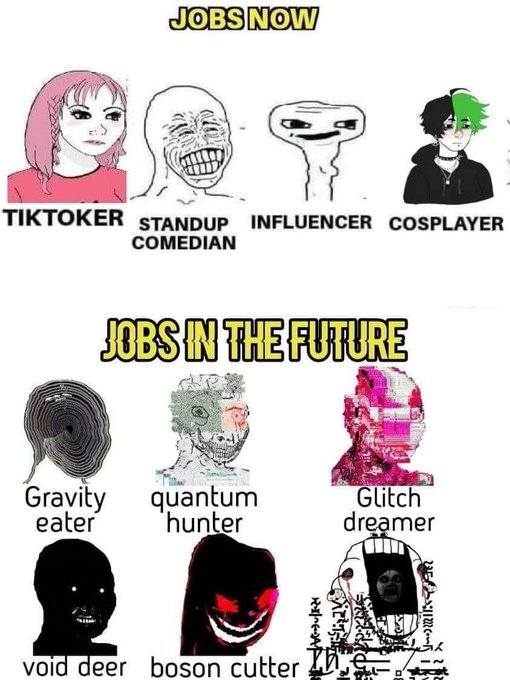
This meme depicts a world where internet careers evolve into terrifying, futuristic dystopian roles. It contrasts the recognizable "Jobs Now" with ominous future titles such as "Gravity Eater" and "Boson Cutter." It perfectly captures the Cyberpunk aesthetic by showing how digital fame transforms into high-tech monsters and glitched realities.
simple-description (llama3.2-vision_11b)
The meme depicts a series of futuristic and dystopian character archetypes, such as "Vaper" and "Rage" (not shown in the snippet), juxtaposed with more traditional and humorous character archetypes, such as "TikToker" and "Influencer." The text at the top of the image reads "Jobs Now" and "Jobs in the Future," implying a commentary on the changing nature of work and the rise of new professions.
detailed-analysis (gemma3-27b-vision)
Okay, let's break down this meme image, titled "Jobs Now" and "Jobs in the Future," using the requested theoretical frameworks. It's a complex image, so this will be a detailed analysis.
Visual Description
The image is a grid featuring cartoon or digitally manipulated faces paired with job titles. The "Jobs Now" row shows relatively conventional (though digitally mediated) occupations: Tik Toker, Standup Comedian, Influencer, and Cosplayer. The visuals are fairly standard for internet culture – stylized anime/manga aesthetics, and internet meme faces (like a distorted smiling face).
The "Jobs in the Future" row presents a dramatically different aesthetic. The images are heavily distorted, abstract, and bordering on the unsettling. They appear generated or heavily manipulated using digital art techniques. The figures are often fragmented, glitchy, or appear to be dissolving. The visuals evoke a sense of unease, hyper-reality, and digital decay. The images feel less human in the traditional sense and more like digital artifacts. There's a progression from relatively conventional, if internet-based, representations of work to completely abstract and almost incomprehensible ones.
Foucauldian Genealogical Discourse Analysis
This image is ripe for a Foucauldian analysis. Michel Foucault’s work emphasizes how power operates through discourse—the systems of knowledge and language that shape our understanding of the world.
- Genealogy of Labor: The image maps a genealogy of labor, showing a shift in what constitutes "work." "Jobs Now" are rooted in performance and visibility within existing (capitalist) structures. "Jobs in the Future" dismantle those structures, turning work into something fundamentally different, perhaps even incomprehensible from our current vantage point.
- Discursive Formation: The titles themselves ("Gravity Eater," "Void Deer") aren’t defined by practical skills but by abstract concepts. This suggests a shift in the discursive formation of work. Traditionally, work is defined by producing a tangible (or easily understandable) output. These future jobs suggest a work focused on concepts, experiences, or even the manipulation of fundamental forces, exceeding easily defined categories.
- Power/Knowledge: The shift in imagery suggests a changing relationship between power and knowledge. "Jobs Now" rely on visible performance—a kind of ‘self-branding’—to accrue power (influence, followers, income). The chaotic, abstract imagery of "Jobs in the Future" suggests power may become less about visibility and more about manipulating the underlying systems (gravity, quantum reality) that shape our world, and knowledge is less about defined categories and more about the ability to navigate and manipulate abstract forces.
- Discipline & Control: The image can be read as reflecting a sense of increasing digital discipline and control. The fragmentation and distortion in the "Future" row reflect the way digital technologies blur the lines between the self and external forces.
Postmodernism
The image is almost a textbook example of Postmodern themes.
- Simulacra and Simulation: The stark contrast between the “Now” and “Future” rows illustrates Jean Baudrillard’s concept of simulacra. "Jobs Now" still have a grounding in 'real' activities (performing comedy, making costumes, influencing purchasing habits). "Jobs in the Future" have become pure simulation - work divorced from any clear origin or purpose, operating at the level of signs and concepts. The "Gravity Eater" isn't doing anything in a traditional sense; it’s embodying a concept.
- Fragmentation & Deconstruction: The visual fragmentation of the "Future" jobs reflects the postmodern tendency to deconstruct grand narratives and fixed meanings. The "self" itself seems broken down into glitching pixels and abstract forms.
- Hyperreality: The distortion and abstraction in the "Future" row create a sense of hyperreality—a simulated reality that is more real than real. It’s not that these jobs will exist in a straightforward way, but that they represent a state where the boundaries between reality and simulation have completely collapsed.
- Loss of the Subject: The distorted figures suggest a fragmentation and loss of the coherent “self.” The future worker is no longer a defined individual but a node within a complex network of digital forces.
Critical Theory
Framed through Critical Theory (particularly the Frankfurt School), the image can be seen as a commentary on the alienation of labor under advanced capitalism.
- Commodification of Experience: "Jobs Now" show the ongoing commodification of experience. The influencer, cosplayer, and even the comedian are selling a curated version of themselves and their experiences.
- Alienation and Dehumanization: The "Jobs in the Future" take this to the extreme. They represent a level of alienation where work has become so abstract and disconnected from human needs and desires that it borders on the meaningless. The worker is no longer creating something for others or even for themselves, but simply existing as a function within a system.
- Technological Determinism: The image can also be interpreted as a critique of technological determinism—the idea that technology drives social change. The image suggests a future where technology has not liberated us but has instead created new forms of exploitation and alienation.
- Loss of Meaning: The increasingly abstract and incomprehensible nature of the "Future" jobs suggests a loss of meaning and purpose in work.
Marxist Conflict Theory
From a Marxist perspective, this image highlights the evolving nature of exploitation under capitalism.
- Labor Power & Surplus Value: "Jobs Now" represent different forms of selling labor power—attention, performance, creativity. "Jobs in the Future" suggest a future where even abstract conceptual labor is exploited.
- The Reserve Army of Labor: The sheer weirdness of the "Future" jobs could be seen as a metaphorical representation of the expanding "reserve army of labor"—those who are excluded from meaningful employment and forced to take on precarious or exploitative work.
- The Intensification of Exploitation: The abstract nature of "Future" jobs could be interpreted as a form of intensified exploitation—where workers are increasingly required to perform tasks that are divorced from any tangible outcome, leading to increased alienation and control.
- Alienation: The highly-abstract jobs of the future, devoid of clear outputs or purpose, reinforce the concept of alienation central to Marxist theory.
Queer Feminist Intersectional Analysis
While not immediately apparent, a Queer Feminist Intersectional analysis can reveal subtle readings.
- Deconstructing Binary Oppositions: The collapse of traditional job categories and the blurring of boundaries between work and play can be seen as a deconstruction of binary oppositions (work/leisure, creator/consumer). This resonates with Queer and Feminist critiques of rigid social categories.
- Precarious Labor & Gendered Impacts: The precariousness implied in the “Future” jobs disproportionately affects marginalized groups, particularly women, trans people, and people of color. This reinforces the intersectional understanding of how power structures intersect to create systemic inequalities.
- Digital Labor & Emotional Labor: Many of the "Jobs Now" require significant emotional labor (influencing, performing). This is often disproportionately demanded of women. The “Future” jobs, even more abstract, could exacerbate this dynamic.
- Re-imagining Work: The radical re-imagining of work could open up possibilities for alternative economies and work structures that prioritize care, community, and liberation.
Important Notes:
- Subjectivity: Interpretation is subjective. These are just some possible readings based on the given theoretical frameworks.
- Complexity: This image is deliberately complex and open-ended, inviting multiple interpretations.
- Meme Culture: Remember the image is a meme – intended to be provocative and humorous.
I hope this comprehensive analysis is helpful! Let me know if you'd like me to expand on any of these points or explore other theoretical frameworks.
simple-description (llama3.2-vision)
This meme is a humorous comparison of job titles from the past (e.g. "TikToker") to those of the future (e.g. "Glitch Dreamer"). The text "Jobs Now" is at the top, and "Jobs in the Future" is at the bottom. The meme pokes fun at the changing nature of work and the increasing importance of technology and internet culture.