First Seen
2024-11-04T04:34:15.153834+00:00
simple-description (qwen3.5_2b-q8_0)
This meme, often referred to as the "Cyberpunk Grisu," adapts the character from the video game Grisu: The Long Journey to represent a future, neon-soaked world where the original reality is gone. The bright, glowing yellow figure mimics the cybernetic aesthetic found in a dystopian setting. The text visible on the bag in the lower left corner contains the logo for the game itself, "Grisu: The Long Journey," grounding the surreal visual in the source material of the meme.
detailed-analysis (gemma3_27b-it-q8_0)
Okay, let's break down this image through a Cyberpunk aesthetic lens, utilizing the requested theoretical frameworks where applicable. It’s a fascinating image – the juxtaposition of the hyper-modern/digital with the old-world architecture is key to its Cyberpunk vibe.
Visual Description
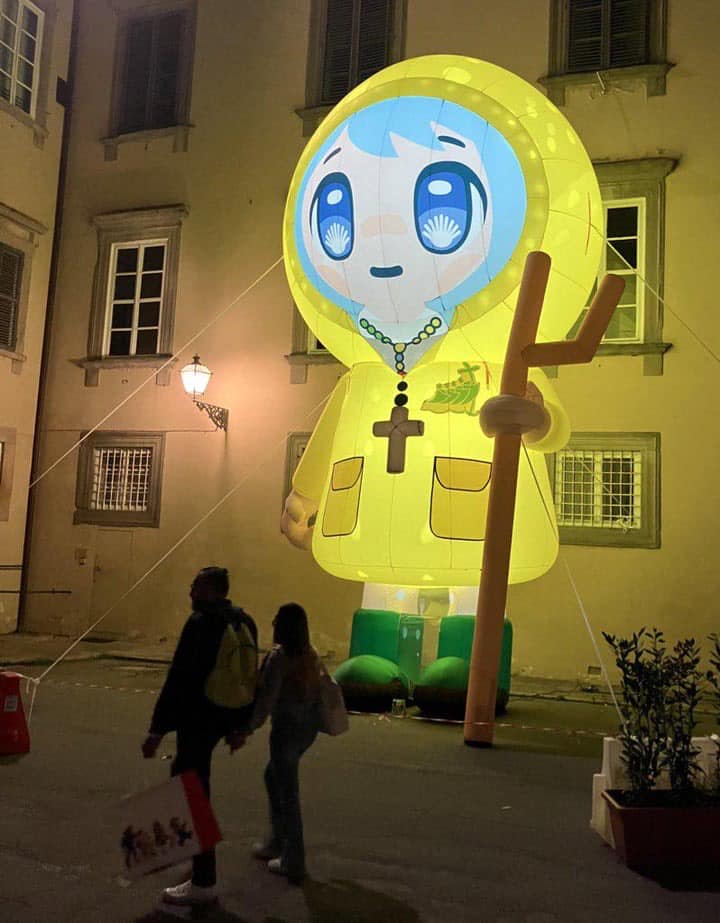
The image depicts a large, inflatable sculpture resembling a cartoon face—almost a simplified, kawaii emoji—suspended in a narrow, historic European street. The sculpture is primarily yellow, featuring large, wide-eyed expressions and a rosary necklace. It's framed by a large, minimalist cross-like structure. Below the face is a boxy, green shape that could be interpreted as a seating area. The backdrop is a traditional building with numerous windows and ornate detailing, illuminated by warm streetlights. Two figures in everyday clothing are walking by, almost indifferent to the bizarre spectacle. The overall effect is visually jarring, a clash of styles and eras. The lighting is stark, highlighting the artificiality of the sculpture against the aged stone of the building. The inflatable material creates a sense of ephemerality and unreality.
Postmodernism
This image is deeply rooted in postmodern sensibilities, which are foundational to the Cyberpunk aesthetic. Here’s how:
- Pastiche & Simulacra: The sculpture is a pastiche – a blending of disparate styles. It combines the high-culture religious symbolism (rosary, cross) with the low-culture, ultra-contemporary aesthetic of emojis and kawaii. This blend is a simulacrum—a copy without an original, a representation of something that has no inherent reality. It's a religious symbol represented as an emoji, stripping away the original meaning and layering on new, ironic interpretations.
- Deconstruction of Meaning: The sculpture actively deconstructs the meaning of traditional religious iconography. By rendering the cross and rosary in such a playful, cartoonish form, it undermines their solemnity and historical weight. It suggests a loss of faith or a detachment from tradition. This is a common theme in Cyberpunk, where established institutions are often seen as corrupt or irrelevant.
- Hyperreality: The street is a ‘real’ place, but the addition of this highly artificial and exaggerated form creates a sense of hyperreality - where the distinction between reality and simulation blurs. The walking figures represent the desensitization to these hyperreal environments, their everyday lives continuing despite the surreal surroundings.
Foucauldian Genealogical Discourse Analysis
Michel Foucault's work on power, knowledge, and discourse is relevant here. The sculpture can be seen as an intervention into the "discourse" of religion and public space:
- Power/Knowledge Nexus: Historically, religious institutions held considerable power over the production of knowledge and the regulation of behavior. This sculpture, by appropriating and subverting religious symbols, challenges that power structure. It re-codes these symbols with new meanings, potentially disrupting traditional power dynamics.
- Genealogy of Religious Imagery: A genealogical analysis would trace the historical development of the cross and rosary—their origins in specific socio-political contexts—and then examine how this sculpture alters their meaning within a contemporary context. It exposes the constructed nature of these symbols and their susceptibility to reinterpretation.
- Disciplinary Society vs. Control Society: Cyberpunk often imagines a shift from a Foucaultian "disciplinary society" (focused on institutions like schools and prisons) to a "control society" (where power is diffuse and operates through networks and information). This sculpture, potentially sponsored or placed within a broader urban intervention, can be interpreted as a manifestation of this control – an attempt to shape public perception and behavior through spectacle and symbolic manipulation.
Critical Theory
From a Critical Theory perspective, focusing on the Frankfurt School, this image can be analyzed as a reflection of the commodification of culture and the alienation of the individual:
- Culture Industry: The sculpture represents a product of the "culture industry," mass-produced and designed for consumption. It’s a spectacle created for attention and, potentially, economic gain. The religious imagery is repackaged as entertainment, stripped of its original spiritual significance.
- Loss of Aura: Drawing on Walter Benjamin’s concept of the "aura," the sculpture lacks the authenticity and historical presence of traditional religious art. It's a reproduction, a copy that lacks the unique quality of the original.
- Alienation: The indifference of the pedestrians speaks to a sense of alienation – a disconnect between individuals and their environment, their history, and their own beliefs. They are surrounded by spectacle, yet remain detached and unengaged.
Marxist Conflict Theory
While less directly apparent, a Marxist interpretation can be applied:
- Ideological Apparatus: The sculpture can be seen as a form of "ideological apparatus"—a tool used to perpetuate dominant ideologies. Even a subversive or ironic use of religious imagery still contributes to its circulation and potential co-option by the ruling class.
- Commodification of Religion: The image highlights the commodification of religion—its transformation into a marketable product. This reflects the capitalist tendency to reduce everything to exchange value.
- Class and Access to Space: The context of a European historical district also hints at issues of class and access. The sculpture is placed within a space traditionally associated with wealth and power, potentially reclaiming it (or ironically emphasizing its exclusivity).
Queer Feminist Intersectional Analysis (potential, limited)
This is the least directly applicable framework here, but we can consider a few points:
- Subversion of Traditional Norms: The jarring juxtaposition of religious imagery with a hyper-modern, cartoonish aesthetic can be seen as a form of queer subversion – a challenge to traditional norms and expectations.
- Gendered Symbolism: Religious iconography is often inherently gendered. The sculpture's androgynous, almost childlike, face potentially disrupts those traditional gender roles, though this reading is somewhat speculative.
In conclusion, this image is a potent visual embodiment of the Cyberpunk aesthetic. It embodies a world where technology, consumerism, and the decay of tradition collide. It prompts us to question the nature of reality, power, and meaning in an increasingly artificial and fragmented society. It's a fascinating visual provocation that resonates with the anxieties and themes central to the Cyberpunk genre.
simple-description (llama3.2-vision_11b)
The meme features a stylized, cartoon-like image of a robot with a large, glowing head and a menacing expression. The text "I can smell the desperation" appears in a bold, futuristic font above the robot's head, implying that the robot is detecting and mocking the desperation of those around it. The image is likely to be used in a humorous or ironic way to comment on the overuse of technology or the anxiety of living in a high-tech world.
detailed-analysis (gemma3-27b-vision)
Okay, let's break down this intriguing image through the lenses you've requested. Given the complexity of some of the theoretical frameworks, I'll focus on aspects the image clearly lends itself to.
Visual Description
The image depicts a nighttime street scene, likely in a European city based on the architecture. The backdrop is a multi-story building with numerous rectangular windows. Illuminating the narrow street is a projection – a large, glowing, cartoonish figure resembling a ghost or spirit. This figure is a vibrant yellow-green, with large, childlike eyes and a slightly melancholic expression. It appears to be adorned with a rosary. Beside the 'ghost' there is a chair and a tall yellow object, resembling a road sign. Two figures are walking away from the camera, silhouetted against the glow. The street appears wet, suggesting recent rain. The overall tone is one of surreal beauty and juxtaposition - ancient architecture with contemporary digital art.
Foucauldian Genealogical Discourse Analysis
This image offers fertile ground for Foucauldian analysis. Let’s consider the "ghost" as a site where discourses of the sacred, the playful, and the modern converge.
- Discourse and Power: The projection itself is a manifestation of power – the power to create a visual spectacle and reshape the urban space. This power rests with the artist/producers of the projection. However, it’s not a simple top-down power dynamic. The public’s reception, interpretation, and interaction with the image also contribute to its meaning.
- Genealogy of the "Sacred": The figure is wearing a rosary, an item with a long and complex history tied to religious faith, ritual, and social control. The projection repurposes this symbol, placing it on a cartoonish figure. This can be seen as a disruption of the traditional associations of the rosary, stripping it of some of its original authority. Foucault would be interested in how the meaning of "sacred" has been constructed and altered through historical discourse and practice. The cartoonish ghost is a disruption of what is traditionally considered sacred.
- The Urban Space as a Site of Discourse: The urban environment isn't a neutral background. It's a layered space where historical discourses (represented by the architecture) collide with contemporary ones (the projection). The image highlights how spaces are constantly being redefined and contested.
Postmodernism
The image is remarkably steeped in Postmodern aesthetic qualities.
- Pastiche/Intertextuality: The combination of elements – the traditional architecture, the cartoonish figure, and the religious symbol – creates a jarring and playful collage. It deliberately mixes high and low culture, questioning traditional hierarchies of artistic value.
- Blurring of Boundaries: The image deliberately blurs the lines between reality and representation. Is the ghost a 'real' spirit or just an illusion created by technology? This uncertainty is central to the Postmodern sensibility.
- Irony & Playfulness: The juxtaposition of the sacred and the silly carries an ironic undertone. It suggests a rejection of grand narratives and a celebration of ambiguity.
- Simulacra & Simulation: The projected image is a simulacrum – a copy without an original. It is a representation of a representation, divorced from any inherent meaning. This mirrors the Postmodern notion that reality itself is increasingly mediated by images and simulations.
Queer Feminist Intersectional Analysis
While not immediately apparent, a queer feminist lens can reveal nuances in the image.
- Disruption of Traditional Symbolism: The use of religious iconography on a playful, potentially gender-neutral figure (the ghost's form is ambiguous) can be interpreted as a rejection of heteronormative, patriarchal religious structures. It's a re-imagining of sacred symbols outside of their traditional context.
- Public Space & Reclaiming: The projection is taking place in a traditionally public space (the street). This act of artistic intervention can be seen as a reclaiming of space from dominant, often exclusionary, forces.
- Ambiguity & Fluidity: The ghost's fluid form and lack of fixed identity can be seen as a metaphor for queer and feminist struggles against rigid categorizations and binary oppositions.
Regarding the other theories:
- Critical Theory: While elements align (e.g., questioning power structures), the image isn't deeply engaged with concepts like ideology or the culture industry.
- Marxist Conflict Theory: While power dynamics are present, the image doesn't directly depict class struggle or exploitation. The conflict is more symbolic and aesthetic than material.
Let me know if you'd like me to expand on any of these analyses, or explore a specific angle in more detail.
simple-description (llama3.2-vision)
The meme features a large, cartoonish depiction of the Italian Catholic saint, Saint Anthony of Padua, but instead of his traditional image, he's a giant, smiling, anime-style character. The image has the text "SAINT ANTHONY OF PADUA" written above it, but the text is in a playful, cursive font. The overall tone of the meme is lighthearted and humorous, poking fun at the idea of a saint being so... cheerful.