First Seen
2023-05-10T20:59:59+00:00
simple-description (llama3.2-vision_11b)
The meme features a photo of a row of futuristic, high-tech, and sleekly designed "beds" or " pods" made from large, cylindrical concrete pipes. The image is captioned "I'm not lazy, I'm just on energy-saving mode" and the text is displayed in a futuristic, cyberpunk-inspired font. The meme is a humorous commentary on the idea of being "lazy" and how technology can make it feel like you're not even working, but still getting the job done.
detailed-analysis (gemma3-27b-vision)
Okay, here's an analysis of the image, broken down into sections based on the requested theoretical frameworks. Not all categories will necessarily have a substantial section; I'll indicate when a framework doesn't strongly apply or yield a deep reading.
Visual Description
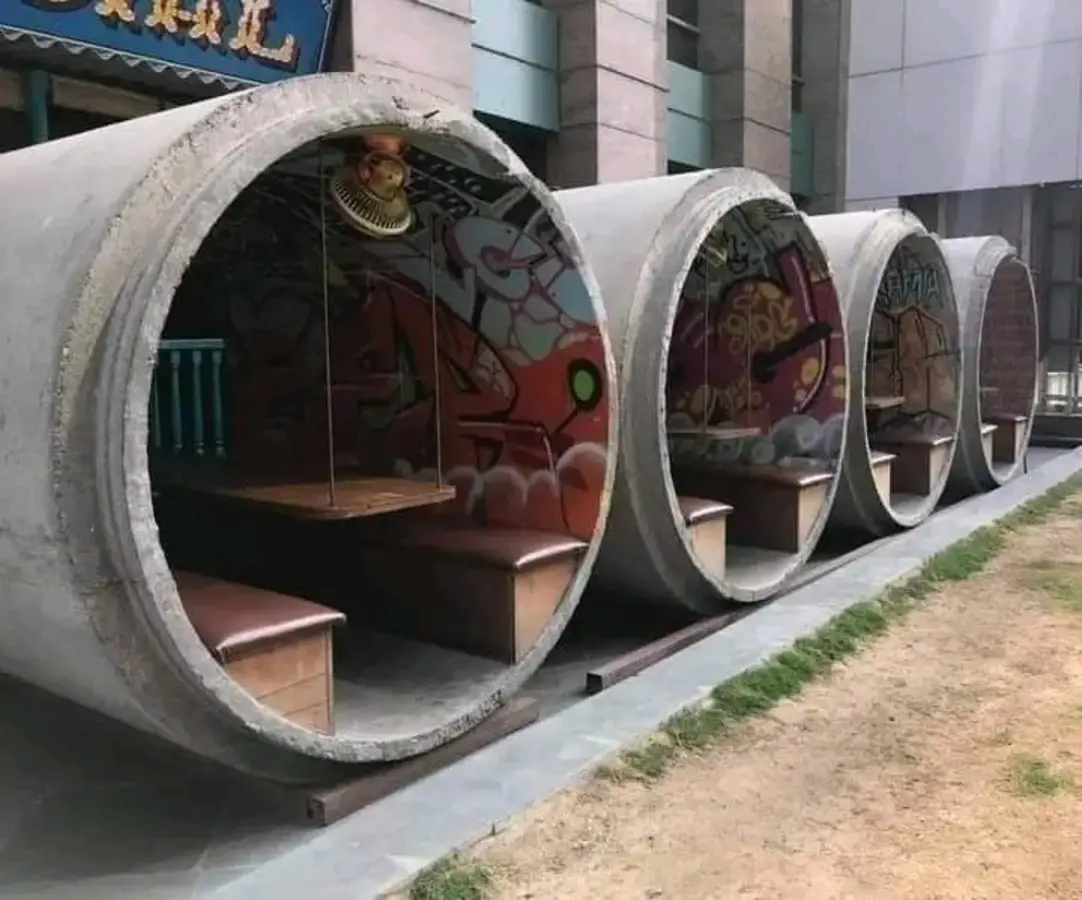
The image depicts a row of repurposed concrete drainage pipes forming individual, semi-enclosed seating areas. These "pipe booths" are lined up along a paved pathway, bordered by a strip of green grass. The interiors of the pipes are painted with colorful, somewhat chaotic, graffiti-style art, which provides a stark contrast to the raw, industrial concrete exterior. Each booth is fitted with wooden seating and a small table. The context appears to be an urban environment, with the facade of a building visible in the background. A small railing/fence is visible on the far left of the first pipe booth. There is a ceiling fan inside one of the pipes. The image has a slightly washed-out, gritty aesthetic.
Foucauldian Genealogical Discourse Analysis
This image immediately invites a Foucauldian analysis through the lens of heterotopias. These "pipe booths" represent a space that is other – a counter-site within the normalized urban landscape.
- Heterotopia of Deviation: They are a space that simultaneously represents and contests societal norms. The repurposing of utilitarian, infrastructural objects (drainage pipes) into a public seating area is a direct act of reclaiming and re-signifying the built environment.
- History of Control & Repurposing: The original function of these pipes – to control and channel the flow of water, an aspect of urban engineering and societal control – is deliberately subverted. Their new function – providing a space for leisure and interaction – challenges the intended purpose. This process of repurposing is a key genealogy – a tracing of how power/knowledge has shifted and manifested in the design of space.
- Disciplinary Power and Surveillance: Though seemingly open, the cylindrical shape of the booths creates a sense of semi-enclosure, potentially offering a degree of privacy but also a contained and somewhat observable space. This hints at the ways even seemingly "free" spaces are subject to forms of control through architectural design.
The colorful graffiti on the interior represents a disruption of the clean, ordered urban aesthetic, potentially acting as a space for expression and resistance. Genealogy would involve tracing the historical development of street art and its relationship to urban power dynamics.
Critical Theory
The image embodies several themes relevant to Critical Theory, particularly those surrounding urban planning, public space, and the commodification of everyday life.
- The Production of Space: Drawing on Henri Lefebvre's work, we can see the "pipe booths" as a product of social forces and power relations. They are not neutral spaces, but rather constructed to serve specific functions (e.g., attracting foot traffic, providing a "unique" atmosphere).
- Spectacle and Authenticity: The "unconventional" design may be viewed as a performance of "cool" or "authenticity" within a hyper-commercialized urban environment. It’s a deliberate attempt to create a visually arresting space that attracts attention (and perhaps, consumption).
- Alienation and Reconnection: These spaces can be interpreted as an attempt to address the alienation inherent in modern urban life. While unconventional, they offer a space for people to gather, interact, and potentially reconnect with a sense of community. However, the constructed nature of this "community" also raises questions about its authenticity.
Marxist Conflict Theory
While subtle, a Marxist reading can identify potential class dynamics at play.
- Reclamation of Public Space: The repurposing of these materials suggests a grassroots effort to reclaim urban space from the forces of capital. By transforming discarded infrastructure into a public amenity, the creators are potentially challenging the dominance of private developers and commercial interests.
- Commodification of "Cool": However, it's also important to recognize that this "cool" aesthetic can easily be commodified. If these "pipe booths" are part of a larger commercial development, they may be used to attract a specific (typically affluent) demographic, further exacerbating inequalities.
- Labor and Infrastructure: The initial construction of the pipes, and subsequent repurposing, involved the labor of workers. Examining the conditions under which this labor was performed would add a layer to a Marxist reading.
Postmodernism
The image is strongly suggestive of postmodern aesthetics and sensibilities.
- Pastiche and Juxtaposition: The combination of raw, industrial concrete with colorful, chaotic graffiti exemplifies postmodern pastiche. It’s a deliberate mixing of high and low culture, a rejection of traditional aesthetic hierarchies.
- Deconstruction of Function: The repurposing of the pipes is a deconstructive act – taking an object designed for one function and giving it an entirely different purpose. This challenges the notion of fixed meaning and inherent function.
- Simulation and Hyperreality: The space can be seen as a simulation of "authentic" urban experience – a carefully constructed environment designed to evoke a sense of "cool" or "grit". It's a hyperreal representation of urban life, divorced from its original context.
Queer Feminist Intersectional Analysis
This is the most challenging framework to apply directly, but possibilities exist:
- Reclaiming Space: The deliberate disruption of conventional urban space could be read as an act of resistance against heteronormative and patriarchal power structures that typically control public space.
- Non-Normative Aesthetics: The unconventional aesthetic – the mixing of materials, the chaotic graffiti – can be seen as a rejection of traditional, "masculine" architectural aesthetics.
- Accessibility & Inclusivity: The design either promotes or hinders accessibility and inclusivity for people of different genders, sexualities, abilities, and racial backgrounds. Further context would be needed to evaluate this aspect. (e.g., Are the booths accessible for wheelchairs? Is the space welcoming to diverse groups?)
- Intersectionality of Location: Depending on the specific neighborhood where this is located, this could be a deliberate act to revitalize a historically marginalized community, or to gentrify it, with significant implications for local residents.
I hope this detailed breakdown provides a comprehensive analysis of the image based on the requested theoretical frameworks! Let me know if you'd like me to elaborate on any specific point.
simple-description (llama3.2-vision)
The meme is an image of a row of tunnels made from large concrete pipes, each with a small wooden bench and a desk inside. The text "office spaces of the future" is written above the image. The meme is likely commenting on the idea that some companies are considering using underground tunnels or pipes as office spaces due to rising costs and environmental concerns.
tesseract-ocr
AL, | ie " F if é / { ; [ i , | : a] al al) P