First Seen
2023-05-10T20:59:59+00:00
simple-description (llama3.2-vision_11b)
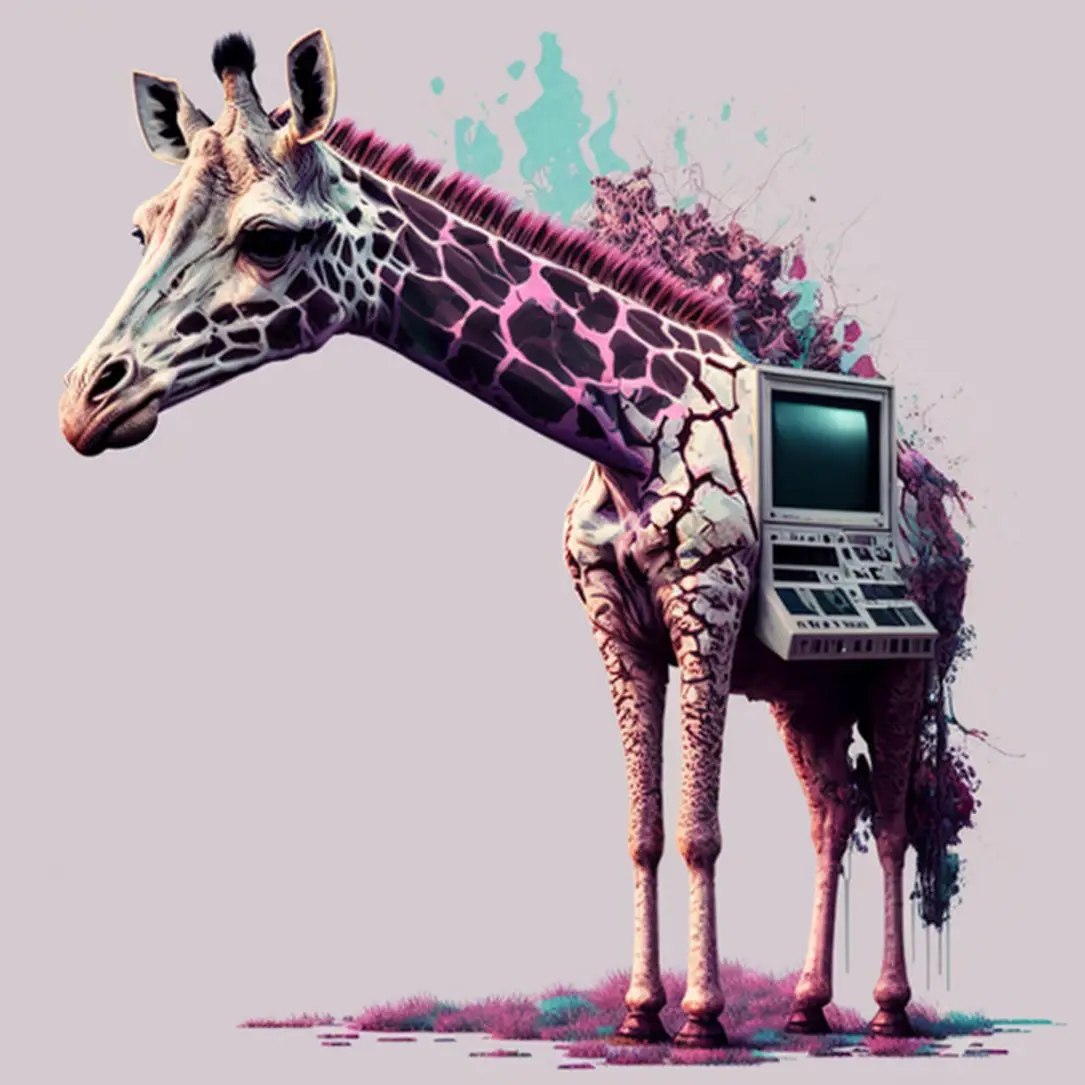
The meme features a cyberpunk-style illustration of a giraffe with a computer virus-infected body. The image depicts a giraffe with glowing purple and blue lines tracing its body, with a computer screen and keyboard attached to its neck. The text "I can smell the virus" is written above the giraffe's head, implying that the giraffe has been infected with a cyberpunk-style virus.
detailed-analysis (gemma3-27b-vision)
Okay, let's break down this compelling image through the lenses of various critical theories. It's a richly layered piece, and multiple interpretations are valid.
1. Visual Description
The image depicts a giraffe, but not a traditionally realistic one. The giraffe's body is dramatically bifurcated. The right half appears relatively intact and maintains the giraffe’s recognizable pattern of brown spots. However, the left side of the giraffe is disintegrating, dissolving into a vortex of magenta and purple abstract shapes resembling plant life or blooming energy. Embedded within the dissolving side, where the giraffe's torso would be, is an old-fashioned, bulky CRT monitor and a corresponding keyboard, seamlessly integrated into the animal's anatomy. The monitor screen is dark and appears to be turned off. The giraffe stands on a similarly coloured plane that is covered in pink "dripping" pixels. A small burst of turquoise paint splashes are visible above the giraffe's head. The overall style is digital art, with a slight painterly texture and a strong emphasis on contrast and colour. It's visually arresting and evokes a sense of both beauty and decay.
2. Postmodernism
This image screams postmodernity. Several key postmodern traits are present:
- Fragmentation & Dissolution: The dissolving giraffe side directly mirrors the postmodern rejection of grand narratives and stable structures. It symbolizes a breakdown of traditional forms and certainties. The division of the animal represents a lack of wholeness, a rejection of essentialism.
- Blending of High and Low Culture: The giraffe, a symbol of natural majesty, is merged with the CRT monitor and keyboard, technology associated with the late 20th century and early digital age. This juxtaposition collapses the boundaries between nature and technology, "high" and "low" culture.
- Simulation & Hyperreality: The blurred lines between the giraffe's organic form and the technology suggests that we live in a world of simulations, where the distinction between "real" and "artificial" is increasingly blurred. The dripping pixels could be seen as the disintegration of the real into digital code.
- Pastiche & Intertextuality: The image is a visual mashup of different elements, creating a pastiche that lacks a clear, singular meaning. It invites viewers to bring their own interpretations and connect it to other cultural references.
3. Foucauldian Genealogical Discourse Analysis
Applying a Foucauldian lens, we can examine the discourse surrounding the giraffe and its relationship with technology.
- Power/Knowledge: The image can be seen as an exploration of how knowledge and power operate through the lens of technology. The integration of the monitor and keyboard into the giraffe suggests that technology isn’t simply an external tool, but is constitutive of the animal’s very being. This hints at how technology shapes our perceptions of the world and ourselves.
- Discipline and Biopower: The image could symbolize the increasing surveillance and control of living things through technology. The monitor, as a device for viewing and collecting information, can be interpreted as an instrument of biopower—the ways in which power operates on the level of life itself. The disintegration of the giraffe's side could represent the erosion of natural boundaries as technology encroaches on and alters life.
- Genealogy: A genealogical approach would trace the historical development of the giraffe/technology relationship. The use of an old CRT monitor is significant—it signals a specific moment in technological history, before the ubiquity of sleek, modern digital devices. This invites questions about how our relationship with technology has evolved and the power dynamics embedded within those changes.
4. Critical Theory
The image lends itself well to a critical theoretical analysis, particularly regarding the impact of technology on nature and identity:
- Frankfurt School (Adorno/Horkheimer): The image can be seen as a visual metaphor for the "Dialectic of Enlightenment." The merging of the natural (giraffe) with the technological (monitor) suggests that the pursuit of rationality and control through technology has led to the domination and fragmentation of nature. The disintegration on one side hints at the loss of authenticity and the commodification of life.
- Walter Benjamin's "Work of Art in the Age of Mechanical Reproduction": This image is itself a form of digital reproduction. It invites us to think about the loss of "aura" (the unique presence of an original artwork) in a world saturated with copies. It also raises questions about the relationship between originality and reproduction in the digital age.
5. Queer Feminist Intersectional Analysis
While not immediately apparent, a queer feminist intersectional reading can be applied:
- Deconstruction of Binary Oppositions: The image’s divided giraffe directly destabilizes the binary between nature/technology, organic/artificial, whole/fragmented. Queer theory often challenges binary oppositions as inherently oppressive.
- Body & Technology: The image can be interpreted as a commentary on the ways in which technology is often imposed upon bodies (particularly marginalized bodies) – shaping, controlling, and modifying them. The giraffe’s body becomes a site of technological intervention.
- Intersectional Approach: We might ask: Who controls the technology? Who benefits from it? Who is harmed by it? An intersectional lens would examine how power dynamics related to technology intersect with other forms of oppression (race, class, gender, sexuality) to create unequal outcomes. The disintegration could symbolize the harm done to those most vulnerable to technological control.
6. Marxist Conflict Theory
From a Marxist perspective, the image can be seen as representing the conflict between nature and capital:
- Commodity Fetishism: The monitor and keyboard, as commodities, have become central to the giraffe’s very being, obscuring the labour and resources that went into their production.
- Alienation: The giraffe’s fragmentation symbolizes the alienation of humans from nature, as technological advancements increasingly mediate our relationship with the natural world. The dissolving side represents a loss of connection to organic life.
- Class struggle: The technology in the giraffe could also symbolise how technology is not evenly distributed, and often benefits a small class of people while further exploiting nature.
In conclusion:
This image is rich in symbolism and offers multiple layers of meaning. The interpretation will change based on the theoretical lens applied. This piece is a visual commentary on the complex relationship between nature, technology, identity, and power in the modern world.
simple-description (llama3.2-vision)
This meme is an image of a cartoon giraffe with a computer monitor and keyboard attached to its body. The text "I can smell the desperation" appears in a speech bubble above the giraffe's head. The image is likely a humorous take on the idea of someone trying to get work done on a computer while feeling overwhelmed or struggling to focus.
tesseract-ocr
re ! b é Pe el a Bs NTN hey . a; , - an , FS ce ssS ae sen Ve.* Zz K SS . ( NS - ‘ - \ . ee ge aN % Ce ‘a 1 : y x oY a : er , m2 [