First Seen
2023-05-10T20:59:59+00:00
simple-description (llama3.2-vision_11b)
The meme features a screenshot of a TV interface with a retro aesthetic, reminiscent of 90s and early 2000s TV shows. The image shows a list of streaming services, including Netflix, Hulu, and Amazon Prime, but with a deliberate error in the font and layout, making it appear as if it's from a "retro" TV. The text "RETRO TV" is displayed in the top-left corner, with the "R" in "RETRO" being a "1" character.
detailed-analysis (gemma3-27b-vision)
Okay, here's a breakdown of the image, applying the requested theoretical lenses where relevant. Note that not every lens will be a perfect fit, and some are more readily applicable than others.
Visual Description
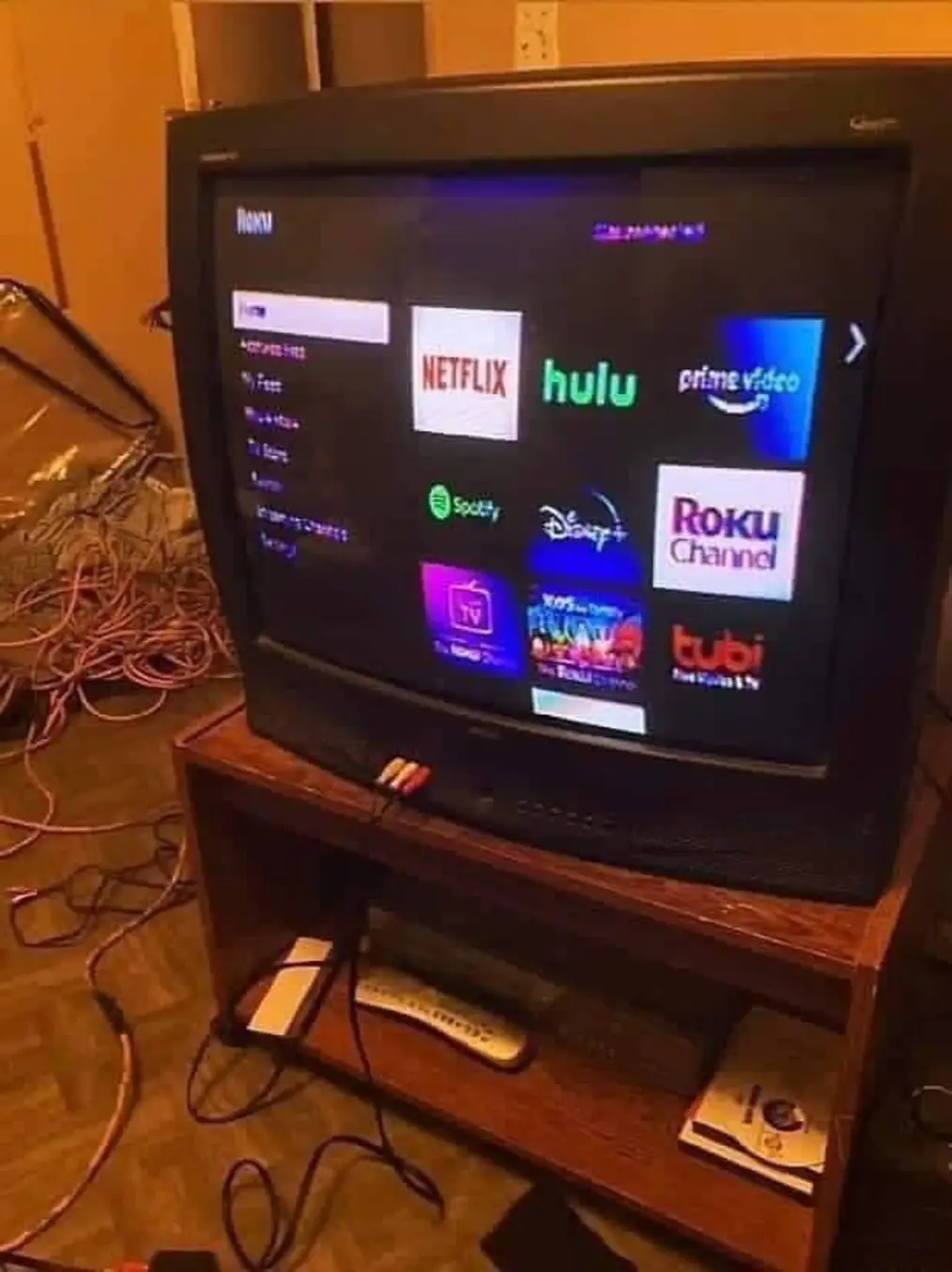
The image depicts a somewhat older flat-screen television, likely a Roku, displaying a streaming service home screen. Popular logos for Netflix, Hulu, Amazon Prime Video, Disney+, Spotify, Tubi, and the Roku Channel are prominent. The TV is sitting on a dark wood TV stand. Below the TV stand are multiple DVDs, two remote controls, and an unidentified black object. The setting appears to be a domestic space, with a carpeted floor and a wall partially visible. The wiring behind the TV is somewhat messy, suggesting a lived-in and functional space. The overall lighting is dim, creating a slightly moody atmosphere.
Foucauldian Genealogical Discourse Analysis
This image presents a prime example of how discourse shapes our understanding of leisure, entertainment, and even access to culture. We can trace a genealogy of how viewing habits have shifted. Previously reliant on broadcast schedules and physical media (represented by the DVDs), the home screen signifies a shift to on-demand culture.
Power/Knowledge: The streaming services represented are not just providers of content, but also gatekeepers. They curate what is available, influence what we watch, and collect data about our viewing habits. This is an exercise of power/knowledge. The algorithms that determine what's promoted within each service are a specific application of this power. They construct a "truth" about what is popular or "good" viewing, shaping individual taste and collective culture.
Disciplinary Practices: The very act of scrolling through the home screen is a disciplinary practice. The user is invited to constantly choose, compare, and consume, which reinforces a culture of constant stimulation and potentially shortens attention spans.
Critical Theory
Critical Theory, particularly the Frankfurt School tradition, sees this image as indicative of a culture industry. The TV and the array of streaming services represent a system designed to produce and distribute standardized cultural goods.
Commodification of Leisure: This image highlights how leisure itself has become a commodity. The streaming services don’t simply provide entertainment; they sell access to entertainment, creating a dependence on consumption.
False Consciousness: The sheer abundance of options presented on the screen might create the illusion of choice, while simultaneously limiting critical engagement with content. The user might feel empowered by having so many options, but they are still within a system of pre-packaged entertainment, potentially distracting from larger social or political issues.
Marxist Conflict Theory
From a Marxist perspective, the image embodies the contradictions of late-stage capitalism.
Means of Production & Consumption: The television is a means of consumption in a capitalist society. The streaming services, owned by massive corporations, control the means of production of cultural content. This creates an unequal power dynamic. Individuals consume the content, generating profits for the corporations.
Alienation: The constant availability of entertainment can contribute to alienation. Individuals may become detached from meaningful social connections or productive activities, seeking solace in the virtual world.
Commodification of Culture: The image demonstrates how culture, once potentially a source of communal meaning and resistance, has become commodified and integrated into the capitalist system.
Postmodernism
This image readily lends itself to a postmodern interpretation.
Hyperreality: The streaming services offer a curated, often idealized, representation of reality. The endless scroll of content can blur the lines between "real" life and the simulated experiences offered through media.
Fragmentation & Pastiche: The home screen itself is a pastiche – a collection of disparate brands and content. This fragmentation mirrors the broader postmodern condition of a loss of grand narratives and a proliferation of diverse, often contradictory, perspectives.
Simulacra and Simulation: The content offered is increasingly divorced from any "original" reality. We're consuming simulations of simulations, where the signifier (the content) no longer necessarily refers to a concrete signified.
Queer Feminist Intersectional Analysis
This lens, while applicable, requires some interpretation.
Representation & Visibility: The image prompts us to ask who is represented in the content offered by these streaming services. Do they offer diverse and nuanced portrayals of LGBTQ+ individuals, women, and people of color? Are marginalized voices adequately amplified? The content itself, not visible in the image, is crucial to this analysis.
Consumption & Gender/Sexuality: How does the consumption of this content reinforce or challenge dominant gender and sexual norms? Does it offer spaces for queer and feminist critique, or does it perpetuate harmful stereotypes?
Access & Inequality: Access to streaming services (and the technology required to use them) is not universal. This creates inequalities based on class, race, and geography. This image could be seen as reinforcing those divisions.
Intersectionality: The experience of consuming this content will be different for individuals based on their intersecting identities (e.g., a queer woman of color will have a different experience than a white, heterosexual man).
Let me know if you’d like any of these analyses elaborated upon!
simple-description (llama3.2-vision)
The meme is an image of a TV with a frozen screen displaying a list of streaming apps, including Netflix, Hulu, and Amazon Prime. The text "Help me" is written on the screen, implying that the user is having trouble accessing their favorite shows. The image is likely humorous because it pokes fun at the frustration of dealing with a frozen TV screen.
tesseract-ocr
SS ou aoe ead Py a S ae] > 4 be op ee gt pe ~- els nen Pa ret oh * =| " / BEZe A ie are J K\_ — e ial as ee re ior a j - as “ F S— n= 7 ind ‘ ' th a 4