First Seen
2023-07-14T21:12:43+00:00
simple-description (qwen3.5_2b-q8_0)
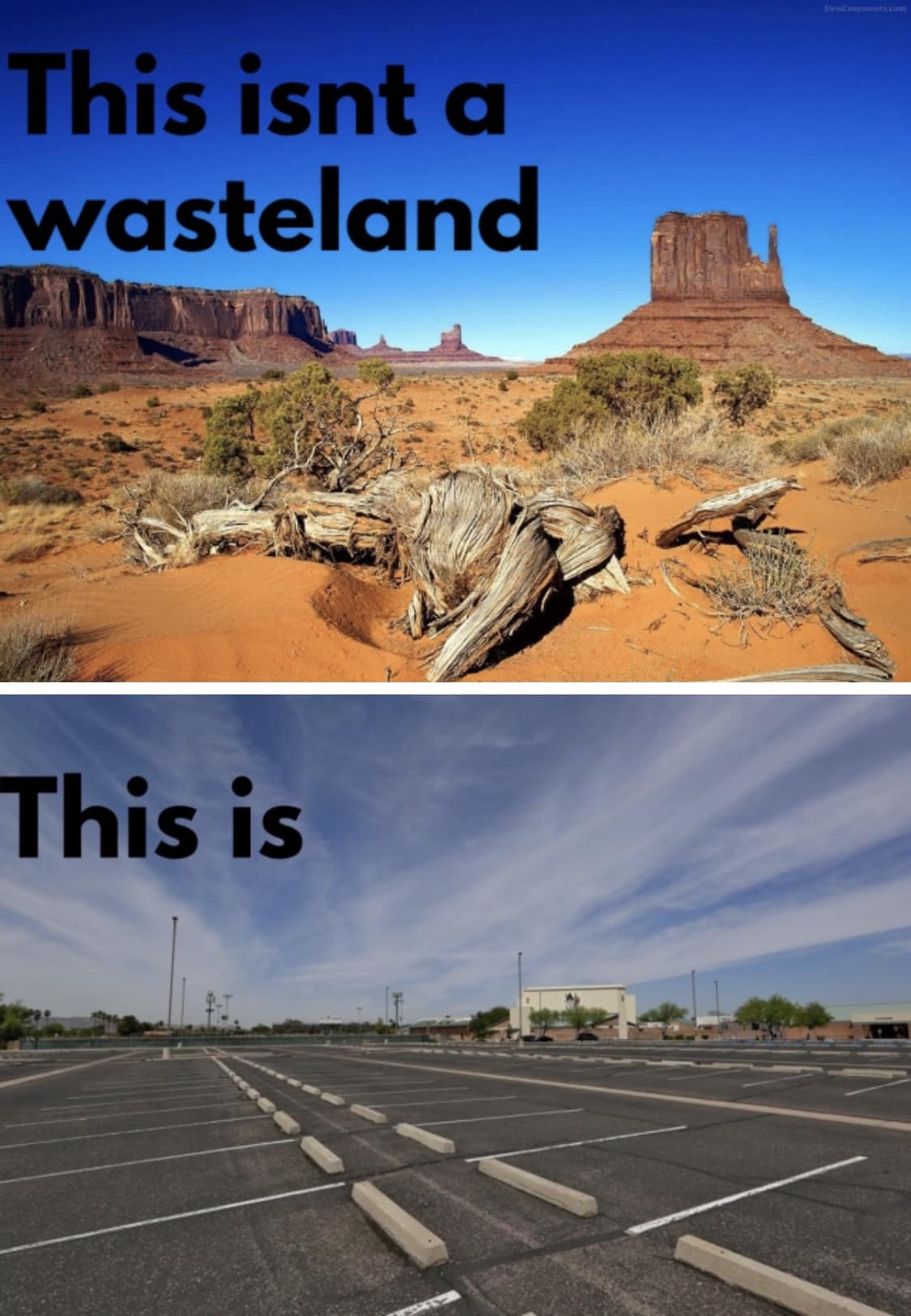
This meme plays on the irony of viewing a beautiful desert landscape, specifically Monument Valley, as a "wasteland." In the top photo, majestic red rock cliffs and sand dunes are labeled "This isn't a wasteland," while the bottom image shows the exact same scene as an empty, barren parking lot labeled "This is." It humorously suggests that a "wasteland" might just be a fresh coat of asphalt, highlighting the raw beauty of the arid environment.
simple-description (llama3.2-vision_11b)
The meme is a play on the phrase "This is not a desert" and instead says "This is a wasteland". It's a humorous way to describe a desolate and barren landscape, often used to express a sense of disappointment or disillusionment with a place or situation. The image likely features a bleak, arid environment with a caption that reads "This is a wasteland" in a dry, sarcastic tone.
detailed-analysis (gemma3-27b-vision)
Okay, here's an analysis of the image, broken down into sections as requested. Given the content, not every section will be applicable or robust, but I'll cover the relevant ones, aiming for depth where appropriate.
Visual Description
The image is a diptych, presented with text overlaid. The top panel depicts a desert landscape, most likely in the American Southwest (reminiscent of Monument Valley). It features reddish rock formations, sparse vegetation, and a dry, scrubby plant in the foreground. The colors are warm and natural, with a clear blue sky. The text overlaid reads "This isn't a wasteland."
The bottom panel shows an empty asphalt parking lot with faded lane markings and a blurry, distant building in the background. The sky is overcast and gray. The overall color palette is muted and desaturated. The text reads “This is.”
The contrast between the two images is stark. One represents a natural landscape (however harsh), the other, a human-constructed, devoid space. The text forces a direct comparison and seems to be making a statement about the perceived or assigned meaning of “wasteland.”
Critical Theory
The image is ripe for a critical theory analysis, specifically in terms of how we define "wasteland." It challenges the viewer to reconsider what constitutes desolation or barrenness. The image asks: Is a stark, naturally occurring desert more of a wasteland than an equally barren parking lot?
The parking lot appears to be a product of a failed or abandoned modernity. The faded lines, emptiness, and lack of activity speak to a loss of purpose. However, the desert, while harsh, exists within a natural order, possessing its own intrinsic value. The image invites us to question why we often apply the label "wasteland" to environments that aren't directly serving human economic or utilitarian purposes. It suggests our categorization of landscapes is culturally determined, and often reflects a bias towards the built environment.
Postmodernism
The image embodies several postmodern characteristics.
- Deconstruction of Binary Oppositions: The contrast between the natural landscape and the artificial parking lot inherently deconstructs the binary of "nature/culture." It suggests that both can be considered "wastelands" depending on the perspective.
- The Simulacrum & Simulation: The parking lot can be viewed as a simulacrum—a copy without an original. It’s designed to facilitate activity, but in its emptiness, it becomes a hollow representation of purpose.
- Meta-commentary: The image is a self-aware commentary on how we perceive landscapes. The overlaid text highlights the constructed nature of meaning and challenges the viewer to question their own assumptions.
- Fragmentation/Juxtaposition: The diptych format itself is a fragmented juxtaposition, forcing a comparison that might not naturally occur.
Marxist Conflict Theory
From a Marxist perspective, the image can be interpreted as a critique of capitalism and its impact on the environment. The desert, representing a pre-capitalist (or at least, pre-industrial) landscape, is contrasted with the parking lot, a direct product of consumer culture, and built infrastructure. The emptiness of the parking lot can be seen as a symptom of capitalist overproduction or obsolescence. It implies that capitalism can create environments that are functionally barren, even while ostensibly being designed for utility.
The image hints at the commodification of land—the desert may be seen as a resource to be exploited, while the parking lot represents the ultimate stage of that exploitation (a space for exploitation). The emptiness of the parking lot implies failure in that cycle, highlighting the inherent contradictions of the capitalist system.
Foucauldian Genealogical Discourse Analysis
A Foucauldian reading focuses on the discourse surrounding the concept of "wasteland." How has the term been historically constructed? What power relations are embedded within it?
Historically, the idea of a "wasteland" is tied to notions of "improvement" and "progress" – the belief that land must be made productive for it to have value. This is deeply intertwined with colonial ideologies and the justification of land seizure. The image critiques this discourse by asking us to reconsider whether a naturally barren landscape is inherently less valuable than a similarly barren one created by humans.
The labeling of land as "wasteland" isn't neutral. It's a productive statement that justifies intervention, control, and the imposition of particular forms of knowledge and power. The image challenges this by suggesting that "wasteland" is a socially constructed category that serves particular interests.
Queer Feminist Intersectional Analysis
This analysis is less direct, but still potentially applicable. From an intersectional perspective, we can consider how the concept of "wasteland" might be tied to marginalized bodies and experiences.
- Land & Indigenous Sovereignty: The desert landscape, particularly in the American Southwest, has deep cultural and spiritual significance for Indigenous communities. Labeling it a "wasteland" is an act of erasure and a denial of Indigenous knowledge and connection to the land. It perpetuates colonial violence and disregards the inherent value of Indigenous cultures.
- Devalued Spaces & Marginalized Communities: Similarly, empty spaces like the parking lot often become sites of social exclusion and danger, particularly for marginalized groups. The image can be read as a metaphor for the ways in which certain bodies and communities are similarly "discarded" or devalued.
- Deconstruction of "Productivity": Feminist and queer thought often challenge heteronormative and capitalist notions of "productivity." The emptiness of both landscapes can be seen as a rejection of these demands, suggesting the value of spaces that exist outside of capitalist or patriarchal control.
Hopefully, this breakdown provides a comprehensive and nuanced analysis of the image across the requested theoretical lenses. Let me know if you'd like me to elaborate on any particular point!
simple-description (llama3.2-vision)
This meme is a humorous comparison between two vastly different landscapes. The top image shows a beautiful, serene desert landscape with a caption "This is a wasteland". The bottom image shows a barren, empty parking lot with a caption "This is a wasteland". The meme is poking fun at the idea that a beautiful desert landscape is not a wasteland, but a parking lot is.
tesseract-ocr
APRA. | \ Je ies Mee) h. t 4 ry ; a —s. eg ae. SG. - > Se a. se OE ee LD ae eR 1 ee eee =a ees ae a ee a me ii HS ag ae oR i a} ee ie = og _ uh + ga- Lp i a se G ey b\w 4 b Ae mi - is 3 , iy 7 , Wee Mr ~ WZ SS see : W SSS r ft FF J i _—, " ————— Petia i rian mA SAE Ls SE SS = i — —~ Se = + =e 7 ae eine ay “s, et Z = eee ee es 2 ee