First Seen
2023-07-14T23:18:58+00:00
simple-description (qwen3.5_2b-q8_0)
This meme perfectly captures the feeling of "Desertcore" because it emphasizes the deep silence and isolation of the vast, empty desert landscape. The glowing lanterns and the cozy campfire suggest a warm, safe, and happy atmosphere, proving that you can feel content even far from civilization. You can clearly see the caravans in the scene, including the left one which has the text "YAMAHA", "RACING", "350", "55" and "TITAN" on the right side, showing that you are camping with your family and friends.
simple-description (llama3.2-vision_11b)
The meme is a photo of a desert landscape with a caravan parked in the distance, surrounded by sand dunes and rocky outcrops. In the foreground, a person is sitting in a chair, surrounded by a collection of quirky desertcore-inspired items, such as a vintage radio, a vinyl record, and a few scattered books. The text "Desertcore" is written in the sand nearby, emphasizing the theme of the meme.
detailed-analysis (gemma3-27b-vision)
Okay, here's an analysis of the image broken down into the sections you requested, only applying those theories where relevant. Given the image’s content, some sections will be more developed than others.
Visual Description
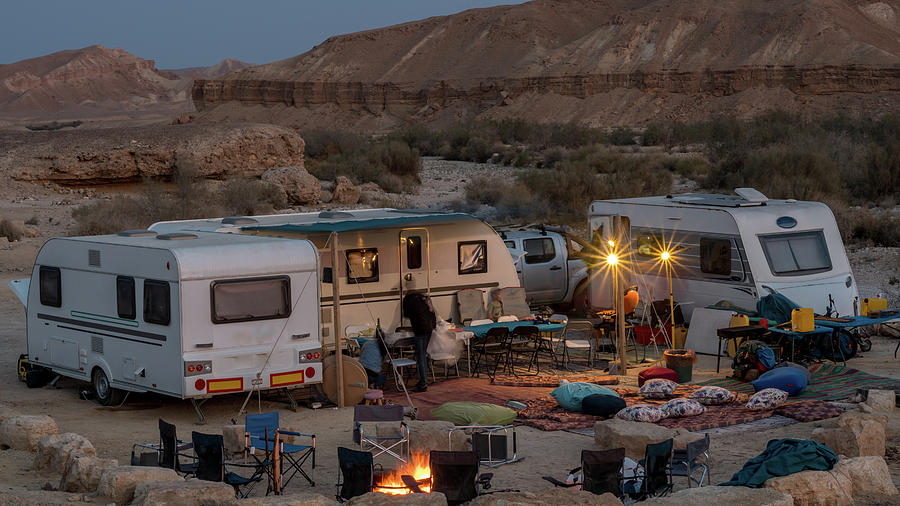
The photograph depicts a campsite at dusk or dawn, in an arid, rocky landscape. Four vintage camper trailers are parked in a relatively flat area, forming the center of the scene. The trailers are of various designs, hinting at different eras of recreational travel. A campfire blazes brightly, casting a warm glow on the surrounding area. Several camping chairs are arranged around the fire, and various camping gear – bags, tents, tables – are scattered about.
The backdrop is a dramatic, eroded landscape of layered rocks and hills, likely a desert or canyon environment. The sky is a muted blend of blues and grays suggesting either early morning or late evening. The overall effect is one of rustic simplicity, a temporary human intrusion into a wild and imposing landscape. The warm light emanating from the fire and the trailers creates a sense of coziness and community against the backdrop of a more desolate environment. The scene feels both isolated and communal.
Foucauldian Genealogical Discourse Analysis
This image offers interesting points for a Foucauldian analysis, particularly in the context of leisure and the construction of "nature" and the "outdoors."
- Discipline & Normalization: The organized campsite itself – the trailers neatly lined up, the chairs arranged around the fire, the gear laid out – represents a form of self-discipline and normalization. Camping, as a leisure activity, has rules (implicit and explicit) governing behavior, space, and interaction. It’s a way of creating order within a chaotic landscape. The alignment of the vehicles implies adherence to certain norms of camping etiquette (parking in a row, keeping a relatively clean campsite).
- Power/Knowledge: The very act of being in this landscape is tied to power dynamics. Who has the means to acquire the trailers, travel to this location, and bring the necessary equipment? The ability to “experience nature” is not equally distributed. This points towards knowledge as a form of power – the knowledge of how to camp, the knowledge of which locations are accessible, and the knowledge of what constitutes “appropriate” behavior in the outdoors.
- Genealogy of Camping: A genealogical approach would trace the historical development of camping as a practice. From its roots in military strategy and exploration, to the rise of the automobile and the mass production of trailers, to its current status as a popular recreational activity, camping has undergone a continuous transformation shaped by social, economic, and technological forces. It’s not a “natural” practice but one constructed over time.
- Discourse of Wilderness: The image evokes a discourse of "wilderness" – the idea of a pristine, untouched landscape that is separate from civilization. However, as Foucault would argue, this discourse is itself a construction. The very act of bringing a campsite into this environment challenges the notion of a truly “wild” space.
Critical Theory (Frankfurt School)
The image lends itself to a Critical Theory reading, specifically focusing on the commodification of experience and the alienation of modern life.
- Commodification of Leisure: The vintage trailers, while evocative of a simpler time, are nonetheless commodities. They represent a purchase, an investment in a lifestyle. The entire experience of camping – the equipment, the travel, the location – is ultimately tied to a capitalist economy.
- False Consciousness: The attempt to "connect with nature" through camping might be seen as a form of false consciousness. The campers are seeking an escape from the alienation of modern life, but they are doing so within the framework of that system. The very act of escaping requires resources and participation in the capitalist system they're attempting to escape.
- Loss of Authenticity: The curated nature of the campsite – the neatly arranged gear, the attempt to create a cozy atmosphere – could be seen as a symptom of a broader loss of authenticity in modern life. The campers are not truly “immersed” in nature but are instead creating a carefully constructed simulacrum of it.
- Repressive Leisure: While seemingly liberating, the pursuit of leisure can also be a form of social control. By directing people towards pre-defined forms of recreation, the dominant ideology can maintain the status quo.
Postmodernism
The image embodies several elements of postmodern thought:
- Pastiche and Irony: The vintage trailers themselves evoke a sense of pastiche – a combination of different styles and eras. This could be seen as a rejection of grand narratives and a celebration of fragmentation. There's a potential irony in using these old vehicles to "escape" modern life.
- Simulacra and Simulation: As touched on in the Critical Theory section, the campsite can be seen as a simulacrum of a more authentic connection with nature. It’s a copy of an experience, a representation that has become detached from its original referent.
- Deconstruction of “Nature”: Postmodernism challenges the notion of a fixed, objective “nature.” The campsite actively constructs the landscape, making it a culturally mediated experience.
- Rejection of Grand Narratives: The image doesn’t tell a straightforward story. It’s a fragmented, ambiguous scene that invites multiple interpretations. It’s a rejection of the idea that there is one “correct” way to experience the outdoors.
I hope this analysis is thorough and helpful. Let me know if you'd like me to elaborate on any of these points or explore other theoretical frameworks.
simple-description (llama3.2-vision)
The meme shows a campsite in a desert with a camper and a car, but the camper is on fire and the people inside are frantically waving for help. The text on the meme reads "When you finally get the campsite to be in the middle of nowhere and it's on fire".
tesseract-ocr
a ao re eee BEST Pr 3h MO te meat) (fits Mb : Re a A ; ee a ee | Sep Na wo ee = 1s ve ORO at “ay aa ore i> = | oe ) ce a wl ee es. o =e fees - a ee ae we ~~ lel SSE S| Za Ba > Se VAN ie) - | 4 poe ot =