First Seen
2023-07-14T23:20:22+00:00
simple-description (qwen3.5_2b-q8_0)
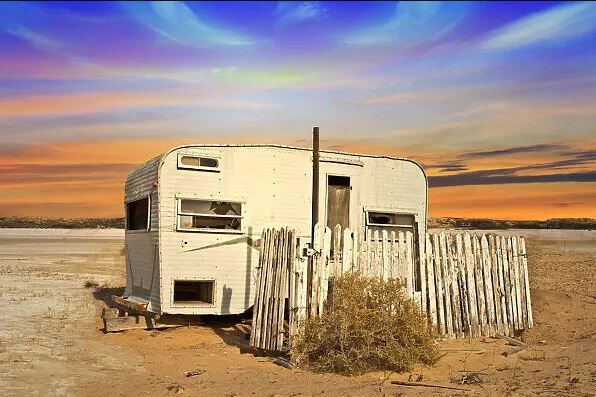
The image depicts a weathered, abandoned white trailer standing alone in a vast, dry desert landscape with a dramatic, colorful sunset sky. This visual is a popular reference for the 'Desertcore' aesthetic, which captures the feeling of being small, isolated, or lost in a vast, empty world. While the image itself does not contain text, it evokes a strong sense of nostalgia for simpler times or a feeling of loneliness in the modern world.
simple-description (llama3.2-vision_11b)
The meme is an image of a small, run-down, and abandoned mobile home, likely in a desert setting. The image is captioned "Desertcore" and features a small, dilapidated trailer surrounded by desert landscape. The image's aesthetic is meant to evoke a sense of desolation and abandonment, with the trailer's rusty exterior and broken windows suggesting a life left behind.
detailed-analysis (gemma3-27b-vision)
Okay, let's break down this image through the lens of several theoretical frameworks. It's a rich image with plenty to unpack.
Visual Description
The image depicts a dilapidated, vintage travel trailer (or camper) situated in a barren, arid landscape. The trailer is primarily white, though heavily weathered and showing signs of decay. The paint is peeling, windows are broken or missing, and the overall structure appears neglected. A broken, white picket fence surrounds the trailer, further contributing to the sense of abandonment and disrepair. Sparse, dried vegetation grows in front of the fence.
The background is dominated by a wide, flat expanse of land under a dramatic sky. The sky displays a gradient of color, moving from orange and yellow near the horizon to blue and purple higher up. The landscape suggests a desert or scrubland environment. The light is harsh, and creates strong shadows. The scene overall evokes a sense of isolation, abandonment, and the passage of time.
Foucauldian Genealogical Discourse Analysis
This image lends itself well to a Foucauldian reading. The trailer, as an object, embodies a discourse of freedom, mobility, and the American Dream of open-road exploration, especially prominent in the mid-20th century. However, its current state – dilapidated and isolated – demonstrates a rupture in that discourse. The trailer isn't functioning as a vehicle of freedom anymore; it’s a relic.
A genealogical approach asks us to trace the history of this object and its meaning. We might ask: What cultural forces initially framed the trailer as a symbol of liberation? How did that meaning become intertwined with ideas of class, consumerism, and national identity? The decay of the trailer then reveals the power/knowledge relationship at play. The trailer fails to fulfill its promise, suggesting a breakdown of the systems (economic, social, cultural) that initially produced that promise.
The broken fence is crucial. It isn’t functioning as a boundary, a symbol of ownership, or even a deterrent. It's a fractured attempt at control, highlighting the fragility of such systems. The image therefore is an archeological dig into the failed promises of modernity.
Critical Theory
From a critical theory perspective (influenced by the Frankfurt School), this image can be seen as embodying alienation and the commodification of the self. The trailer, originally designed as a vehicle for leisure and escape, has become a symbol of breakdown. The American Dream of boundless freedom is exposed as a false consciousness.
The trailer’s abandonment and decay can be interpreted as a metaphor for the failures of capitalist consumer culture. The promise of happiness through material possessions is revealed as empty. The trailer's isolation reinforces a sense of rootlessness and individual disconnection. The landscape’s emptiness mirrors the emptiness felt within a system that prioritizes profit over human connection and wellbeing.
The image asks us to question the underlying assumptions of progress and modernity and to consider the social and psychological costs of a system built on consumption and control.
Marxist Conflict Theory
A Marxist reading emphasizes the class dynamics at play. This trailer could represent the former dwelling of someone who once aspired to middle-class status, perhaps embracing the post-war ideal of suburban travel and leisure. Its current state suggests economic hardship or displacement. The trailer is a material condition reflecting societal inequalities.
The image implicitly highlights the conflict between the haves and the have-nots. It suggests the vulnerability of those at the margins of the economic system, those who may have lost their economic footing and been left behind. The abandoned trailer is a visible sign of economic failure and the fragility of the American Dream for many.
The desolate landscape serves as a reminder of the vast resources controlled by a few, while others struggle to survive.
Postmodernism
A postmodern lens can see this image as a deconstruction of grand narratives. The trailer, once a symbol of a coherent lifestyle (the mobile, freedom-seeking American), now stands as a fragment, a simulacrum—a copy without an original. It's a signifier that has lost its stable meaning.
The image celebrates fragmentation and the collapse of meaning. The broken fence, the peeling paint, the desolate landscape—all contribute to a sense of disorder and the breakdown of traditional structures. The image doesn’t offer a clear narrative or a fixed interpretation. It embraces ambiguity and invites multiple readings.
The sky’s dramatic colors can be seen as a hyperreal spectacle—an exaggeration of natural beauty that further underscores the artificiality of the scene.
Note: While the image could potentially be analyzed through a Queer Feminist Intersectional lens, it doesn't immediately lend itself to that analysis without additional context. To apply that framework, one would need to speculate on the possible life and experiences of the inhabitant(s), their gender, sexuality, and how those identities intersected with their socio-economic situation, but doing so would largely be projecting meaning onto the image.
Hopefully, this provides a comprehensive breakdown of the image through various theoretical frameworks! Let me know if you'd like me to elaborate on any particular aspect.
simple-description (llama3.2-vision)
This meme is an image of a small, abandoned, and decrepit camper trailer, often referred to as a "trailer" or "trailer home." The image is captioned "When you finally get the house you've been dreaming of."
tesseract-ocr
4= 7 =—— — = ——— Oe | a —— nm i ‘al ey! (ee ne Sa eee ai Rs oe