First Seen
2023-07-14T23:32:06+00:00
simple-description (qwen3.5_2b-q8_0)
The text "AIRCRAFT CAR" is clearly visible on the front of the vintage silver trailer. The "Desertcore" meme references a popular trend that uses this specific combination of an out-of-place vehicle (a small car in a vast desert) and a caption about it being an "aircraft car" to describe the absurdity of seeing such a normal-looking vehicle in an alien, empty environment. The humor comes from the irony of a vehicle named "Aircraft Car" existing in a wasteland where one might expect to see a desert car or a vehicle in the desert.
simple-description (llama3.2-vision_11b)
The meme is a photo of a 1960s-era Airstream trailer parked in the middle of a desert landscape, with a small palm tree and a few rocks in the foreground. The image is captioned "Airstream in the desert" and is meant to evoke a sense of nostalgia and freedom. The meme is likely being used to express a desire to escape to a peaceful, natural environment and experience the simplicity of life on the road.
detailed-analysis (gemma3-27b-vision)
Okay, let's break down this image through various theoretical lenses. I'll organize it into sections based on the headings you provided, only including those that genuinely apply to a meaningful interpretation of the image.
1. Visual Description
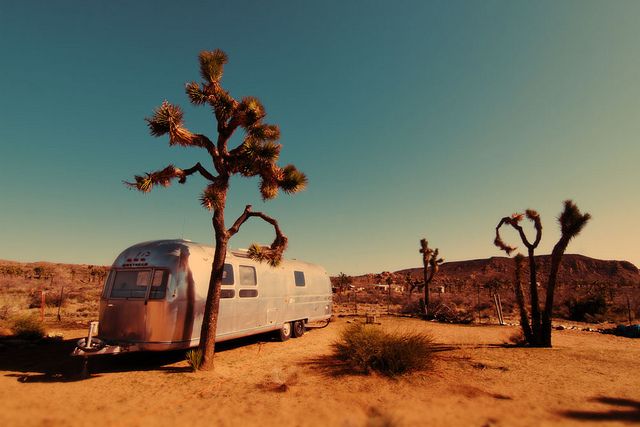
The photograph depicts a silver Airstream trailer parked in a desolate, desert landscape. The trailer is the clear focal point, reflecting light and standing out against the reddish-brown earth and muted tones of the surrounding environment. Several Joshua trees stand near the trailer, defining the location as likely the Mojave Desert. The sky is a gradient of blue, fading upwards. The overall lighting is harsh and creates strong shadows, suggesting a bright, sunny day. The ground is arid and uneven, covered with sparse vegetation and rocky patches. In the distance, a faint outline of low hills or mountains is visible. The image evokes a sense of isolation, quietness, and possibly a lifestyle centered around travel or escapism. The color palette is dominated by warm earth tones contrasted with the cool silver of the Airstream and the blue of the sky.
2. Postmodernism
This image speaks to several key themes in postmodern thought.
- Simulacra & Simulation: The Airstream itself can be read as a simulation of a home – a mobile, curated space that isn’t rooted in a traditional sense of place. It's a constructed environment within the harsh reality of the desert. It presents an idealized vision of ‘home on the road’ which is separate from the messiness and complication of traditional living.
- Fragmentation and Deconstruction of Place: The trailer isn't of the desert, but in it. It disrupts the natural landscape and suggests a fragmented experience of place. The traditional idea of home as a fixed location is broken down.
- Irony & Pastiche: The retro aesthetic of the Airstream (often associated with a specific period of American travel and optimism) juxtaposed with the harsh, almost barren landscape creates a sense of irony. It’s a nostalgic image deployed in a place where that nostalgia seems incongruous. It's a bit of a pastiche – a mixing of styles and cultural references.
3. Marxist Conflict Theory
While not immediately obvious, some Marxist interpretation is possible:
- Commodity Fetishism: The Airstream itself, as a luxury good, represents a form of commodity fetishism. Its aesthetic appeal and the lifestyle it promises (freedom, adventure) are presented as desirable in and of themselves, obscuring the labor and resources required to produce it. It's a symbol of consumerism.
- Access and Mobility as Privilege: The ability to choose to live a nomadic lifestyle, owning a vehicle like an Airstream, is a privilege reserved for those with financial resources. The image implicitly highlights the disparity between those who can afford such freedom and those who are bound by economic necessity to a fixed location.
- Control of Land & Resource Access: The presence of the trailer in the desert implicitly speaks to the control of land and resources. The desert is often seen as a space for recreation and tourism, but it also represents land that has been historically taken from indigenous populations and is subject to various forms of exploitation.
4. Queer Feminist Intersectional Analysis
This is where things become more subtle, but also potentially rich.
- Rejection of Normative Structures: Nomadic living, as represented by the Airstream, can be seen as a rejection of traditional, heteronormative societal structures that emphasize settling down, marriage, and family in a fixed location. It represents a different way of living that is outside the mainstream.
- Space & Freedom: The open landscape and the mobile nature of the Airstream could be interpreted as representing a desire for spatial and personal freedom – a freedom from societal constraints and expectations. This is particularly relevant for queer individuals and other marginalized groups who often experience restrictions on their movement and self-expression.
- Precarity & Vulnerability: The image also subtly hints at the precarity of such a lifestyle. Living in a remote location, reliant on a vehicle for shelter and transportation, carries risks and vulnerabilities, especially for marginalized groups who may lack access to resources and support networks.
- Indigenous displacement: The presence of a vehicle, and a person, in the desert calls up the history of Indigenous displacement that occurred, and continues to occur, in these areas.
Let me know if you'd like me to elaborate on any of these interpretations or explore other theoretical angles!
simple-description (llama3.2-vision)
The meme is a picture of an Airstream trailer parked in the middle of a desert, with a Joshua Tree branch leaning against the side of the trailer. The text "I'm not arguing, I'm just explaining why I'm right" appears in a speech bubble above the tree's branch. The image is meant to be humorous, implying that the person in the trailer is being stubborn and argumentative.
tesseract-ocr
5% ay ba ———w =F iy. es ey wif * Sa ee joe i TE a oe eS PB = ce ee — a <2 Seal