First Seen
2023-08-21T04:41:15+00:00
simple-description (qwen3.5_2b-q8_0)
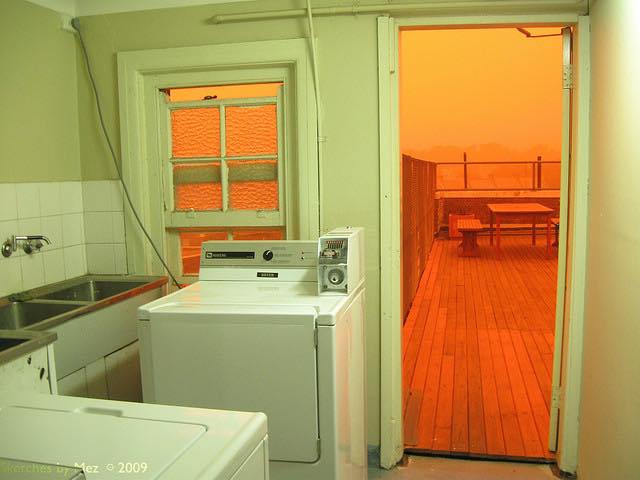
This image creates a liminal feeling—a sense of being stuck in an empty, transitional zone—by covering everything in an unnatural, orange glow that makes the room feel ghostly or surreal. The space acts as a waiting area where things are held up in transition, much like the clothes sitting idle on the machines, giving a sense of eerie stillness and being caught in a weird gap of time. The watermark at the bottom left says "Ken Burns by Mez 2009".
simple-description (llama3.2-vision_11b)
The meme depicts a dimly lit, abandoned kitchen with a single, flickering fluorescent light overhead. The atmosphere is eerie and foreboding, with peeling paint and rusty appliances. The caption "The kitchen is a liminal space" is overlaid on the image, implying that the kitchen is a transitional or intermediate space where nothing is clear or defined.
detailed-analysis (gemma3-27b-vision)
Okay, let's break down this image through several critical lenses as you requested. I'll include sections only where applicable, and will attempt to be thorough given the visual information available.
Visual Description
The photograph depicts the interior of what appears to be a communal laundry room, contrasting with a vibrant orange-hued outdoor space visible through an open doorway. The laundry room is defined by institutional green-toned paint and white tiling. A row of older, industrial-style washing machines dominates the foreground. There's a stainless steel sink and countertop along the left side of the frame. The lighting within the laundry room is rather muted and functional, while the outdoor space is bathed in a warm, almost surreal, reddish light—possibly a sunset or strong atmospheric condition. The outdoor area is a wooden deck with simple wooden furniture. A security/metering box is seen beside the washing machines. The scene evokes a sense of functional utility juxtaposed with a dreamy escape. The photograph has a somewhat grainy or slightly faded quality, indicating it may be older or processed with a certain aesthetic in mind.
Foucauldian Genealogical Discourse Analysis
This image lends itself well to a Foucauldian reading. The laundry room, as a space, is inherently linked to disciplinary power. Consider:
- Normalization: Laundry, as a task, is framed as essential for cleanliness and social acceptability. The institutional setting of the laundry room (green paint, utilitarian machines) creates an environment that enforces this norm. The washing machines themselves act as tools of standardization – they are designed to perform a task in a specific, prescribed manner, subtly dictating how 'clean' is achieved.
- Surveillance/Panopticism: While not explicitly visible, the room's structure suggests a level of visibility and potential monitoring. The open doorway itself suggests a gaze extending from the outside, even if no one is currently looking. The utility of the space can be seen as a disciplinary method for monitoring and regulating behaviour (keeping spaces clean, managing time for chores etc.).
- Genealogy of Cleanliness: Tracing the history of laundry reveals a shift from laborious, manual tasks to mechanized, industrial processes. This shift is not merely about efficiency but is also tied to evolving notions of hygiene, class, and social control. The image could be seen as a snapshot within that historical trajectory.
- Discourse of ‘Work’: The laundry room is explicitly a space of labor, especially for those who share the facility. The discourse around necessary but often invisible labor becomes visible within the scene.
Critical Theory
The photograph embodies several themes relevant to Critical Theory.
- Alienation: The setting, while functional, is devoid of warmth or personalization. The utilitarian nature of the room could represent alienation from the labor involved and from the products of that labor (clean clothes).
- Space and Power: The division between the laundry room and the outdoor space highlights the ways in which space is constructed to reflect and reinforce power dynamics. The laundry room represents the sphere of necessity and obligation, while the deck suggests leisure, freedom, or escape.
- The Everyday as Political: The photograph subtly suggests that even seemingly mundane aspects of daily life, like doing laundry, are infused with political and social implications. The conditions of the laundry room—its functionality, its accessibility (or lack thereof)—can reveal broader inequalities.
Marxist Conflict Theory
A Marxist reading of the image could focus on:
- Division of Labor: The laundry room itself points to a division of labor, with some people responsible for maintaining the space and machines, and others relegated to the task of doing the laundry.
- Access to Resources: Who has access to this laundry facility? Is it available to all, or is it limited to certain groups (e.g., residents of a particular building, members of a certain social class)? The photograph doesn’t answer these questions, but it prompts them.
- Commodification of Labor: Laundry is a task that could be outsourced and commodified. The existence of a shared laundry facility suggests a collective solution to a task that might otherwise be expensive or time-consuming for individuals. The space could be seen as a negotiation between capitalist means (outsourced, paid service) and collective, communal means (sharing resources and labor).
Postmodernism
The photograph exhibits some postmodern qualities:
- Juxtaposition and Irony: The stark contrast between the institutional laundry room and the vibrant outdoor space creates a sense of irony and disjunction. The image does not present a cohesive, unified narrative but rather a fragmented, ambiguous scene.
- Deconstruction of Norms: The image subtly challenges conventional notions of ‘cleanliness’ and ‘domesticity’. The institutional setting decontextualizes the laundry room from the private sphere, and the vibrant outdoor space disrupts the association of laundry with routine and obligation.
- Subjectivity and Interpretation: The image is open to multiple interpretations. There is no single, definitive meaning. The viewer is invited to project their own experiences and associations onto the scene.
Queer Feminist Intersectional Analysis
While the image does not explicitly depict individuals, a Queer Feminist Intersectional analysis can be applied by considering how the space might imply social inequalities and gendered labor:
- Gendered Labor: Historically, laundry has been associated with women's work. The laundry room could be seen as a symbolic representation of the unpaid or undervalued labor that women are often expected to perform.
- Spatial Politics: How does the space accommodate or marginalize different bodies? Does it offer accessibility for people with disabilities? Are there assumptions about who uses the space and how? (ex. The lack of personal items might indicate a non-affirming space)
- Intersectional Considerations: Does the space reflect class and/or racial biases in access or maintenance? Does it offer a safe, affirming space for marginalized genders and sexualities?
- Visibility & Invisibility: What is made visible through this space and what is rendered invisible? For example, the functional nature of the space and the unseen labor that maintains it could be interpreted through a queer feminist lens as a symbolic reflection of the ways in which marginalized labor is often overlooked.
Important Notes:
- This analysis is based solely on the visual information present in the photograph. Without additional context, it’s impossible to draw definitive conclusions.
- These critical lenses are not mutually exclusive. The photograph can be interpreted through multiple frameworks simultaneously.
- The interpretation of an image is subjective. Different viewers may bring different perspectives and experiences to the analysis.
Let me know if you'd like me to elaborate on any of these points!
simple-description (llama3.2-vision)
This meme is a photo of a laundry room with a washing machine and dryer. The image is edited to have a bright, sunny yellow color, but the text "I can smell the desperation" is written in a darker, more muted color, implying that the person is feeling overwhelmed and desperate. The image is likely a humorous commentary on the challenges of doing laundry.
tesseract-ocr
ad \ Bal