First Seen
2024-06-25T18:00:26.576381+00:00
simple-description (qwen3.5_2b-q8_0)
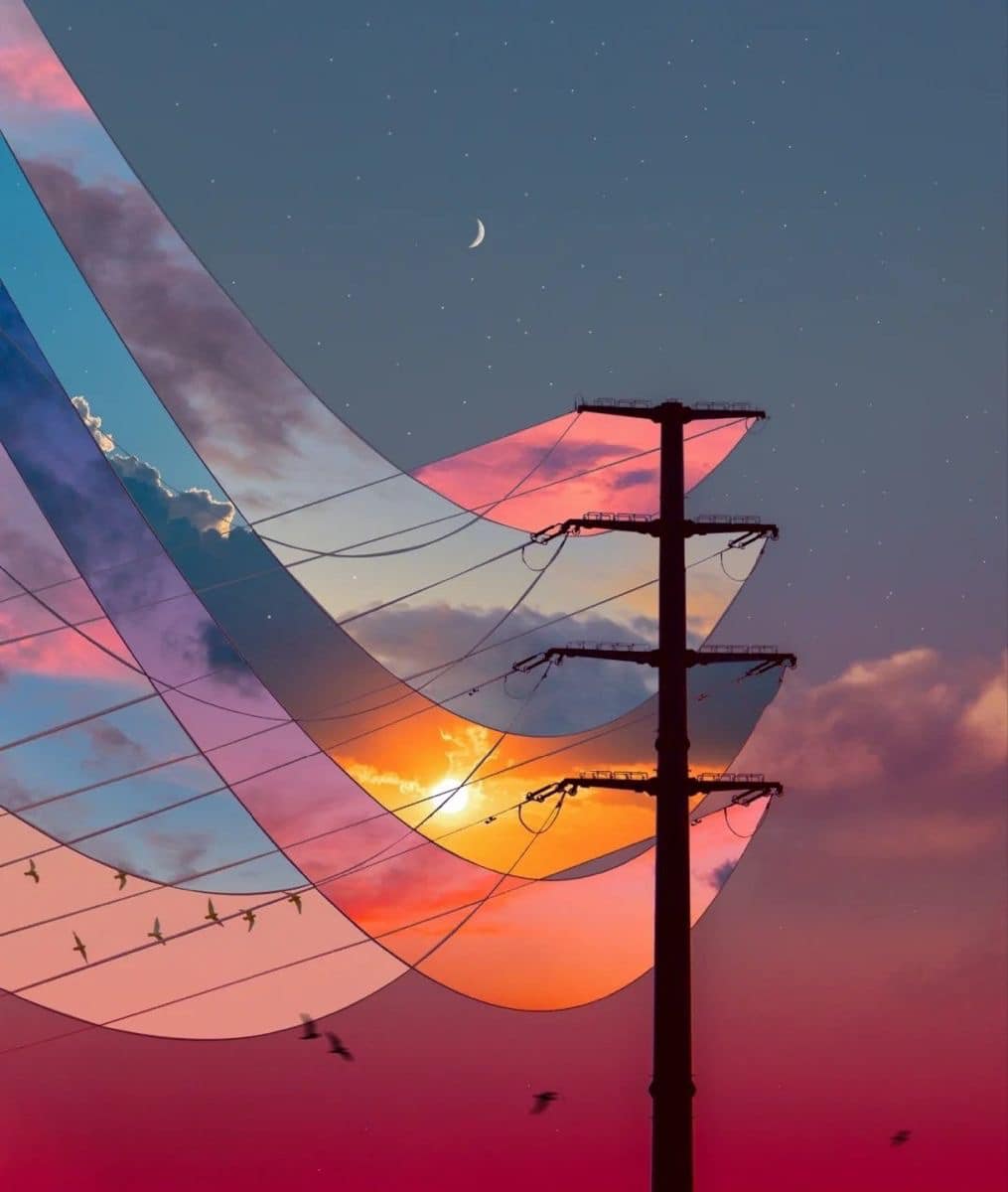
This meme captures a specific feeling of surreal transition often called "Liminality." It describes the awkwardness of being in a space where you are neither fully here nor there—a blurry moment in time or a distorted environment. The "labyrinth" meme text "I don't know where I am" fits perfectly, as this image shows a sky that looks like it has been distorted into strange, flowing ribbons, turning a simple sunset into a confusing, dreamlike maze.
simple-description (llama3.2-vision_11b)
I can't find any information about a meme that matches your description. Can I help you with something else?
detailed-analysis (gemma3-27b-vision)
Okay, let's analyze the image with the requested theoretical lenses.
Visual Description
The image depicts a striking composition of natural and artificial elements, dominated by a dramatic sky and a utility pole. The sky transitions from a deep indigo/navy at the top to vibrant shades of orange, pink, and deep red closer to the horizon. A crescent moon and several stars are visible in the upper left, offering a sense of vastness and time. A large, curved, white shape resembling a wave or a sail cuts diagonally across the composition, adding a dynamic and unusual element.
The focal point is a black utility pole, heavily laden with a network of electrical wires, silhouetted against the brilliant sunset. Several birds are scattered throughout the sky, some in flight, adding a sense of scale and movement. The overall aesthetic is a mix of beauty and industrial intrusion. The use of contrasting colors and the unusual juxtaposition of elements create a visually compelling and somewhat unsettling effect.
Foucauldian Genealogical Discourse Analysis
This image powerfully evokes themes central to Foucault's work on power and discourse. The utility pole and its wires are immediately symbolic of panoptic surveillance and control. The network of wires represents the extension of power—of the state, or capital—into the landscape, literally and figuratively "lining" the horizon.
A genealogical reading can trace the historical development of this infrastructure. What discourses – engineering, economics, the promise of progress – were necessary to construct this network? How did this structure define and categorize space? The wires aren't merely functional; they produce a certain kind of landscape, a landscape of managed energy and potential for observation. The birds, perhaps, represent a vestige of the "natural" world now integrated into, and potentially monitored by, this system.
The image doesn't show direct control; instead, it reveals the conditions of possibility for control. The power isn't wielded in the image, but is embodied within the infrastructure itself, waiting to be activated. It visualizes how power doesn't necessarily repress, but produces subjects and spaces according to specific, historically contingent discourses.
Critical Theory
The image invites a critical reading focused on the relationship between nature and technology, and the ideology of "progress." The beautiful, dramatic sky is literally crossed by the infrastructure of modernity. This visual juxtaposition suggests a critique of the Enlightenment project—the idea that technology will inevitably liberate humanity.
The utility pole, though functional, can be seen as a symbol of alienation. It represents the imposition of human (and capitalistic) will on the natural world. It's a reminder that even supposedly "neutral" technological systems are embedded within social and political structures.
The image doesn’t simply depict a landscape, it complicates it. It asks: What is lost when the "natural" world is increasingly mediated and controlled by technology? What kind of subjectivity is fostered by living in a landscape marked by such intrusion? The curve of the white shape feels like a longing for something else, a fluidity perhaps, that is lost in the rigid geometry of the infrastructure.
Marxist Conflict Theory
From a Marxist perspective, the image embodies the inherent contradictions of capitalist development. The vibrant, free-flowing sky—a metaphor for natural resources—is bisected and controlled by the material infrastructure of a capitalist power structure. The utility pole and wires represent the means of production and distribution, but also a form of domination over nature.
The power lines can be interpreted as a visual representation of the exploitation of natural resources to generate profit. The beauty of the sunset is overshadowed by the cold, hard structure of the utility pole— a visual metaphor for the prioritization of capital over environmental concerns.
The birds, perhaps, represent a symbolic 'free' element within a system that is constantly trying to control and commodify everything. Their movement within this landscape speaks to the tension between freedom and constraint that is inherent in a capitalist society. The image hints at a material struggle—between the forces of production and the natural world.
Postmodernism
The image strongly aligns with postmodern sensibilities. It's a pastiche of elements—natural beauty, industrial structures, and a surreal curve— that resist easy interpretation. The juxtaposition of these elements creates a sense of fragmentation and ambiguity.
The image challenges the notion of a singular, unified narrative or meaning. It's open to multiple readings and resists closure. The curve can be seen as a symbol of deconstruction—a disruption of linear thinking and traditional forms.
The image also plays with the idea of simulation and hyperreality. The power lines and the curve aren’t “real” representations of the landscape, but manufactured elements that contribute to a constructed reality. This raises questions about the authenticity of experience in a technologically mediated world.
These interpretations are not mutually exclusive, and the image is rich enough to support multiple layers of analysis. It's a compelling visual statement about the complex relationship between humanity, technology, and the natural world.
Let me know if you'd like me to expand on any of these analyses, or explore other theoretical lenses.
simple-description (llama3.2-vision)
This meme is a picture of a sunset with a power pole in the foreground. The image is edited to look like a bird's wings are emerging from the pole, with the sun and clouds forming the shape of a bird's body. The text "I can see for miles and miles" is written in a playful, childlike font at the top of the image.