First Seen
2024-02-02T22:15:40.657559+00:00
simple-description (qwen3.5_2b-q8_0)
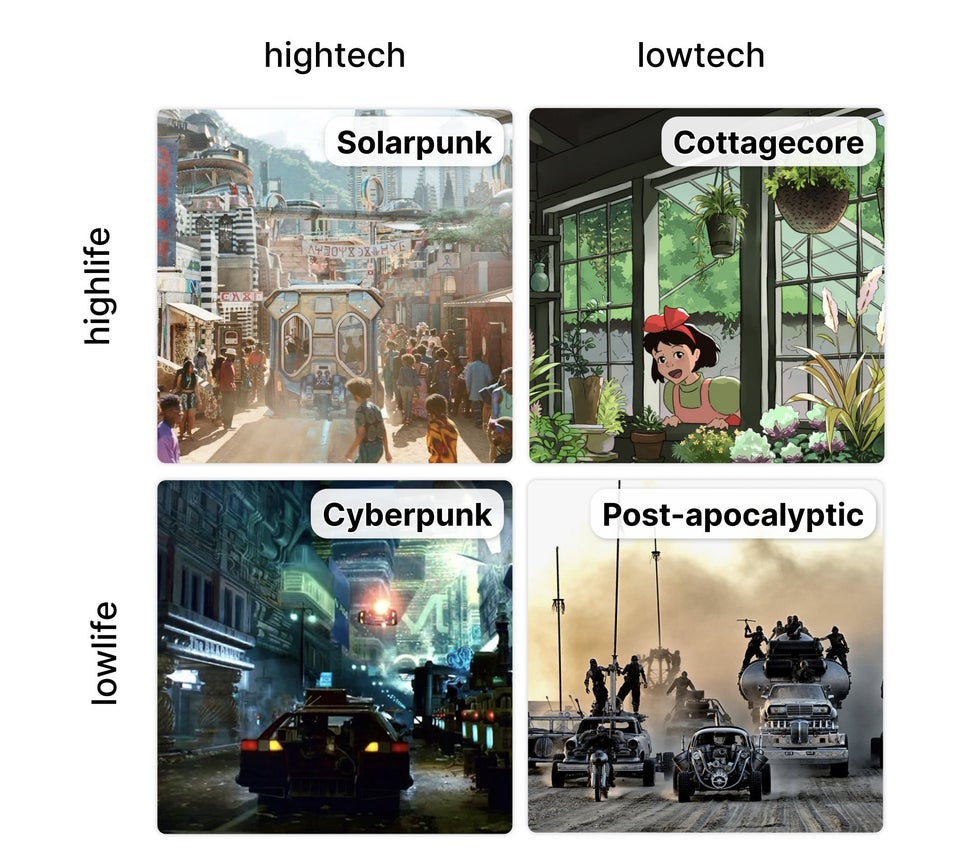
This visual meme categorizes four distinct aesthetic genres based on two axes: technological advancement ("hightech" vs. "lowtech") and the state of living ("highlife" vs. "lowlife").
The top-left corner depicts a vibrant Solarpunk city where high technology coexists with high life and lush nature. In contrast, the bottom-right square presents a grim lowlife and lowtech wasteland with dusty trucks and ruined structures. The bottom-left features a Cyberpunk aesthetic, using dark neon lights and shadows to show a wealthy but struggling technological future. Finally, the top-right Cottagecore quadrant captures a highlife dream of a cozy, nature-filled home, emphasizing peace over progress.
simple-description (llama3.2-vision_11b)
The meme is a visual comparison between two fictional worlds, "cyberpunk" (high-tech) and "post-apocalyptic" (low-tech). The image shows a futuristic city with neon lights and towering skyscrapers (cyberpunk) next to a desolate, war-torn landscape with abandoned cars and ruins (post-apocalyptic). The text "cyberpunk" and "post-apocalyptic" are written above each image, highlighting the contrast between the two worlds.
detailed-analysis (gemma3-27b-vision)
Okay, here's an analysis of the image, broken down into the sections requested, focusing on how each image aligns with the presented aesthetic (Solarpunk, Cottagecore, Cyberpunk, Post-Apocalyptic) and how those aesthetics can be interpreted through the lenses of the specified theories. I'll focus on the most prominent and applicable areas for each image.
Please note: Applying these complex theories to visual images is always interpretive. There is room for multiple valid readings. I'll try to be as detailed and justified as possible in my interpretations.
1. Solarpunk (High Tech, High Life)
Visual Description: The image depicts a vibrant, green-filled urban environment. Plants are integrated into the architecture – climbing the sides of buildings, growing on rooftops, and forming canopies over streets. There's a layering of old and new architecture, suggesting a repurposing of existing structures. The color palette is dominated by greens, blues, and yellows, evoking a sense of natural harmony and renewable energy. The inclusion of transportation, such as the bus, indicates a functional urban core.
Critical Theory: Solarpunk is a direct response to dystopian futures often seen in science fiction. It proposes a utopian vision where technology and nature coexist sustainably. From a critical theory perspective, it’s an attempt to problematize the dominant technological paradigm that prioritizes profit and control over ecological wellbeing. The image subverts the expectation of sterile, hyper-modern cities by embedding them in a lush, organic environment.
Postmodernism: Solarpunk can be viewed as a postmodern aesthetic. It’s a collage of influences, blending the futuristic with the pastoral. It rejects grand narratives of technological progress and instead embraces localized, community-based solutions. The image’s layering of styles - old and new - is characteristic of postmodern aesthetics.
Marxist Conflict Theory: The image can be interpreted as a visual representation of a post-scarcity society where the means of production are oriented toward ecological sustainability rather than profit. This is a direct contrast to the inherent contradictions of capitalism, which demands endless growth and exploitation of resources. The abundance of green spaces suggests access to resources is not limited to a privileged few.
2. Cottagecore (Low Tech, High Life)
Visual Description: This image evokes a quaint, rustic, and idyllic scene. A young woman is positioned in a greenhouse or sunroom filled with lush plants, sunlight streaming through the glass. The composition is soft, warm, and inviting. The style of the illustration suggests a return to a simpler, more natural way of life.
Queer Feminist Intersectional Analysis: Cottagecore, while seemingly innocent, can be analyzed through a queer feminist lens. It represents a rejection of patriarchal norms, often centered around hyper-productivity and ambition. The focus on domesticity, gardening, and crafting can be reappropriated as acts of resistance and self-care. It also creates space for non-normative family structures and ways of living. The imagery often romanticizes pre-industrial lifestyles where gender roles were more fluid and community-based. The emphasis on natural cycles and self-sufficiency aligns with ecofeminist principles.
Postmodernism: Cottagecore's embrace of "authenticity" and nostalgia is a hallmark of postmodern aesthetics. It critiques consumer culture by valuing handmade, locally sourced goods. The aesthetic also represents a rejection of the rational, industrialized world in favor of emotional experiences and subjective meanings.
Critical Theory: The image can be seen as a counter-hegemonic representation of ideal life. By presenting a life centered around natural cycles, home, and craft, it challenges the dominant, consumer-driven narratives promoted by mass media. It represents a rejection of the pressure to be constantly productive and successful, offering an alternative vision of fulfillment based on connection to nature and community.
3. Cyberpunk (Low Tech, Low Life)
Visual Description: This image is a gritty, neon-lit urban scene depicting a rainy night. Sleek vehicles traverse a dark, congested street. The environment is a mix of high-tech and decay, with holographic advertisements, towering skyscrapers, and a general sense of alienation. The color palette is dominated by blues, purples, and blacks, creating a sense of claustrophobia and social unrest.
Marxist Conflict Theory: Cyberpunk, at its core, is deeply concerned with power structures and social inequalities. This image represents a dystopian future where corporations have replaced governments, and the gap between the rich and the poor has widened. The advanced technology is used for control and surveillance rather than to improve the lives of ordinary people. The dark, oppressive environment reflects the alienation and exploitation of the working class.
Critical Theory: The image embodies the concept of technological determinism – the idea that technology shapes society rather than the other way around. In this case, the technology is used to perpetuate existing power imbalances and create a hyper-controlled society. The image also raises questions about the nature of reality and the blurring lines between the physical and virtual worlds.
Postmodernism: Cyberpunk embraces fragmentation, simulation, and the breakdown of traditional values. The image represents a world where identity is fluid, boundaries are blurred, and meaning is constantly shifting. The combination of high-tech and low-life elements creates a sense of irony and contradiction.
4. Post-Apocalyptic (Low Tech, Low Life)
Visual Description: This image depicts a desolate landscape populated by heavily armed vehicles and figures. The environment is dusty, barren, and appears to have been ravaged by some kind of catastrophe. The vehicles are reminiscent of military convoys, suggesting a struggle for resources and survival. The color palette is muted, with shades of brown, gray, and sand, creating a sense of hopelessness and despair.
Marxist Conflict Theory: Post-Apocalyptic narratives often explore the aftermath of systemic collapse and the struggle for resources in a world where the rules of society have broken down. This image can be interpreted as a commentary on the inherent contradictions of capitalism – the tendency toward overproduction, environmental destruction, and social inequality. The vehicles, representing the last vestiges of power, are fighting for control of a dwindling pool of resources.
Critical Theory: The image embodies the concept of disaster capitalism – the practice of exploiting crises to advance political or economic agendas. The vehicles, representing the forces of control, are positioned to take advantage of the chaos and rebuild society in their own image. The image also raises questions about the nature of civilization and the fragility of social structures.
Foucauldian Genealogical Discourse Analysis: Examining the image through a Foucauldian lens, we can explore the power dynamics at play in a post-apocalyptic setting. The vehicles represent the tools of surveillance and control, while the figures represent the subjects of that control. The landscape itself can be seen as a discourse – a system of knowledge and power that shapes how we understand the world. By analyzing the visual elements of the image, we can uncover the underlying power relations that are shaping the post-apocalyptic world.
I hope this detailed analysis provides a valuable interpretation of the images through the requested theoretical frameworks. Let me know if you'd like me to elaborate on any specific point or explore additional theories.
simple-description (llama3.2-vision)
The meme is a table with four columns and four rows, each labeled with a different subgenre of science fiction. The columns are labeled "high" and "low" and "tech" and "life", with the subgenres of "Solarpunk", "Cottagecore", "Cyberpunk", and "Post-apocalyptic" in each row. The subgenres are also listed in the top row, with "High" and "Low" in the first and second columns, and "Tech" and "Life" in the third and fourth columns.
tesseract-ocr
hightech lowtech ne _ — ae. Solarpunk | Cottagecore | Sh 6a mg WE Es died ee a =”. i a o 2 Geu M eee eee wes © BSpan eee f sca ae bs ; ee ee Li lw < ries bed ae i a Henny ri Dy” 1 y ut +o PN Gaia BES || = | = wi Pe ee ae Lag se J 1 ! WLI . “ae? i Cyberpunk ] Post-apocalyptic = * 4 o ae” ie _ = Pr ns ee DB oateeat C >: = aa “. ig, Aa ae aos ae —_ — 2 met. RAPA, Ce Se el