First Seen
2023-12-12T23:39:51+00:00
simple-description (qwen3.5_2b-q8_0)
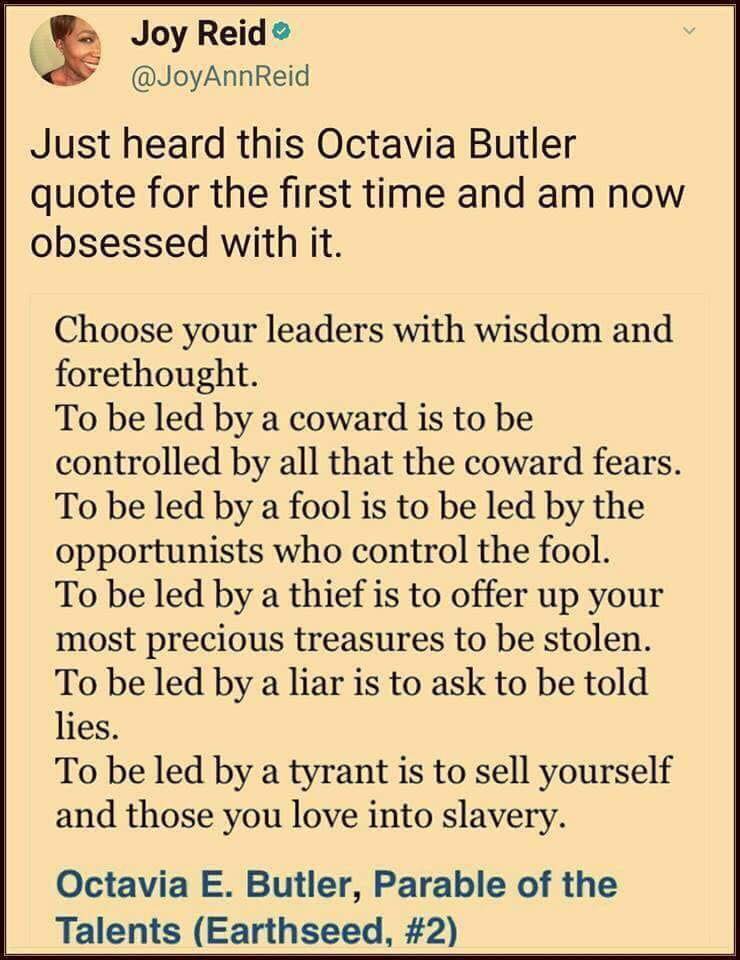
This is a social media post by Joy Reid featuring a quote by Octavia Butler. The text argues that to be controlled by a coward, liar, or tyrant is the same as being sold into slavery by those in power. Through an Afrofuturist perspective, this quote serves as a powerful metaphor for spiritual liberation, emphasizing the choice to break free from earthly chains and moral bondage.
simple-description (llama3.2-vision_11b)
The meme is an image of a quote from Octavia Butler's science fiction novel "Parable of the Sower", which explores themes of Afrofuturism. The quote is a commentary on the need for strong leadership in a world where social and economic systems are failing. The meme is likely being shared in a context where people are discussing the need for more effective leadership in the face of social and economic crises.
detailed-analysis (gemma3-27b-vision)
Okay, here's an analysis of the image (a Twitter post featuring a quote from Octavia Butler), broken down into sections based on the theoretical frameworks you requested. I'll only include sections that are genuinely applicable to the content.
1. Visual Description
The image is a screenshot of a Twitter post by Joy-Ann Reid (@JoyAnnReid). It features a quote attributed to Octavia E. Butler from her novel Parable of the Talents. The text is prominently displayed against a light blue background, and is formatted as a series of short, declarative statements. The post includes the author's name and book title. The image is straightforward in its presentation, serving as a direct sharing of text. The context is modern social media – a digital space designed for rapid dissemination and engagement with ideas.
2. Foucauldian Genealogical Discourse Analysis
This quote is highly amenable to a Foucauldian analysis. The quote implicitly deals with power dynamics and how power is exercised through leadership. Foucault would be interested in how the categories of “coward,” “fool,” “thief,” “liar,” and “tyrant” have been historically constructed as ways to categorize and control individuals and groups.
- Genealogy: A genealogical analysis would trace how these classifications have evolved over time, focusing on the discourses that have shaped them. For example, the idea of a "tyrant" has changed dramatically across history, from a king with absolute power to a more nuanced understanding of oppressive systems.
- Power/Knowledge: The quote illustrates Foucault’s concept of power/knowledge. Those who lead (or claim to lead) utilize knowledge (or the appearance of knowledge) to exert control. The quote points out how vulnerabilities associated with each type of leader (fear in a coward, naiveté in a fool, greed in a thief, dishonesty in a liar, brutality in a tyrant) become the mechanisms of control over those who follow.
- Discipline & Panopticism: While not explicitly stated, the idea of being "controlled" by a leader's weaknesses subtly evokes the idea of disciplinary power. The follower, aware of the leader's flaws, is implicitly under surveillance (by observing the leader's behavior) and therefore subject to self-regulation. The leader’s weaknesses, once known, become tools of control.
3. Critical Theory
The quote lends itself powerfully to a Critical Theory analysis, particularly concerning the nature of ideology and domination.
- Ideology Critique: The quote serves as a critique of the ways in which flawed or self-serving leaders can gain power and perpetuate systems of inequality. It suggests that following such leaders means accepting a distorted or oppressive reality. It’s a warning against blindly accepting leadership without critical examination.
- Hegemony: The quote touches upon the concept of hegemony (Gramsci). A dominant group maintains power not merely through force, but through shaping the values, beliefs, and norms of society. A flawed leader can establish hegemony by exploiting vulnerabilities and convincing others to accept their leadership as natural or inevitable.
- Emancipation: The quote implicitly advocates for emancipation from oppressive leadership. By warning against following those with self-serving motivations, it suggests that genuine liberation requires critical thought, foresight, and a rejection of leaders who prioritize their own interests over the well-being of others.
4. Marxist Conflict Theory
The quote’s most obvious relevance to Marxist Conflict Theory lies in its final statement: “To be led by a tyrant is to sell yourself and those you love into slavery.”
- Class Struggle: The idea of being “sold into slavery” directly evokes the historical exploitation of the working class by the ruling class. The tyrant, in this context, represents the oppressor who extracts value from the labor and lives of others.
- Exploitation: The quote highlights the core concept of exploitation. The tyrant’s leadership is not benevolent; it is a system designed to benefit the leader at the expense of the followers.
- False Consciousness: Following a tyrant is akin to false consciousness – a state in which individuals are unaware of their own oppression and accept the ideology of the ruling class.
5. Queer Feminist Intersectional Analysis
While the quote is not explicitly about gender, sexuality, or race, an intersectional lens can enrich the analysis.
- Interlocking Systems of Oppression: The quote speaks to a broader pattern of how power is used to dominate and control. Those who are marginalized—based on gender, race, sexuality, class, etc.—are often disproportionately vulnerable to exploitative leadership.
- Vulnerability & Control: The quote highlights the ways in which leaders exploit vulnerabilities (fear, foolishness, trust). Marginalized groups often have fewer resources and therefore are more easily exploited by those in power.
- Critical Consciousness: The quote's call for “wisdom and forethought” resonates with feminist and queer activism, which emphasizes the importance of critical self-awareness and collective resistance against all forms of oppression.
I hope this comprehensive breakdown is helpful. Let me know if you’d like me to elaborate on any specific point or theoretical framework.
tesseract-ocr
» Joy Reid? £ @JoyAnnReid Just heard this Octavia Butler quote for the first time and am now obsessed with it. Choose your leaders with wisdom and forethought. To be led by a coward is to be controlled by all that the coward fears. To be led by a fool is to be led by the opportunists who control the fool. To be led by a thief is to offer up your most precious treasures to be stolen. To be led by a liar is to ask to be told lies. To be led by a tyrant is to sell yourself and those you love into slavery. Octavia E. Butler, Parable of the Talents (Earthseed, #2)
simple-description (llama3.2-vision)
This meme is a humorous take on the quote from the novel "Parable of the ... ", which is a commentary on the dangers of power and the corrupting influence it can have on individuals. The quote is presented in a format that is easy to read and understand, with each line of the quote separated by a blank line. The quote is a commentary on the nature of power and how it can corrupt even the best of people.