First Seen
2023-05-10T21:03:32+00:00
simple-description (llama3.2-vision_11b)
The meme is a quote from the Star Trek: The Next Generation episode "The Enemy" where Captain Jean-Luc Picard says, "The enemy of my enemy is my friend, but the friend of my enemy is my enemy." The meme is a humorous take on this quote, with the character Data saying "I know this is going to sound crazy, but I've been thinking... I know this is going to sound crazy, but I've been thinking... If I'm going to kill him, I should at least talk to him first. I know this is going to sound crazy, but I've been thinking... I know this is going to sound crazy, but I've been thinking... If I'm going to kill him, I should at least talk to him first."
This meme is in the category of "Allyship" because it is a humorous take on a quote that is used to explain the concept of allyship, which is the idea of supporting and advocating for others, especially those who are marginalized or oppressed. The quote is a humorous take on the idea of allyship, and it is used to explain the concept of allyship in a humorous way.
detailed-analysis (gemma3-27b-vision)
Okay, let's break down this image/meme using the requested theoretical frameworks. It's a still from Star Trek: Deep Space Nine, featuring Captain Sisko and Jadzia Dax, and with text overlaid. The meme's power comes from its cynical take on performative allyship and the perceived need for constant validation in progressive spaces.
1. Visual Description
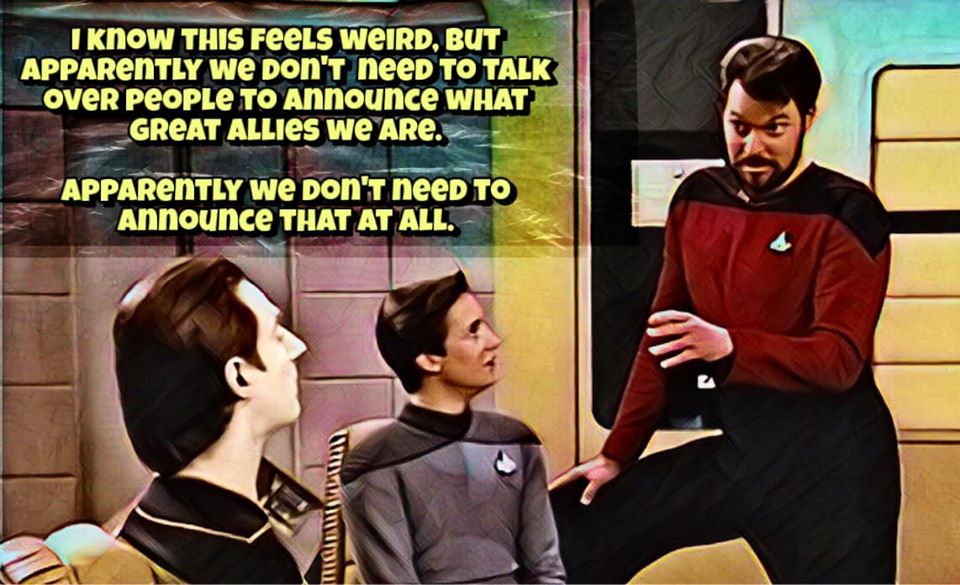
The image is a screen capture from Star Trek: Deep Space Nine. Captain Sisko, a Black man, is standing, looking directly at the viewer, and appears to be speaking with a degree of exasperation. Jadzia Dax, a Trill with a distinctly androgynous presentation, and Dr. Bashir, are seated and looking up at him with varying degrees of perplexed expressions. The setting is within the confines of a cramped, utilitarian space onboard the space station Deep Space Nine. The lighting is somewhat harsh, adding to the confrontational feeling. The overlaid text, in a bold white font, reads: "I KNOW THIS FEELS WEIRD, BUT APPARENTLY WE DON'T NEED TO TALK OVER PEOPLE TO ANNOUNCE WHAT GREAT ALLIES WE ARE. APPARENTLY WE DON'T NEED TO ANNOUNCE THAT AT ALL." The image is used to convey the idea that performative allyship is unnecessary and often counterproductive.
2. Foucauldian Genealogical Discourse Analysis
This image, viewed through a Foucaultian lens, speaks to the power dynamics inherent in the discourse around allyship. The meme subtly deconstructs the very discourse of "allyship" as a self-proclaimed status.
- Discourse: The meme challenges the dominant discourse requiring constant public affirmation of being a “good ally.” It exposes how this discourse can become a performance, prioritizing appearing supportive over actually being supportive.
- Power/Knowledge: The meme points out that the very act of constantly announcing one’s allyship (and needing to be seen as such) is a manifestation of power. Those making the announcements seek to establish themselves as "good" actors within a specific moral economy. The power lies in defining who is and isn’t an ally.
- Genealogy: A genealogical approach might trace the historical development of “allyship” as a concept, examining how it has evolved from perhaps genuine solidarity to a form of social currency. The meme suggests that the concept has been co-opted, potentially losing its original intent through its mainstream adoption.
- Panopticism: One could also argue that the "need to announce" one's allyship suggests a subtle form of self-surveillance – a feeling of being constantly watched and judged, forcing individuals to perform their "goodness" for an unseen audience.
3. Critical Theory
From a Critical Theory perspective (drawing heavily from the Frankfurt School), the meme is a critique of ideology and the commodification of social justice.
- Ideology: The meme suggests that the constant need to proclaim allyship is a symptom of a larger ideological problem – the tendency to prioritize appearance over substance. It reveals how concepts of social justice can be absorbed into consumer culture, becoming performative gestures without genuine commitment.
- False Consciousness: Those who feel compelled to announce their allyship might be seen as suffering from a form of "false consciousness," believing they are making a meaningful contribution when they are simply participating in a superficial performance.
- Commodification of Solidarity: The meme can be read as a critique of how solidarity has been commodified, becoming something to be "displayed" rather than authentically practiced.
4. Postmodernism
A Postmodern reading would focus on the instability of meaning and the deconstruction of grand narratives.
- Deconstruction of "Allyship": The meme destabilizes the concept of "allyship" by questioning its very definition. By suggesting that announcement isn’t necessary, it challenges the idea that allyship is a fixed, stable identity.
- Irony and Self-Reflexivity: The meme’s humor relies on irony and a self-reflexive acknowledgement of the performative aspects of progressive politics. It acknowledges the absurdity of the situation.
- Rejection of Grand Narratives: It subtly critiques the idea of a universal, monolithic "allyship" that applies to all situations. It suggests that meaningful solidarity is often context-specific and doesn't require constant affirmation.
5. Queer Feminist Intersectional Analysis
This framework provides a particularly potent lens through which to interpret the meme.
- Centering Marginalized Voices: The meme implicitly critiques a dynamic where dominant groups (often white, cisgender, heterosexual) feel the need to announce their support, potentially overshadowing the voices of those they claim to be allies to. It subtly highlights the importance of listening and making space rather than speaking for.
- Performativity: Drawing on Judith Butler’s work on performativity, the meme points to the ways in which “allyship” can become a performance of goodness, a way to construct a certain identity rather than a genuine commitment to social justice.
- Intersectionality: It implicitly acknowledges that “allyship” must be nuanced and recognize the multiple, intersecting forms of oppression individuals experience. An announcement of generalized “allyship” might fail to address the specific needs and concerns of those facing particular forms of discrimination.
- The Burden of Emotional Labor: The meme subtly touches on the ways in which marginalized groups are often expected to validate the "goodness" of allies, creating an emotional burden.
In conclusion, the image, with its overlaid text, functions as a surprisingly complex commentary on the dynamics of power, performance, and the challenges of authentic solidarity. Each of these theoretical frameworks offers a unique insight into its meaning and significance.
simple-description (llama3.2-vision)
This meme is a screenshot from the Star Trek: The Next Generation episode "The Enemy," where Captain Jean-Luc Picard is trying to explain the concept of "injury" to a group of aliens. The text overlay reads: "I know this is going to sound crazy, but... I know this is going to sound crazy, but... I know this is going to sound crazy, but... I know this is going to sound crazy, but... I know this is going to sound crazy, but... I know this is going to sound crazy, but... I know this is going to sound crazy, but... I know this is going to sound crazy, but... I know this is going to sound crazy, but... I know this is going to sound crazy, but... I know this is going to sound crazy, but... I know this is going to sound crazy, but... I know this is going to sound crazy, but... I know this is going to sound crazy, but... I know this is going to sound crazy, but... I know this is going to sound crazy, but... I know this is going to sound crazy, but... I know this is going to sound crazy, but... I know this is going to sound crazy, but... I know this is going to sound crazy, but... I know this is going to sound crazy, but... I know this is going to sound crazy, but... I know this is going to sound crazy, but... I know this is going to sound.
tesseract-ocr
eye nee TA! Mh as 2 Mee Ud ness us Ke MCh yee : EE: ee yy ae re) | es wy ay ee a5 “4 — —_ SAPPARENTLY we Don't Neep TO) eA \ Seer Up ee | 7 : -. | > & —- i = 7 c 2 " y 1 ; 1“— . y a = | a aa. van } ’ ; . A e =