First Seen
2023-05-10T21:03:32+00:00
simple-description (llama3.2-vision_11b)
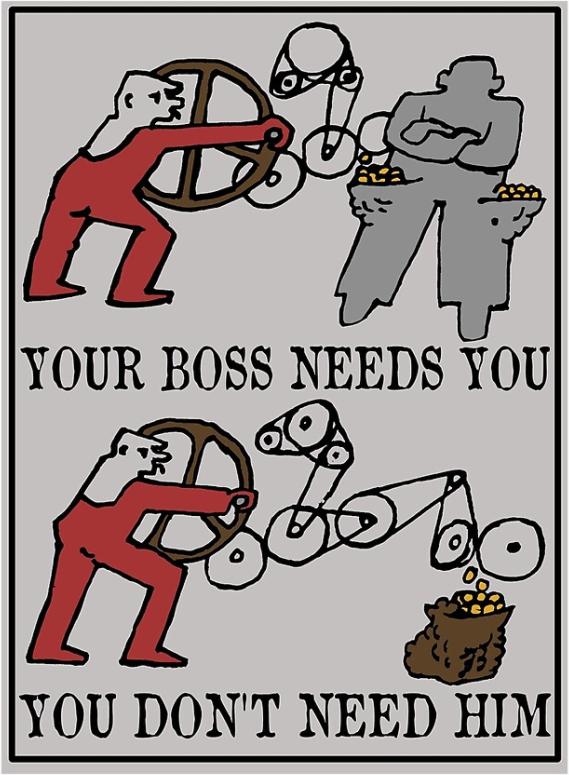
The meme is a play on the classic "your boss needs you" and "you don't need him" phrase, but with a twist that is characteristic of Anarcho-Syndicalism, a political philosophy that advocates for worker self-management and the abolition of the state. The image depicts a worker being forced to work by a boss, but with a twist that the worker is actually creating a machine that will eventually free them from their boss's control. The text "your boss needs you" is on the top, while "you don't need him" is on the bottom, highlighting the worker's ability to create a machine that will free them from their boss's control.
detailed-analysis (gemma3-27b-vision)
Okay, let's break down this image through several theoretical lenses.
Visual Description
The image is a vertically oriented, graphic poster with a stark, almost simplistic, illustrative style. It is divided into two distinct panels. The overall color scheme is a muted gray background.
- Panel 1 (Top): Shows a red, muscular figure operating complex machinery (gears, belts, pipes). The machinery is aimed toward a larger, gray, imposing figure with an exaggerated muscular build, that appears to be hoarding gold coins. The red figure is clearly working for the gray figure.
- Panel 2 (Bottom): Mirrors the top panel, but the machinery is aimed away from the hoarding figure. The hoarding figure is no longer receiving anything from the complex system, and is left alone with its pile of gold.
- Text: The poster features bold, direct text. “YOUR BOSS NEEDS YOU” is placed above the top panel, while “YOU DON’T NEED HIM” is placed below the bottom panel.
The style is reminiscent of agitprop posters—aimed at inciting political action. The figures are caricatured, and the machinery is dehumanizing.
Foucauldian Genealogical Discourse Analysis
This image can be analyzed through a Foucauldian lens to understand the discourses surrounding power and labor.
- Discourse of Labor: The image lays bare a discourse of labor that positions the worker as a source of power for the “boss.” The machinery isn’t just a tool; it's a technology of power that extracts value from the worker and directs it toward the hoarding figure.
- Genealogy of Power: Tracing the “genealogy” of this power dynamic—its historical emergence—reveals how capitalist structures have normalized the extraction of labor. The image doesn’t show the origins of this power, but it visualizes the effects of its historical development. It suggests that this power dynamic isn't natural, but is a constructed historical outcome.
- Panopticism & Discipline: While not directly illustrating panoptic surveillance, the machinery functions as a disciplinary mechanism. It’s a system that monitors and regulates the worker’s efforts, channeling them toward the "boss". The worker is part of a larger system designed to enhance the power of the hoarding figure.
- Reversal of Discourse: The bottom panel disrupts this established discourse. By turning the machinery away, it suggests a reversal of power—a refusal to participate in the system. It suggests that the worker is not inherently dependent on the boss.
Marxist Conflict Theory
This image is strongly aligned with Marxist conflict theory.
- Class Struggle: The central theme is the inherent conflict between the working class (represented by the red figure) and the capitalist class (the gray hoarding figure). The hoarding figure represents the accumulation of capital through the exploitation of labor.
- Means of Production: The complex machinery embodies the “means of production”—the tools and resources used to create goods and services. The image shows that the worker operates the means of production, yet doesn’t benefit from the resulting wealth.
- Surplus Value: The gold coins represent “surplus value”—the difference between the value the worker produces and the wages they receive. The hoarding figure is amassing surplus value through the exploitation of the red figure’s labor.
- Alienation: The worker is alienated from the fruits of their labor. They are reduced to a mere cog in a machine, contributing to the wealth of another without receiving equitable compensation.
- Revolutionary Potential: The bottom panel implies a call to action. By turning the machinery away, the worker asserts their independence and potentially disrupts the capitalist system. It suggests a possibility of reclaiming the means of production and redistributing wealth.
Postmodernism
A postmodern analysis of this image could focus on the deconstruction of grand narratives and the rejection of essentialist categories.
- Deconstruction of Power: The image deconstructs the traditional power dynamic between boss and worker. It exposes the constructed nature of this relationship, suggesting it’s not fixed or inevitable.
- Rejection of Essentialism: It rejects the notion of a “natural” order where some individuals are inherently suited to be bosses and others to be workers. It suggests that power is relational and contingent.
- Emphasis on Agency: The bottom panel emphasizes the agency of the worker. By choosing to redirect the machinery, the worker challenges the established system and asserts their own power.
- Irony & Parody: The simplistic, almost cartoonish style of the image can be seen as a form of parody. It mocks the absurdity of capitalist accumulation and the unequal distribution of wealth.
Queer Feminist Intersectional Analysis
While not immediately apparent, a Queer Feminist Intersectional lens can also be applied.
- Exploitation as Interlocking Oppression: The exploitation of labor can be seen as intersecting with other forms of oppression—gender, race, class, etc. The red figure may also experience other forms of marginalization, making their exploitation even more pronounced.
- Rejection of Hierarchical Structures: Queer and feminist theory challenge hierarchical structures of power. The image implicitly critiques the patriarchal and capitalist structures that perpetuate exploitation.
- Solidarity & Collective Action: The image’s emphasis on worker agency can be interpreted as a call for solidarity and collective action. It suggests that workers can challenge oppressive systems by working together.
- Subversion of Norms: The red figure’s decision to redirect the machinery can be seen as a subversive act. It challenges the norms of capitalist labor and asserts their right to self-determination.
In conclusion, this image is a powerful visual statement that can be analyzed through multiple theoretical lenses. It is a critique of capitalist exploitation, a call for worker agency, and a challenge to the established order. The stark simplicity of the image and the directness of the text make it a potent tool for political activism and social commentary.
simple-description (llama3.2-vision)
This meme is a humorous illustration of the classic "I'm not a [insert job title] because I'm a [insert job title]" joke. The image depicts a person with a wheel, a hammer, and a bucket of gold, with the text "Your boss needs you" and "You don't need him" above and below the image, respectively. The meme is a play on the idea that a person with a simple toolset can still be successful, implying that they don't need a boss to be successful.
tesseract-ocr
( ) sI\er ea YOUR BOSS ae YOU JAIN ha YOU DON'T NEED HIM