First Seen
2024-03-25T20:53:36.150714+00:00
simple-description (qwen3.5_2b-q8_0)
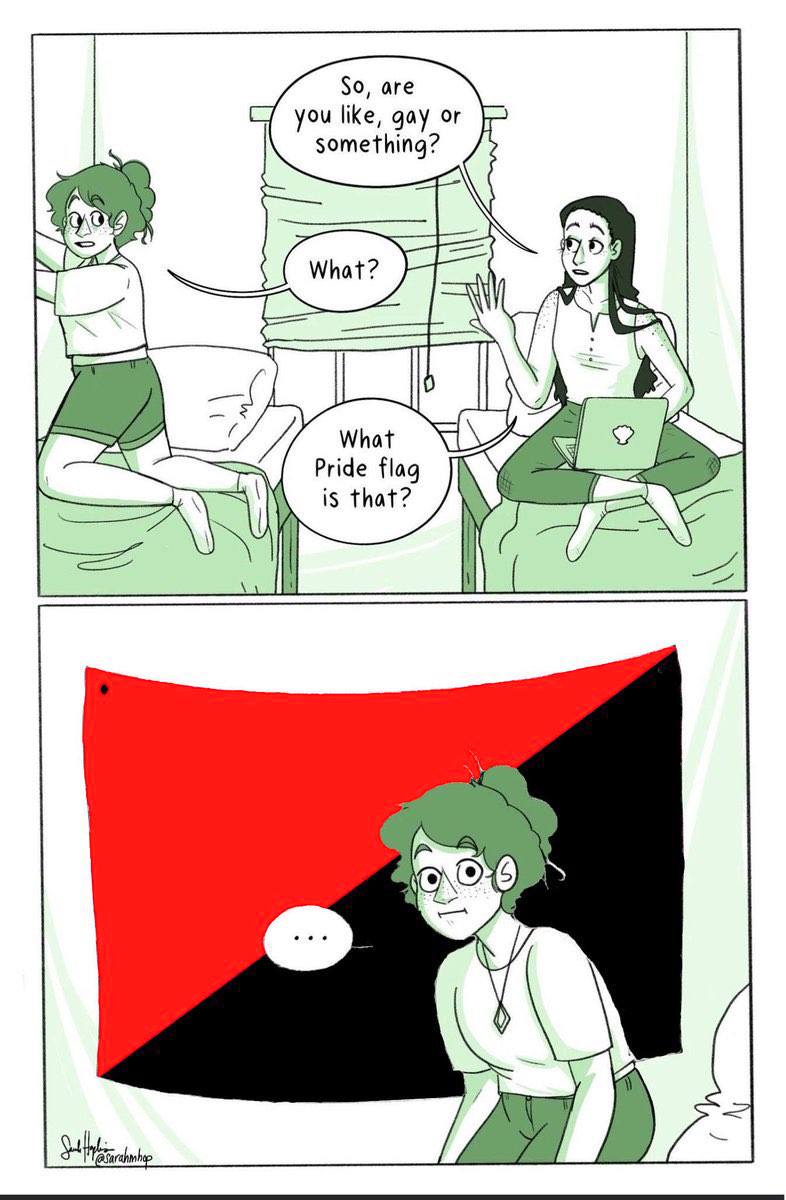
In the top panel, two women are sitting on beds and engaging in a conversation where one asks, "So, are you like, gay or something?" while the other gestures vaguely before clarifying, "What Pride flag is that?" In the bottom panel, the character is shown staring blankly at a large red-and-black diagonal flag, leaving her speechless with a final text bubble of "...".
In the context of Anarcho-Syndicalism, this meme humorously highlights a workplace dynamic where a worker's personal identity is being treated as a simple preference rather than a political stance. The character is confused because she is being asked about her sexual identity ("gay or something") while simultaneously expected to recognize a symbol of "direct action" and anarchist solidarity (the red-and-black flag), leaving her speechless to bridge the gap between her personal identity and her political ideology.
simple-description (llama3.2-vision_11b)
This meme is a humorous take on the concept of anarcho-syndicalism, a political ideology that advocates for worker self-management and the abolition of the state. The meme shows a person asking if the anarcho-syndicalist flag is a "pride" flag, implying that the flag is a symbol of identity or community, rather than a political ideology. The text "What is this, a pride flag?" is a sarcastic commentary on the idea that the anarcho-syndicalist flag is being treated like a symbol of identity or community, rather than a political ideology.
detailed-analysis (gemma3-27b-vision)
Okay, here's an analysis of the comic panel, broken down into relevant theoretical frameworks. Since not all frameworks apply equally, I'll focus where they are most pertinent.
Visual Description
The comic panel depicts a domestic interior scene with two figures, likely young adults, sitting on green, rounded poufs. The style is cartoonish with simple line work and muted colors. One figure, with short dark hair, is looking directly at the other, asking "So, are you gay or something?" The other figure, with curly green hair, is visibly surprised and asks "What?". In the second panel, the focus shifts to the green-haired figure holding up a black and red flag, possibly depicting the colors of the flag. The overall tone is casual but carries an undercurrent of tension due to the question asked and the surprised reaction. The artist's signature is in the bottom left corner.
Queer Feminist Intersectional Analysis
This framework is the most directly applicable here.
- The Question as Control & Visibility: The question “So, are you gay or something?” functions as an attempt to demand visibility from the green-haired individual. It's not a genuine inquiry but a means of asserting power and potentially controlling the narrative surrounding their identity. This highlights the historical and ongoing pressure on LGBTQ+ individuals to come out on others’ terms rather than on their own.
- Intersectional Dynamics: The artist's rendering of the character's body and clothing is indicative of how the individual is positioned in society based on their gender and appearance.
- The Flag as Reclaiming Space: The second panel, with the flag, is crucial. The flag shown is a combination of a part of the LGBTQ+ pride flag with a part of the anarchist flag, the black flag. It is a reappropriation of symbols, refusing a singular, easily-defined identity. It also suggests that the individual's queerness doesn't exist in isolation but is interwoven with other political and ideological positions. It’s an assertion of identity but on their terms, reclaiming the space for self-definition that was initially denied by the question.
- The Power of Surprise: The first character’s surprise isn't simply a lack of knowledge; it indicates a societal expectation of heteronormativity. The surprise implies that being queer is considered deviant from the norm, requiring explanation.
Foucauldian Genealogical Discourse Analysis
- Power/Knowledge: The exchange demonstrates Foucault’s concept of power/knowledge. The question isn't simply about information; it's about the power to categorize and label, to define what is “normal” and what is “other.” The questioner attempts to establish a discourse where queerness is something that needs to be identified and potentially judged.
- Discipline and Normalization: The question contributes to the disciplinary practices that seek to normalize heterosexuality. By asking this question, the individual expects the other to conform to a binary understanding of sexuality (gay or not gay). This is a subtle form of discipline, attempting to maintain the boundaries of "normal" behavior.
- Genealogy of the Question: A genealogical analysis could trace the historical development of this type of question – how societal norms surrounding sexuality have evolved and how these norms are embedded in language and social interactions. The question itself is not neutral; it's a product of historical and cultural forces.
Critical Theory
- Social Construction of Identity: The interaction supports the critical theory assertion that identity is socially constructed. The very act of asking someone about their sexuality implies that it's a defining characteristic, and that this characteristic is subject to social scrutiny and categorization. The meaning of "gay" is not inherent but is assigned through societal norms and discourse.
- Ideology and Hegemony: The expectation that someone should have a readily available answer to this question reflects a dominant ideology that prioritizes heterosexuality as the norm. This ideology is reinforced through everyday interactions, media representation, and cultural norms. The question itself is a subtle form of ideological control.
Marxist Conflict Theory
While less directly applicable, a Marxist lens can be brought to bear.
- Power Dynamics & Control: The question can be seen as an exercise of power, with the questioner attempting to assert dominance by controlling the discourse surrounding the other person’s identity.
- Social Stratification: The question contributes to a system of social stratification where LGBTQ+ individuals are often marginalized and subjected to scrutiny and discrimination.
- Symbolic Capital: The flag shown in the second panel can be seen as a form of symbolic capital. By asserting a unique identity, the character is claiming space and refusing to be defined by dominant societal norms.
Postmodernism
- Deconstruction of Binaries: The presentation of the flag in the second panel is a direct rejection of rigid categories. The colors present on the flag reject strict definitions of identity, suggesting that individuals can occupy multiple positions and resist simple categorization.
- Rejection of Grand Narratives: The image questions the notion of a singular "queer identity." The use of the flag suggests a multiplicity of perspectives and experiences.
- Subjectivity and Fragmentation: The character’s surprised reaction highlights the subjective nature of identity. The image suggests that identity is fluid and fragmented.
I hope this detailed breakdown provides a comprehensive analysis of the comic panel through these theoretical lenses. Let me know if you'd like me to expand on any specific aspect!
tesseract-ocr
a & by ig =) “24 ( She Li i “a ’ an Se
simple-description (llama3.2-vision)
This meme is a humorous exchange between two characters. The first character asks if the other is gay or something, and the second character responds with "what pride flag is that?" implying that the first character is displaying a pride flag in a way that is not clear or recognizable.